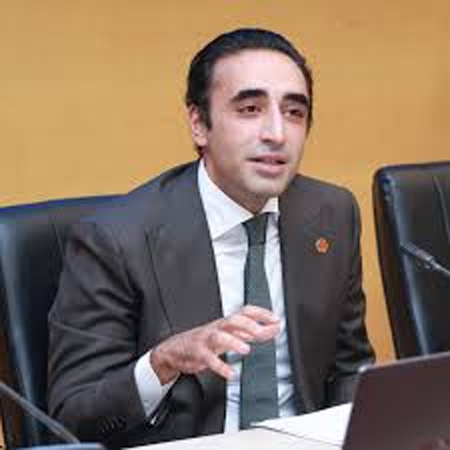
 Pakistan Peoples Party (PPP) Chairman Bilawal Bhutto Zardari said has that his party has not held any talks about imposing governor’s Rule in Khyber-Pakhtunkhwa, stressing that no constitutional decision has been made and no internal consultation has taken place.
Speaking to the media on Thursday after offering condolences for the father of PPP Central Punjab General Secretary Syed Hassan Murtaza, he warned that the Pakistan Tehreek-e-Insaf (PTI) is “creating circumstances that may compel the federal government to take tough decisions” through its “constant provocation and confrontation.”
Bilawal described the 14-year sentence handed to former DG ISI Lt-Gen (retd) Faiz Hameed as a “historic verdict” that will curb the misuse of power and political interference. He added that further investigations are expected, sending a clear message that no one is above the law. He drew a parallel with former Prime Minister Imran Khan, labeling both Khan and Hameed as “pharaohs” who threatened opponents, targeted women, and destabilized institutions, and noted that both are now facing legal accountability.
Turning to constitutional reforms, Bilawal recalled the Charter of Democracy promise between PPP and PML-N to establish a Constitutional Court, a pledge now fulfilled through the 27th Amendment which guarantees equal provincial representation. He highlighted that the first Chief Justice of the new court hails from South Punjab, underscoring PPP’s long-standing commitment to regional balance. He also said the PPP blocked a federal attempt to amend the NFC Award that would have eroded provincial financial autonomy, protecting the interests of Punjab and other provinces.
The PPP chairman clarified that his party has not been approached about the 28th Amendment or the creation of any new province, and he placed the blame for the country’s economic woes on Islamabad-based bureaucrats and the FBR, which have repeatedly missed revenue targets. He praised the PDM government for averting default and laying the groundwork for stabilization, but stressed the need to boost exports, support agriculture with nationwide subsidies on fertilizers, and continue PPP’s role in resolving the crisis.
Bilawal concluded by expressing hope that the recent judicial verdict will finally close the door on political engineering, interference, and unconstitutional actions, reinforcing the principle that no individual or group is above the law.