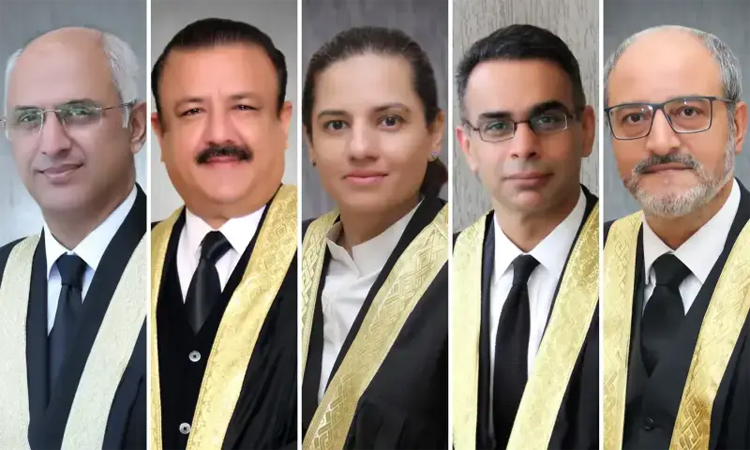
 The Federal Constitutional Court has adjourned indefinitely the hearing of an appeal challenging the appointment of retired judges to election tribunals. The case was taken up on Tuesday by a five-member larger bench headed by Justice Aamer Farooq.
During the proceedings, Advocate Sameer Khosa argued that Justice Aamer Farooq, as a High Court judge, had already ruled on a similar preliminary petition, raising a question over the bench’s eligibility to hear the case.
At this, Justice Baqar Najafi asked whether the intra-court appeal was even maintainable. Justice Aamer Farooq clarified that the petitions referred to by the lawyer had been objected to at the preliminary stage, and that he had issued no judgment on any petition filed by the current appellant. “Even if a decision was given in some other case, it has no relevance to these proceedings,” he remarked.
Advocate Khosa informed the court that he had advised his client regarding the requirements and independence of the constitutional court and requested time to seek instructions on whether his client wished to continue appearing before the court.
Accepting the request, the court adjourned the hearing for an indefinite period.
Meanwhile, the FCC on Tuesday dismissed a petition filed against the Gutka Act.
A two-member bench comprising Justice Hassan Azhar Rizvi and Justice Hassan Rizvi heard the case and remarked, “Gutka is dangerous for human health, and it is manufactured through unhygienic betel nuts, which leads to cancer disease.”
Advocate Shah Khawar said, “I did not receive any directions from my client in this regard.”
On this occasion, Justice Hassan Rizvi said, “We can summon your client if you desire, and then we will offer him Gutka in the court.” Justice Hassan Rizvi further said that Gutka is more dangerous for human health than cigarettes. He went on to say that a huge number of patients of Gutka are in the hospitals.
Moreover, the FCC on Tuesday issued a notice to the federal government on an appeal challenging the Practice and Procedure (Amendment) Ordinance. A five-member larger bench headed by Justice Aamer Farooq heard the appeal filed by Barrister Gohar.
During the hearing, Advocate Sameer Khosa argued that a seven-member bench of the Supreme Court had already issued an initial ruling on the Practice and Procedure law, while the FCCP had also adopted the Supreme Court rules. Under those rules, he contended, a five-member bench cannot hear the appeal. He maintained that any previous decision can only be reconsidered by a bench equal to or larger than the one that issued the ruling.
Justice Aamer Farooq, however, observed that no such requirement existed in the notification containing the rules issued by the Constitutional Court.
Additional Attorney General Aamir Rehman argued that decisions of the FCCP apply to the Supreme Court under Article 189, but since the FCCP is a separate court, the number of judges on the bench is not a determining factor. He maintained that the Constitutional Court itself has the authority to decide how many judges should hear any given appeal.
Advocate Khosa reiterated that the current appeal was filed under the Practice and Procedure Act, and therefore, in his view, the appeal must be heard by a larger bench.
Justice Farooq remarked that, at the stage of issuing notices, the court saw no difficulty.
The court then issued a notice to the federal government and adjourned further proceedings to the next date.