 The GSP+ status is critically important for national economy of Pakistan because it grants duty-free preferential access to the European Union (EU) market, which remains the country’s largest export destination. In return, Pakistan commits to implementing 27 international conventions related to human rights, labour rights, environmental protection, and good governance. GSP+ status with the European Union is far more than a trade concession for Pakistan. It allows around £6 billion of Pakistani goods, mainly textiles, to enter the world’s largest single market duty-free every year, saving exporters £450-550 million in tariffs and protecting 1.5-2 million direct jobs, most of which benefit the women. Status was granted in 2014 in return for ratifying and implementing 27 core international conventions. GSP+ has already delivered a cumulative £3.6 billion export gain and helped in enhancing Pakistan-EU trade from £4.5 billion to nearly £9 billion. In 2014, Pakistan committed to meeting 27 international conventions. Today, we have achieved nearly 80-85% legal alignment and built strong, lasting institutions to support these standards. Over a decade, Pakistan has built an entire national compliance incorporating provincial entities.
Latest Context
On 19 November, Deputy Prime Minister and Foreign Minister Ishaq Dar discussed the GSP+ scheme with European Union Council President Antonio Costa, ahead of an upcoming review this month. Previous month, EU representatives expressed concerns about the issues related to governance and human rights.
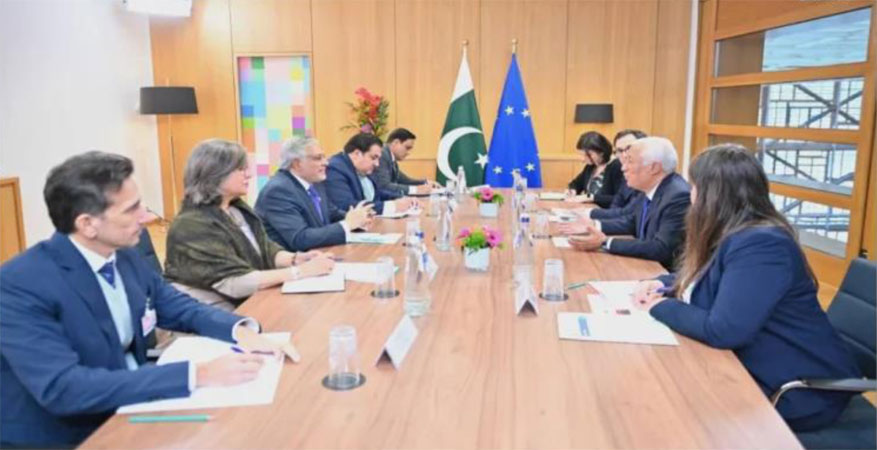
With a crucial five-day EU monitoring mission arriving on 24-28 November 2025, Pakistan is determined to convert the remaining gaps into irreversible progress. Pakistan’s efforts to defend its GSP+ status are being led by Deputy Prime Minister/Foreign Minister Ishaq Dar, Commerce Minister Jam Kamal Khan, and Human Rights Secretary Abdul Khalique Shaikh. The two official GSP+ Focal Points, one each in the Ministry of Commerce and Ministry of Human Rights, are coordinating these efforts. Stakeholders, including the Federation of Pakistan Chambers of Commerce & Industry (FPCCI) and textile exporters, emphasize that €1.5-2 billion in annual duty-free exports and 1.5-2 million jobs are at stake. Meanwhile, organizations like the Pakistan Institute of Labour Education and Research (PILER), trade unions, the Human Rights Commission of Pakistan (HRCP), and the Sindh Human Rights Commission highlight improvements in labour inspections and civic space. Governmental efforts are supported by independent verification from the UN Country Team and International Labour Organization (ILO). The stakeholders will jointly engage with the EU mission from 24-28 November 2025 to secure continued GSP+ benefits.
Progress on 27 Conventions
The government has made progress on the 27 conventions, as evident from the establishment of Provincial Treaty Implementation Cells (TICs), the National Commission for Human Rights (NCHR) regaining “A” status accreditation, and recent reforms like the 2025 Child Marriage Restraint Act.
Reforms For Improvement
Major domestic reforms show real progress, raising the child marriage age to 18 in Islamabad, restoring the NCHR to “A”-status, improving minority protections, increasing labour inspections by 20% and allowing free union registration in export zones. These reforms are driven by Pakistan’s priorities, not external pressure.
Since 2012, Pakistan has enacted wide ranging reforms to strengthen its human rights framework which included:
Anti-Rape (Investigation and Trial) Act (2021). Establishes special courts for gender- based crimes, mandates forensic evidence collection, and introduces stronger penalties for offenders.
Domestic Violence Acts (2020–22). Enacted at federal and provincial levels to criminalize domestic abuse, provide protection orders, and establish shelter and legal aid mechanisms for victims.
Transgender Persons (Protection of Rights) Act (2018). Recognizes self-perceived gender identity, prohibits discrimination, and ensures equal access to education, employment, and public services.
Zainab Alert Act (2020). Creates a rapid response system for missing and abducted children and establishes a centralized database for child protection
National Commission on HRs (NCHR). An independent statutory body empowered to investigate human rights violations, review laws, and advise the government on compliance with international conventions, reaffirming Pakistan’s continued compliance with GSP+ conventions.
n National Commission for Human Rights (NCHR) regained “A” status accreditation (May 2025)
n ” Islamabad Capital Territory Child Marriage Restraint Act 2025 (raises age to 18)
n “ Establishment of Commission for Protection of Journalists & Media Professionals (2021-24-25)
n ” Commission of inquiry on enforced disappearances: 10,592 total cases registered; 6,786 traced, 1,914 disposed by June 2025
A nationwide compliance system is in place, Treaty Implementation Cells in every province, GSP+ focal points, annual scorecards and active human rights mechanisms. More than 10,500 disappearance cases have been registered and over 8,700 traced or resolved, showing transparency and accountability.
Pakistan is recognised as a climate leader in the GSP+ group, delivering the Ten Billion Trees project, the Living Indus initiative and stronger climate commitments. Despite floods and climate challenges, we continue leading on the Paris Agreement.
Governance reforms are delivering real results, 190 tons of narcotics seized, continued FATF compliance, nationwide digital procurement and stronger accountability institutions. Clean and transparent governance is becoming the norm.
Global recognition has followed national efforts, including Pakistan’s election to the UN Human Rights Council for 2025-2027. Only eight countries meet all 27 conventions, Pakistan is one of them.
Progress in Labour Rights All four provinces harmonised core labour laws post-18th Amendment (2019-2024). Punjab & Sindh Labour Inspection Policy 2023-25 ? 20% increase in inspections (2025 target met).Trade union registration in Export Processing Zones & SEZs liberalised (2024 amendments). Tripartite Labour Standing Committees revived at federal & provincial levels. Updated NDCs submitted October 2025 (60% emission reduction conditional on finance). Living Indus Initiative (2023 2030) – flagship programme for river basin restoration. Ten Billion Tree Tsunami Phase-I completed (2024); Phase-II ongoing Single-Use Plastic (Prohibition) Regulations 2023 enforced in Islamabad & Punjab. Significant reduction observed in falcon trafficking cases after 2023 crackdown. EU acknowledges Pakistan as “one of the most proactive” on climate among GSP+ countries, despite being among the most vulnerable.
Progress in Governance & Anti-Corruption
n ” Successfully exited FATF grey list October 2022; sustained compliance in all follow up reports
n ” Digital public procurement platforms rolled out (e-Pak Procurement 2024)
n ” NAB amendments 2022-2024 reduced political weaponisation (case closure rate up 40%)
n ” UNTOC & Drug Convention: Record drug seizures 2023-2025 (190 tons narcotics)
Genuine Concerns of Pakistan : Global Double Standards
Politicization of human rights for geopolitical ends undermines genuine advocacy and reveals selective moral compass of those who weaponize these issues for political leverage. Human rights have increasingly been used as a strategy of victimhood to mask anarchist and separatist agendas abroad, particularly by dissidents in exile across West. Terrorist networks and their affiliates manipulate rights discourse and international platforms to constrain state responses and expand their operational space. Terror groups create fronts under guise of human rights activists/ NGOs, camouflaged as defenders of rights, in reality acting as proxies for terrorist agendas. Such sub-kinetic proxies erode legitimacy of state action, narrow Pakistan’s freedom of response while enabling expansion of militant networks under cover of advocacy. Their true agenda is to incite violence against state and fuel ethnic discord within Pakistan. While these lobbyists seek to malign Pakistan, they remain silent on persistent human rights violations by Western countries and India as documented in Human Rights Watch and Amnesty International reports of 2019, 2020, 2021 and 2023, as well as in various UN assessments. From Islamophobia and racial violence in UK, France and Germany to systemic discrimination, police brutality and suppression of dissent in US, double standards are glaring. West continues to use human rights narrative as a strategic tool to maintain structural inequalities in developing countries and advance geopolitical agendas under moral pretexts. Pakistan has moved ahead progressively on 27 conventions with pure intentions.
Challenges being faced by Pakistan from ethnically and religiously motivated banned terrorist groups (BLA, BLF , TTP , JUA ) and their supporters guised as political activists (PTM , BYC , NDM) should not be viewed with the lens of human rights. While assessing Pakistan’s progress on 27 conventions, EU mission should be fair enough in reading the ground realities amid country’s role as front line state against terrorist groups of all brands.