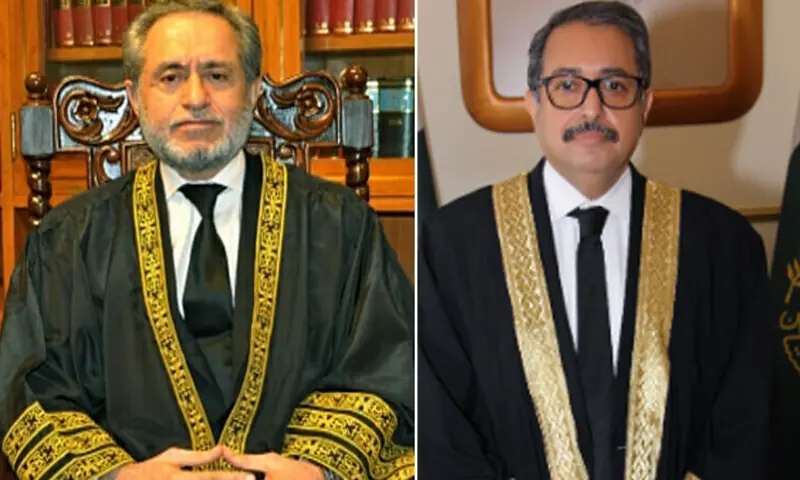
Following the passage of the 27th Constitutional Amendment, Pakistan’s key judicial bodies have undergone significant restructuring. Supreme Court (SC) Justice Jamal Khan Mandokhail has been included in the Supreme Judicial Council (SJC) and the Practice and Procedure Committee, while Federal Constitutional Court (FCC) Justice Aamer Farooq has been appointed to the Judicial Commission of Pakistan (JCP). These changes were made to align the composition of statutory bodies with the amended constitutional framework.
Read More: Supreme Judicial Council Sole Authority Over Judges’ Misconduct rules SC
The Supreme Court, in a press release on Tuesday, said that Justice Mandokhail, the second-most senior SC judge, was jointly nominated by Chief Justice of Pakistan (CJP) Yahya Afridi and FCC Chief Justice Aminuddin Khan as a member of the SJC. The council, responsible for judicial accountability, now comprises the CJP, FCC CJ Aminuddin, Justice Munib Akhtar, Justice Syed Hassan Azhar Rizvi of the FCC, Lahore High Court CJ Aalia Neelum, Islamabad High Court CJ Sardar Muhammad Sarfraz Dogar, and Justice Mandokhail.
Justice Mandokhail has also joined the three-member Practice and Procedure Committee, which forms benches and fixes cases, alongside the CJP and Justice Akhtar. Meanwhile, Justice Aamer Farooq, the second-most senior judge of the FCC, was nominated to the JCP, which handles appointments to the superior judiciary. The JCP will now include the CJP, FCC CJ, Justice Akhtar, Justice Rizvi, Justice Farooq, Attorney General Mansoor Usman Awan, Law Minister Azam Nazir Tarar, representatives from the Pakistan Bar Council, the National Assembly, the Senate, and a woman or non-Muslim nominated by the NA speaker.
These changes come amid a wider restructuring of the judiciary after the establishment of the FCC through the 27th Amendment. The amendment has sparked criticism from former and sitting judges and legal experts, who argue it diminishes the Supreme Court’s position as the country’s highest judicial forum. Two SC judges, Athar Minallah and Mansoor Ali Shah, resigned shortly after the amendment was enacted, citing concerns over its implications.
Read More: Two SC judges warn new code of conduct will restrict judicial freedom
The International Commission of Jurists (ICJ) has also raised concerns about the amendment, highlighting issues including the formation of the FCC, judicial appointments, the composition of the JCP, the transfer of high court judges, and immunities granted to the president and military leadership. The ICJ noted that the Supreme Court would now primarily serve as an appellate court for cases not involving constitutional interpretation, while the FCC would assume many functions previously handled by the SC.