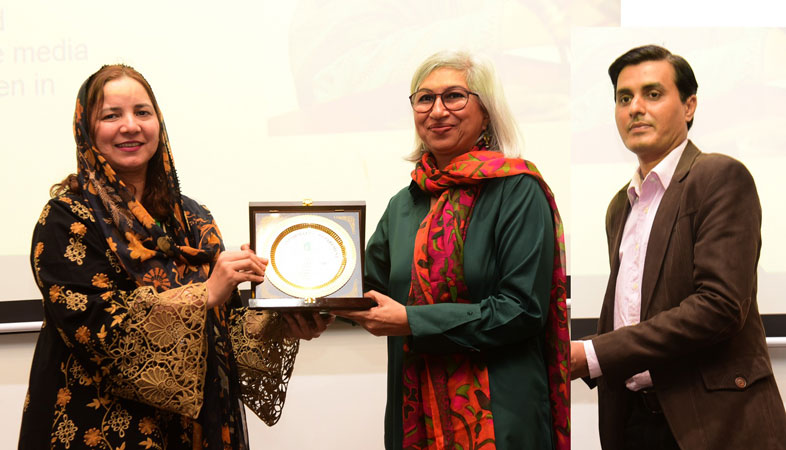
 Assistant Professor, the Institute of Environmental Studies, University of Karachi, Dr Amir Alamgir on Wednesday called for the need to declare a climate emergency in the country, asserting that only through long-term, strategic practices can the cascading crises of climate change be mitigated.
He was sharing his views in a panel discussion on “Climate-induced Social Fragmentation and its link to Violent Extremism”, organized by the Press Information Department (PID).
Professor Dr Amir Alamgir explained that the lack of fresh water is also leading to a decline in fish populations, which is another factor driving migration from these regions to cities. He added that migrants moving from rural to urban areas are developing resentful attitudes towards city dwellers.
He said that the people living in our coastal areas were previously associated with agriculture, fisheries, or livestock. However, with the intrusion of seawater, agriculture is no longer viable there. Consequently, many residents have migrated to urban areas, while those who remain have been forced to cultivate crops that require less water.
Dr Amir Alamgir further emphasized that climate change is also adversely affecting mental health.
He also pointed out that we must also engage schools to help raise awareness about reducing plastic use. He suggested that we can work to increase awareness about climate change issues by engaging religious scholars and students in madrasas.
Citing a research study, he mentioned that it has identified which types of trees should be planted in specific districts of Karachi. Dr Amir Alamgir underscored the necessity of altering our lifestyles.
He noted that some work has already been done through scholars in certain areas and with the help of madrasa students. He proposed that Friday sermons in mosques should also address these critical issues.
Dr Alamgir said that we must prepare ourselves at an individual level and begin working from our own homes to solve the problems of climate change.
He recommended that electronic media should dedicate at least one specific program per week to climate change, featuring environmental experts to discuss solutions and raise public awareness.
He observed that in the coming times, we may face increased challenges such as food security crises and heat-strokes, and we must work together to find solutions. Finally, he urged everyone to support the individuals and organizations that are working on climate change issues.
Speaking on the occasion, another panelist, journalist, Zofeen T Ebrahim said that climate change-induced crises are eroding mutual trust among people.
She said that migrants moving from rural to urban areas often struggle to integrate into the urban society and face significant challenges.
She emphasized that solving the problems created by climate change requires a collective effort not only from government institutions and NGOs but from every segment of society.
She added that we need to work in an organized manner and also require a cadre of well-trained teams of volunteers who can operate systematically. Finally, she stressed that we must also focus on addressing underlying issues like social injustice, poverty, and inequality.
Presenting vote of thanks in the concluding session, Director General Press Information Department (PID) Karachi, Erum Tanveer said that we often talk about melting glaciers, rising temperatures or floods, but today’s conversation reminded us that the real story is about people, about families being displaced, livelihoods being lost and communities being pulled apart.
She said that our panelists helped us see what we mean by climate-induced social fragmentation. It’s when environmental stress, floods, drought or loss of land weakens the bonds that hold a society together.
She said when people lose that sense of belonging or stability, they become more vulnerable, not just economically but also ideologically, as we have discussed it here in detail. That is why extremist narratives often find their way in; that was the linkage that we were trying to basically identify in today’s seminar, she added.
The DG PID Karachi said that we also heard some very powerful examples from across Pakistan, from Sindh to Balochistan, from South Punjab to the North, where climate stress has already started to create pockets of social tension and as one of our speakers pointed out, it is not always in the rural area – urban migration too is reshaping the social map.
She said that when thousands of families move into cities already struggling with jobs, housing and inequality, frustration and resentment can easily grow. These are conditions that extremists know very well how to exploit, she said. She said that the institutions need to work in a very coordinated manner, because all these things are interrelated. The vicious cycle that was highlighted by Dr. Amir Alamgir was basically describing all these dimensions of the climate change and its impact on the society.
She said that we were talking about the role of the media here and build solutions that address both adaptation and the social collision together. As far as the environmental issues are concerned, we need to know the very important point whose voices are missing. Women, youth and marginalised communities are among the first to suffer from both environmental shocks and extremist violence, yet they are often absent from the policy making table, she said.
Their perspectives, their lived experiences must be at the centre of any national response, because inclusion is not just fair, it’s a smart policy. Another thread that came through strongly today was the role of the religious and community leaders. They have immense influence in shaping values and behaviours, the DG PID Karachi said.
She said that if we can connect faith-based messages, as our speakers actually pointed out, about compassion and collective responsibility to the climate agenda, we can turn a potential vulnerability into a real source of strength.
She said that if we want to build resilience against extremism, we must first build resilience within communities. Climate adaptation must go hand-in-hand with inclusion, trust and social cohesion.
Later, Director General Press Information Department (PID) Karachi, Erum Tanveer presented souvenirs to the panelists Professor Dr. Amir Alamgir and journalist, Zofeen T. Ebrahim.