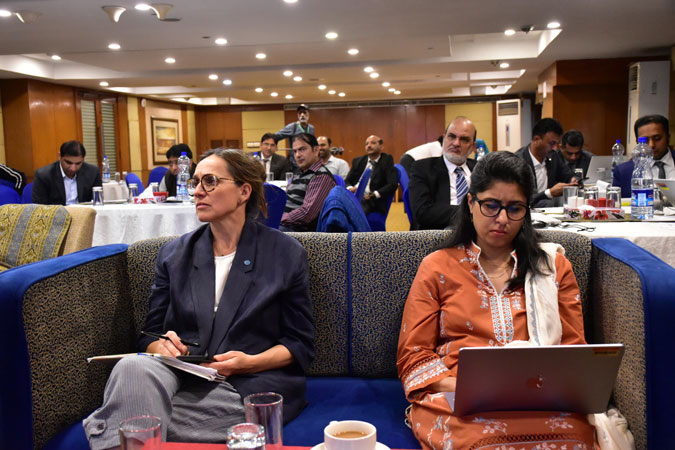
 The Food and Agriculture Organisation of the United Nations (FAO), together with the Punjab Agriculture Department, Punjab Irrigation Department, MNS University of Agriculture Multan, IHE Delft, and the International Water Management Institute (IWMI), formally launched the Water Budgeting and Agricultural Water Productivity Project under FAO’s global WaPOR programme. The project aims to strengthen evidence-based water governance and improve irrigation efficiency in the Indus Basin Irrigation System (IBIS).
The launch event, held today at Park Lane Hotel in Lahore, introduced stakeholders to the scope, methodology, and expected outcomes of the study, which focuses on Bahawalnagar and Bahawalpur districts. The initiative will utilize FAO’s WaPOR remote sensing database to assess crop water productivity, groundwater sustainability, and irrigation performance across Punjab. The workshop opened with remarks from Dr. Maria Zaidi, WaPOR National Coordinator, followed by a welcome from Ms. Amina Bajwa, Assistant FAO Representative – Programme. Participants were then introduced to the WaPOR project by Virginie Gillet, Land and Water Officer, FAO Headquarters.
Dr Zaidi provided an overview of the project’s objectives and implementation approach, highlighting its alignment with the Punjab Agriculture Policy 2018 and the Punjab Irrigation, Drainage, and Rivers Act (PIDRA) 2023, both of which emphasize integrated surface and groundwater management.
A detailed briefing on water governance under provincial policies and the SDG framework was given by Mr. Khurram Amin, Additional Secretary (Technical), Punjab Irrigation Department. Technical presentations from the Punjab Irrigation Department provided insights into surface and groundwater conditions in the Bahawalpur Zone. Academic contributions were shared by Marlos Mul, Associate Professor at IHE Delft, who highlighted the importance of scientific backstopping and coordinated learning.
Global perspectives on big data for water management were presented by Dr. S.A. Prathapar, while Jiro Ariyama, FAO’s International Water Expert, shared lessons learned from FAO’s previous water productivity and water accounting interventions in Pakistan. The event also welcomed the participation of additional partners and provincial leadership, including Julius Muchemi, Head of Province for FAO Sindh, and Emelda Berejena, Technical Advisor for the FAO GCF-funded project and Head of Province for FAO Punjab, who emphasized the importance of cross-provincial collaboration in achieving long-term water security.
Participants engaged in group discussions on groundwater sustainability, irrigation efficiency, project implementation arrangements, and institutional roles. Representatives from PID, PAD, MNSUA, IWMI, and FAO contributed to shaping the Technical Working Group, which will guide the project’s technical design and execution.
In her closing remarks, FAO HQ’s Virginie Gillet presented the Way Forward, reaffirming FAO’s commitment to building institutional capacity and supporting Punjab in advancing climate-resilient, sustainable water management through remote sensing technologies. The Water Budgeting and Agricultural Water Productivity Project is expected to enhance institutional capacity to use remote sensing tools such as WaPOR; generate insights for improved irrigation service delivery and crop water productivity; clarify groundwater abstraction trends-including solar tubewell use; and contribute to broader climate resilience, water governance reforms, and food security across the Indus Basin.