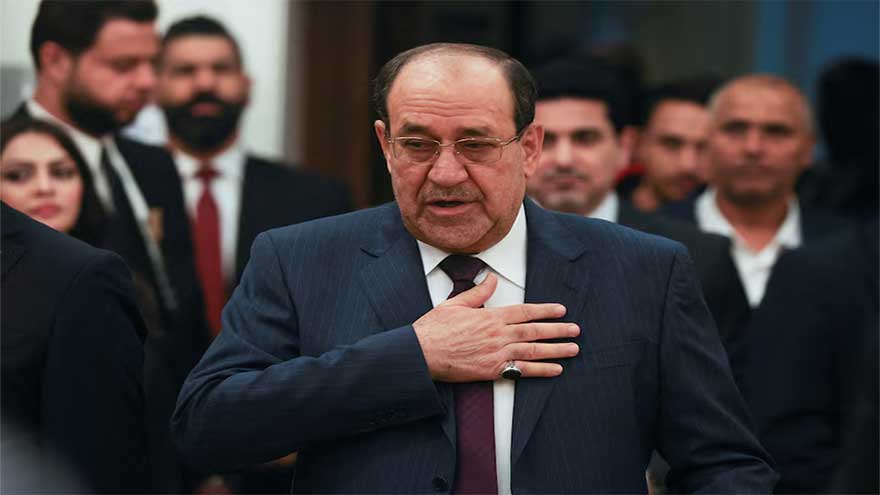
BAGHDAD – Former Iraqi Prime Minister Nouri al-Maliki continues to wield immense influence in Iraq’s political landscape, even as critics hold him responsible for deepening sectarian divisions and failing to prevent the Islamic State’s rise a decade ago.
Now in his mid-70s, Maliki leads the powerful State of Law coalition, a Shi’ite Muslim bloc widely expected to play a decisive role in choosing Iraq’s next premier following the upcoming November 11 parliamentary elections.
Maliki, who served as prime minister from 2006 to 2014, was forced to step down after mounting pressure from an unlikely alliance of the US, Iran, Sunni leaders, and Iraq’s top Shi’ite cleric. His administration was blamed for worsening sectarian violence and neglecting issues such as corruption, unemployment, and poor governance.
Read More: Qureshi calls on Iraq’s president, FM; discusses bilateral ties, global issues
Despite the controversy, Maliki has made a political comeback, rebuilding his base through close ties with armed militias, the security establishment, and the judiciary. His journey from exile under Saddam Hussein to signing the dictator’s execution order in 2006 reflects a life shaped by ideological struggle and revenge against a Sunni-led regime that once persecuted Shi’ites.
Born in 1950 in Janaja, a small village in southern Iraq, Maliki hails from a politically active family. His grandfather was a poet who resisted British colonial rule, while his father was a staunch Arab nationalist. After being sentenced to death for his role in the Islamic Dawa Party, Maliki spent 25 years in exile before returning following Saddam’s fall.
Critics argue that Maliki’s sectarian policies alienated Iraq’s Sunni population, paving the way for the Islamic State’s insurgency. His decision to target a Sunni vice president immediately after the US withdrawal in 2011 drew comparisons between Maliki’s leadership style and that of Saddam Hussein himself.
Read More: Saddam Hussein still revered as a hero
Although he denies sectarian bias, insisting that his government fought extremists of all kinds, analysts say his governance contributed to the country’s instability. A 2015 Iraqi parliamentary inquiry even recommended that he stand trial for the fall of Mosul to ISIS.
Yet, despite years of political and public backlash, Maliki remains a formidable power broker in Iraqi politics — one whose alliances, ideology, and ambition could once again shape the country’s future leadership.