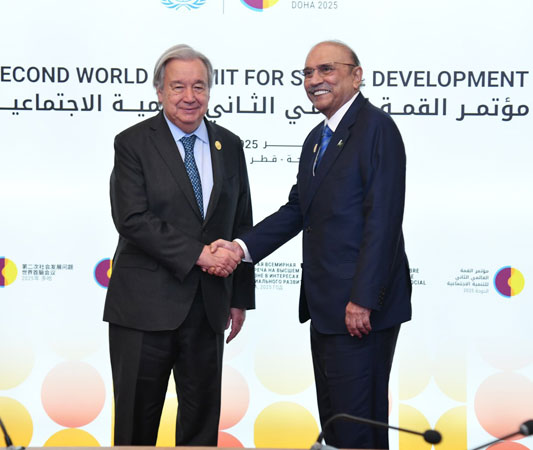
 President Asif Ali Zardari said on Tuesday that the violation of the Indus Waters Treaty (IWT) by India could not and would not succeed, and warned against the weaponisation of water.
President Zardari addressed the issue while speaking at the Second World Summit for Social Development in Doha, Qatar, saying: “We in Pakistan, on one hand, face the brunt of the impact of climate change, which has caused devastation for our people in the form of large-scale floods … on the other hand, we face a new threat in the form of water weaponisation. Water, which all the world knows, is an equal right of any human being and humanity.”
The president also reaffirmed Pakistan’s commitment to social justice, inclusive development and global solidarity, emphasising the need to eradicate poverty, promote decent work and ensure equality and human rights for all.
The president expressed full support for the Doha Political Declaration and highlighted that the country’s vision for inclusiveness and sustainable development aligned with the spirit of the declaration.
“Pakistan remains steadfast in placing people at the centre of policy,” President Zardari added.
He also reaffirmed the country’s commitment to the Sustainable Development Goals, pledging to raise literacy to 90 per cent and ensure every child attended school within five years.
Outlining a roadmap to translate the Doha Declaration into action, Zardari urged the world to unite around three pillars: dignity, equality and solidarity, emphasising global financial reforms, debt relief, equitable taxation and expanded social protection.
Condemning the “genocide, apartheid, and mass starvation” in Palestine, the president also called for a just and lasting peace.
The president also reiterated Pakistan’s unwavering support for the people of Kashmir, linking both struggles as two sides of the same coin in the pursuit of justice and self-determination.
“Development must begin and end with the betterment of people,” President Zardari said, adding that “we must rise above all differences to embark on a path of compassion and progress for all.”
PPP Chairman Bilawal Bhutto-Zardari also drew the attention of the UN secretary general to India’s weaponisation of water, pointing out that India had unilaterally and illegally suspended the water-sharing agreement and stopped providing discharge data on rivers, creating man-made disasters for Pakistan.
In a meeting with the UN chief, President Zardari reaffirmed Pakistan’s strong support for multilateralism and the central role of the UN in promoting peace, equity and shared prosperity.
Meetings with Iraqi, Tajik counterparts
Zardari also met Iraqi counterpart Dr Abdul Latif Jamal Rashid, both reviewing the entire spectrum of bilateral relations and reaffirming their mutual commitment to further strengthening longstanding ties.
Discussing trade and investment, both sides underlined the importance of enhancing economic linkages through increased business-to-business interactions and facilitative visa regimes.
He noted that the Strategic Partnership Agreement signed in 2024 reflected the growing depth of ties between the two countries.
President Zardari also commended the successful Dosti-II joint military exercise held in August 2025 and reaffirmed Pakistan’s readiness to assist Tajikistan in defence cooperation and capacity building.
The Tajik president invited Zardari to visit the country, which the latter accepted. The two leaders also shared perspectives on regional and global issues of common concern.