HONIARA: When Solomon Islander Dennis Phillip struck metal while ploughing his field, he discovered not a rock — but one of the many unexploded World War II bombs still buried beneath the Pacific nation’s soil.
From 1942 to 1945, fierce fighting between Japanese and Allied forces left behind tens of thousands of munitions. Today, these remnants of war lie hidden under homes, schools, and even playgrounds — killing and injuring civilians decades later.
Locals like Bernadette Miller Wale recall playing with old shells as children, unaware of the danger. In 2021, a bomb explosion near her home killed two of her friends. Now, she dedicates her time to educating communities about the risks.
Read More: Asahi Cyber-Attack Forces Japan’s Top Brewer Back to Pen and Paper
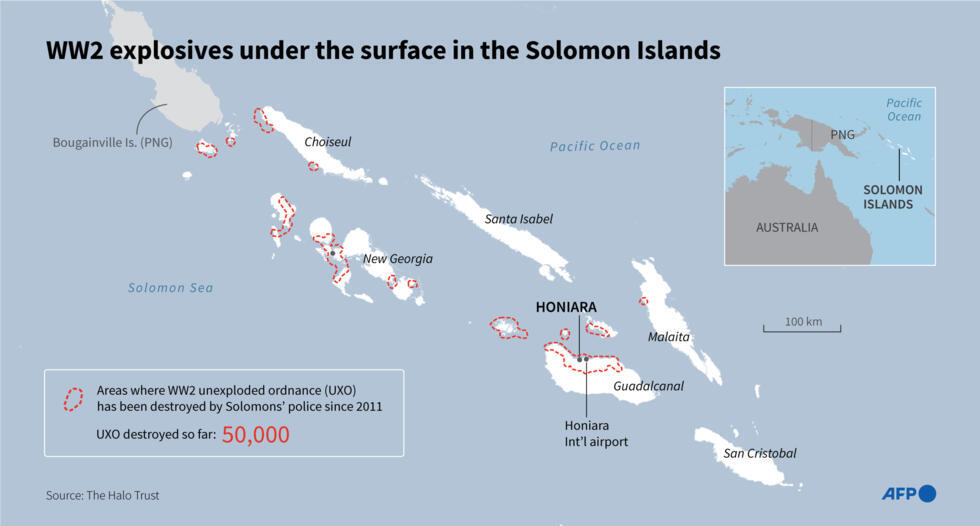
According to officials, more than 50,000 bombs have been found and destroyed since 2011, mostly of American origin (over two-thirds), followed by Japanese (17%).
Groups like The Halo Trust, supported by the U.S. State Department, are mapping the islands to locate and remove unexploded ordnance. Their maps show entire neighborhoods in Honiara littered with bomb sites.
At Bloody Ridge, once the site of brutal combat, efforts to build a national park are being delayed by grenades and shells found just centimeters below the surface.
Read More: Japan Wholesale Inflation Holds Steady at 2.7% in September
“This is not a problem the Solomons can solve alone,” said Emily Davis of The Halo Trust. “Everyone here knows someone affected — a neighbor, a friend, a child.”
Prime Minister Jeremiah Manele has raised the issue with regional leaders, calling it “dear to me” and urging more international help.
With funding for bomb clearance only secured until June 2026, experts warn that without long-term support, this hidden war could continue claiming lives for generations to come.