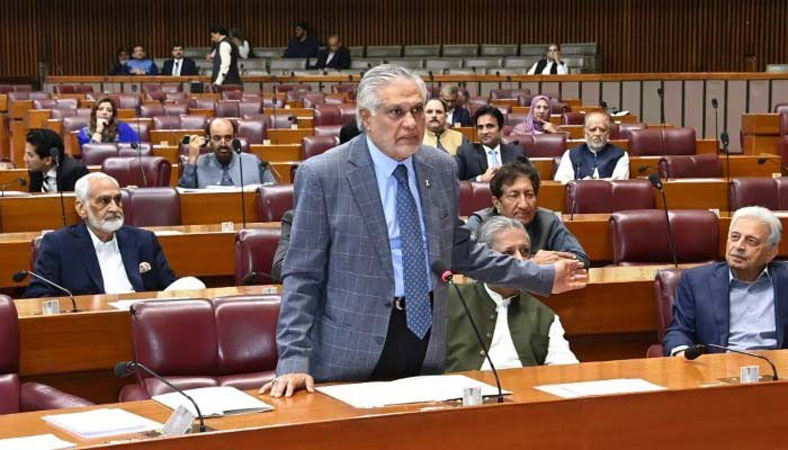
 The 20 points that US President Donald Trump announced as part of his Gaza plan this week were not in line with the draft proposed by a group of Muslim-majority countries, Pakistani Foreign Minister Ishaq Dar said on Friday.
Changes were made in the plan, Dar told Pakistani lawmakers in parliament.
“I have made it clear that these 20 points which Trump has made public are not ours. These are not the same as ours. I say that some changes have been made in it, in the draft we had,” he said.
Trump published on Monday the plan that would end the war between Israel and Hamas and require the return of all hostages living and dead within 72 hours of a ceasefire.
Meanwhile, Pakistan has engaged a European country to secure the release of a former Pakistani senator, Mushtaq Ahmed Khan, from Israel after he was captured from an aid flotilla that was enroute to Gaza, the Pakistani foreign minister said on Friday.
Israeli forces this week intercepted the Global Sumud Flotilla carrying humanitarian aid and activists from around the world, including Swedish campaigner Greta Thunberg and the former Pakistani senator, to the besieged Palestinian territory.
Pakistan’s Foreign office condemned the obstruction of the fleet and said it was working with international partners to secure the release of its citizens, with Prime Minister Shehbaz Sharif applauding their “dignified participation” and calling for their immediate return.
“Of the 45 vessels, they have captured 22 ships and detained all their passengers… According to our information, Senator Mushtaq sahib, who is a former senator from Jamaat e Islami… he is among them,” Pakistani Foreign Minister Ishaq Dar told parliament on Friday.
“We have engaged a European third country, which is influential, we are using their diplomatic process. We have asked them to contact there (Israel) and have our senator immediately released.”
Moreover, Dar dismissed speculation that Pakistan’s engagement with the US could harm its long-standing strategic partnership with China. He said that Pakistan’s foreign policy framework gives China a unique and central place, and no agreement with Washington would come at the expense of Beijing.
“There are reports suggesting that any deal with the U.S. might damage Pakistan-China relations. Let me be very clear – this is not true,” Dar asserted. He stressed that relations with China are deeply rooted in history, mutual trust, and shared strategic interests, and remain an “unshakable cornerstone” of Pakistan’s foreign policy.
Referring to the defence deal with Saudi Arabia, Dar said that the defence pact has the potential to evolve into an Eastern North Atlantic Treaty Organisation (Nato) if more nations decide to join it.
“Our defence pact with Saudi Arabia is significant. More countries now want to sign a similar agreement with us,” he added.
“By God’s will, Pakistan will lead 57 Islamic nations,” he said.
Recalling India’s aggression against Pakistan in May, the deputy prime minister said that, under the defence pact, such strikes on Pakistan would have been considered as an attack on Saudi Arabia.
Separately, Prime Minister Shehbaz Sharif on Friday categorically said that Pakistan neither recognize the Israeli state nor maintain diplomatic ties with it.
The Prime Minister held a telephonie conversation with Jamaat-e-Islami (JI) Ameer Hafiz Naeemur Rehman, during which the two leaders discussed the situation in the Middle East, with a particular focus on the urgent need for a ceasefire in Palestine, a Prime Minister’s Office news release said.
The Prime Minister also highlighted the government’s active role in ensuring the safe return of Pakistani nationals detained by Israel after their participation in the Global Sumud Flotilla, including former Senator Mushtaq Ahmad Khan.
During the conversation, both leaders also reviewed the situation in Indian Illegally Occupied Jammu and Kashmir (IIOJK).
The Prime Minister reiterated that the federal government is committed to playing its full role in promoting peace and supporting the Kashmiri people’s struggle for their legitimate rights.