
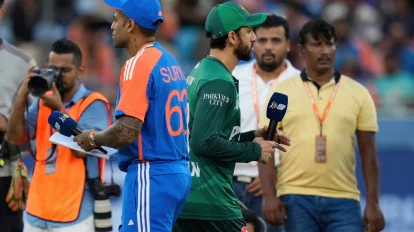
The build-up to Pakistan’s Asia Cup clash with India has been marred by provocation. From the refusal to shake hands at the toss to the politicisation of post-match speeches, India’s conduct has raised questions about cricket’s traditions and the ICC’s credibility. Yet for Pakistan, this is also a moment of pride — a chance for a new-look side to show maturity and resilience on one of the sport’s biggest stages. On September 21 in Dubai, the stakes stretch beyond the scoreboard; the clash will measure Pakistan’s ability to match fire with focus, and arrogance with discipline.
This is not the first time that India’s conduct has strayed from the gentleman’s game. During the 2019 World Cup, Indian players’ decision to wear military-style caps provoked global debate about the intrusion of politics into cricket. In 2022, customary handshakes were conspicuously avoided after a tense T20 World Cup clash. What should have been gestures of unity turned into acts of division. The latest chapter in 2025 continues the cycle: contentious umpiring calls, deliberate snubs, and political undertones in post-match speeches. For a sport built on tradition and etiquette, such repetition is corrosive. Each incident chips away at cricket’s spirit, replacing respect with theatre.
What makes matters worse is the silence of the guardians. Neither the International Cricket Council nor the Asian Cricket Council intervened when the situation demanded clarity. Why did the referee instruct captains to avoid handshakes at the toss? Why did umpires repeatedly lean towards Indian appeals in marginal situations? Why was no disciplinary action taken after the closing snub? The ACC president, who also serves as Pakistan Cricket Board chairman, voiced disappointment but stopped short of sanctions. The ICC justified its inaction by invoking “tournament integrity,” a bureaucratic shield that only magnified suspicions. Fans have been left wondering whether neutrality in cricket governance has become negotiable.
This is dangerous terrain. Few rivalries in world sport command the audience of Pakistan versus India. The last T20 World Cup meeting between the two sides in Melbourne in 2022 drew more than 250 million television viewers, while their Asia Cup encounter in Dubai in 2021 attracted an estimated 220 million. The numbers in 2025 are expected to cross 300 million, a figure rivalled only by global football finals. If fans begin to see these encounters as manipulated or politically tainted, cricket risks irreparable damage to its credibility.
Yet, beyond the drama, the contest will ultimately be decided on the field, and Dubai is no ordinary venue. Its wicket is a study in contrasts: lively seam movement with the new ball, followed by slowing conditions that reward spin and patience. Dew at night skews advantage towards the chasing side. The numbers tell the story. Across the last 20 T20 matches in Dubai, 12 have been won by teams batting second, a statistic that underscores the challenge of defending totals under lights. The average first-innings score at the venue sits between 145 and 150, reflecting its double-edged nature — punishing rash batting early, yet allowing acceleration later. The middle overs, from the 7th to the 15th, become decisive as spinners extract grip and bounce while batsmen attempt to build momentum.
For Pakistan, clarity of roles is non-negotiable. The opening six overs must deliver between 40 and 50 runs without the loss of multiple wickets. That requires aggression, but not abandon. Young opener Saim Ayub, with a domestic T20 strike rate exceeding 140, is the natural aggressor. Alongside him, Sahibzada Farhan, who has averaged above 33 in recent PSL editions, provides a stabilising hand. At one-drop, the 19-year-old Hasan Nawaz, boasting a domestic strike rate beyond 150, brings fearless intent and six-hitting power — a quality especially vital on Dubai’s slower surface where a single counter-attacking innings can shift momentum.
The middle order offers its own balance. Mohammad Nawaz remains one of Pakistan’s most versatile assets, combining a T20I strike rate of 131 with 45 international wickets as a left-arm spinner. His presence allows flexibility: a floater in batting and a wicket-taker in spin-friendly overs. Faheem Ashraf, often overlooked, has quietly rebuilt his credentials as a lower-order finisher, striking above 135 in the PSL and contributing as a change bowler who thrives in middle phases. Together, they form the glue of Pakistan’s transitional overs.
Bowling, however, remains Pakistan’s real weapon. Shaheen Shah Afridi has already collected 91 T20I wickets at an average of 22.1, his inswinging deliveries with the new ball making him one of the deadliest opening bowlers in world cricket. Haris Rauf has become the enforcer, with 83 wickets at a strike rate of 16.4 deliveries per dismissal — his raw pace a consistent threat on Dubai’s bouncy surface. Add to this the mystery of Abrar Ahmed, who has claimed eight wickets in the current Asia Cup at an average below 22, and Pakistan’s attack looks not only balanced but also tailor-made for Dubai’s conditions.
India, meanwhile, has leaned heavily on psychological tactics. The refusal to shake hands, the politicised speeches, and incessant appealing are not isolated gestures. They are calculated ploys to unnerve Pakistan’s younger brigade. The counter lies not in retaliation but in composure. History has offered such lessons before. In 2021, Babar Azam and Mohammad Rizwan’s calm, unbeaten stand in Dubai silenced the noise and reminded the world of cricket’s essence. In 2009, Pakistan’s measured Champions Trophy campaign overcame similar attempts at provocation. The lesson is clear: performance must speak louder than politics.
Pakistan-India clashes have always teetered on the edge of politics. In 1999, Pakistan’s famous Test win in Chennai came in the shadow of heightened regional tensions. In 2003, their World Cup meeting in South Africa carried political undertones that overshadowed the cricket. In 2022, Indian celebrations after a T20 World Cup win drew criticism for being unnecessarily provocative. Each episode revealed a recurring vulnerability: without strong oversight, cricket can too easily be bent by political currents.
The stakes in Dubai therefore go beyond runs and wickets. For Pakistan, it is about showcasing the promise of a younger generation while proving that the sport can still be played with dignity under provocation. For India, the temptation to conflate politics with cricket once again threatens to eclipse the brilliance of their own players. And for the ICC and ACC, silence has become complicity, leaving a credibility vacuum that damages the very fabric of the game.
On September 21, two contests will unfold. One will be fought between bat and ball on Dubai’s flat yet deceptive surface. The other will play out between pride and provocation, between cricket’s spirit and its corrosion. If Pakistan’s young guns can resist psychological traps and deliver with clarity, they will not only secure a crucial victory but also remind the world why cricket still matters. If they falter, the headlines will once again be claimed by controversy, and the absence of handshakes will overshadow the essence of the sport.
Cricket’s spirit is indeed on trial. The verdict this time will not be dictated by administrators or speeches but written on the scoreboard in Dubai.