
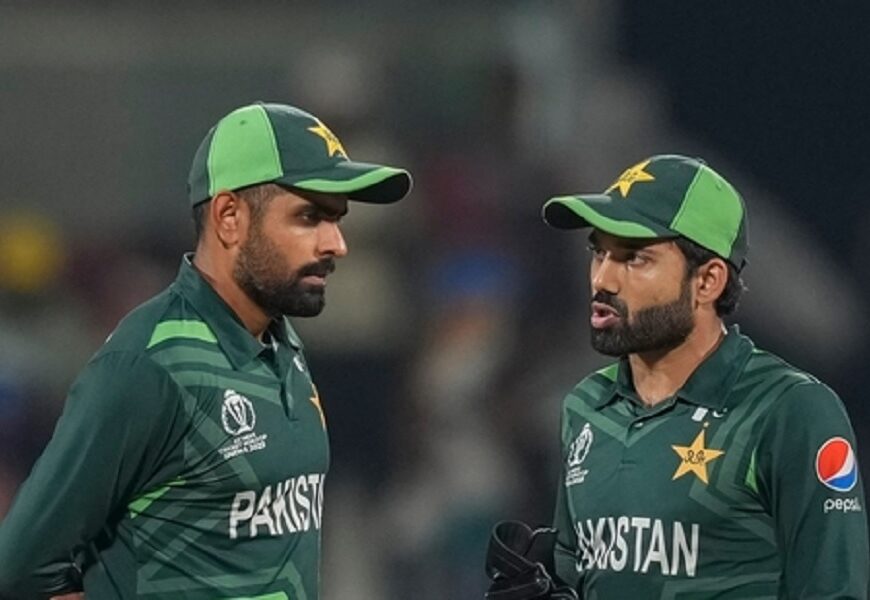
Another India–Pakistan clash, another heartbreak for the Green Shirts. In the much-anticipated Asia Cup group match, Pakistan once again folded under pressure. On a flat batting track, Saim Ayub and Muhammad Haris wasted their starts, skipper Salman Ali Agha looked unsettled, and the promising Hassan Nawaz became an easy victim of India’s spin attack. With no backbone in the innings, Pakistan handed India a straightforward victory — the kind of result that has become all too familiar.
Predictably, the post-match debate has circled back to Babar Azam and Mohammad Rizwan. The outcry is simple: bring them back. The numbers, however, tell a mixed story. With Babar and Rizwan in the XI, Pakistan have played India six times since 2021 — and won only once. That lone triumph came in Dubai when the pair scripted history by chasing down India’s total without losing a wicket. But since then, the duo has failed to turn performances into victories: low scores in Melbourne 2022, another collapse in New York 2024, a powerless chase in Ahmedabad 2023, a humiliating 228-run defeat in Colombo, and a six-wicket loss in Dubai 2025 despite Rizwan’s 46.
Yet even with this record, dropping Babar and Rizwan is not the solution. Babar remains Pakistan’s finest modern batter, with over 12,000 international runs, a career ODI average of 56, and the temperament to handle pressure. Rizwan, too, has been among the most consistent T20 openers in the world, and together they are Pakistan’s most successful opening pair in history. Their return is not a luxury but a necessity. Without their stability, Pakistan’s batting lineup looks like a lottery ticket — occasionally lucky, mostly wasted.
The statistics further underline this gap. Since Babar’s exclusion, Pakistan’s overall run rate in T20 internationals has slipped from 8.3 to 7.6, reflecting the absence of an anchor who can rotate strike and keep the scoreboard ticking. At the same time, only Rizwan has managed to maintain consistency with an average above 45 and a strike rate in the mid-120s. Among the younger crop, Saim Ayub has shown flashes of brilliance with a strike rate of around 136 — currently the highest in the side — but his average sits below 22, underlining how often he throws his wicket away. Muhammad Haris, another exciting prospect, carries a strike rate close to 130 but averages just 20. In contrast, Babar’s strike rate of 128 may appear modest, but his average of nearly 40 makes him the only batter who combines stability with reliability. Without that balance, Pakistan’s innings too often collapses in the middle overs.
India’s approach, by comparison, is a lesson in balance. Their top order rarely wastes starts: Abhishek Sharma and Shubman Gill rotate the strike early, and then accelerate once set.Suryakumar Yadav provides the stability Pakistan so often lacks, while middle-order hitters like Suryakumar Yadav and Hardik Pandya bring explosive finishing power. Crucially, India does not rely on one or two individuals — every batter has a defined role. This combination of strike rotation and calculated hitting ensures that India maintains a healthy run rate throughout the innings, avoiding the stagnation Pakistan frequently suffers when boundaries dry up.
This imbalance is not new. Pakistan cricket has developed a dangerous habit: losing mentally before the first ball is bowled against India. The buildup to these matches is so intense — the crowd pressure, the media scrutiny, the emotional baggage of rivalry — that Pakistan’s players often appear drained before stepping onto the field. Against other teams, the same batters play freely, but against India, fear of failure overshadows intent. This psychological block has cost Pakistan more matches than any tactical misstep.
But tactical failures are equally glaring. Matches are treated like experiments, with youngsters thrown into the fire without support. Saim, Haris, and Hassan Nawaz are exciting players, but in a high-pressure clash against India, they looked like easy targets. No team can win marquee battles with a fragile top order and confused strategy. The problem is not the absence of talent but the absence of planning.
This is where the selection committee must face hard questions. Why was the batting order shuffled so drastically before the Asia Cup? Why does Pakistan keep backing short-term experiments instead of building long-term stability? The chopping and changing not only destroys confidence but also prevents players from understanding their roles. One day Saim is told to play as an anchor, the next as a pinch-hitter. Salman Ali Agha is pushed into captaincy without experience, while proven performers like Fakhar Zaman and Imam-ul-Haq are sidelined inconsistently. A team like India invests in continuity — their players develop over years, not matches. Pakistan, on the other hand, continues to swing between extremes: either over-relying on seniors or throwing all the weight on untested youth. Both approaches fail.
The future plan has to be clearer and more structured. First, Pakistan needs balance: Babar and Rizwan as anchors, paired with fearless stroke-makers like Saim Ayub and Muhammad Haris in supporting roles — not as the main pillars. Second, the middle order must be rebuilt with clarity: a mix of stability (players like Salman Ali Agha or Abdullah Shafique) and finishers with genuine power-hitting skills. For too long, Pakistan’s lower order has lacked a proper finisher in the mold of Hardik Pandya or Glenn Maxwell. This role must be identified and groomed.
Third, Pakistan requires a proper rotation and grooming system. Instead of discarding youngsters after two failures, the selectors must provide consistent exposure. The Pakistan Super League (PSL) has been a successful platform for unearthing talent, but too often those players are thrown into the national side without a transition plan. A gradual integration — starting with lower-pressure series before exposing them to India or Australia — would allow youngsters to mature without drowning in expectation.
Fourth, Pakistan needs to rethink domestic cricket as a feeder system. Our batters rarely face long four-day games that build patience or high-intensity List A tournaments that demand strike rotation. Without these, players either become reckless hitters or overly cautious grafters — but rarely the complete package. Babar Azam is an exception because he grew through both systems before the structure was dismantled. For Pakistan to produce more Babars, the domestic pipeline must be repaired.
Most importantly, the selection committee must set a long-term vision. Selection should not be about pleasing critics or reacting to public pressure. It should be about building a unit that can compete with India, Australia, and England on the biggest stages. That requires planning, not panic. It requires courage to back players in lean phases and discipline to avoid emotional, knee-jerk decisions after every defeat.
Pakistan still has another chance in the Super Four. To succeed, the team must stop repeating the same mistakes. Experience is not optional; it is the backbone. Babar and Rizwan must return — not as saviors, but as part of a balanced strategy. Without mental strength, tactical planning, and a serious rethink by the selectors, Pakistan will continue to walk into big games half-defeated.
In the end, the difference is simple: India wins on planning, Pakistan loses on panic.