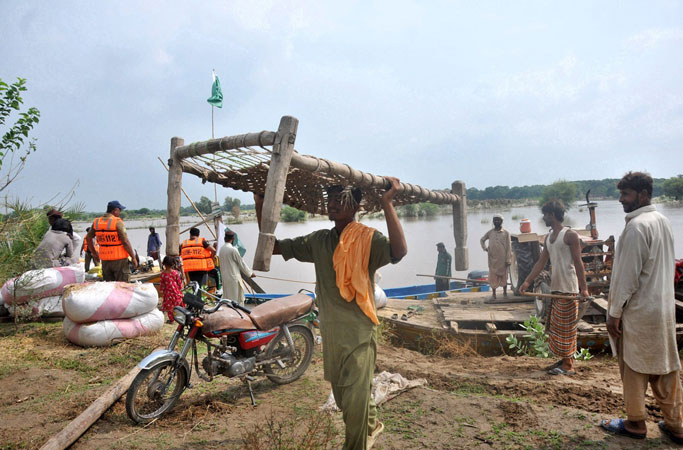
 An extremely high flood was reported at Head Marala on the Chenab River, with water discharge exceeding 531,000 cusecs on Wednesday. The Chenab River bridge has been closed due to rising water levels, and police have been deployed at both ends to prevent accidents.
Flood surges have also been reported at Khanki and Qadirabad, while several settlements in Vehari, Burewala and Mailsi have been inundated.
Punjab is grappling with exceptionally high flood levels in major rivers, with authorities issuing urgent alerts to residents along riverbanks.
The worst floods in four decades have killed at least 43 people in Punjab, with more than 3.3 million affected since August 26, the provincial disaster management authority said.
The Chenab River at Ganda Singh Wala is expected to sustain extreme levels until September 10, while the Indus near Guddu Barrage may see high to very high floods from September 6 to 7.
Ongoing heavy rains have exacerbated the situation, prompting the opening of spillways and widespread evacuations.
At Head Marala on the Chenab, water discharge has surpassed 531,000 cusecs, forcing the closure of the river bridge and deployment of police at both ends. Khanki and Qadirabad Headworks are recording flows of 339,470 cusecs and 232,450 cusecs respectively. Meanwhile, Trimmu and Panjnad Headworks are observing 355,744 and 182,107 cusecs. The Sutlej River is swelling, with Ganda Singh Wala reporting 269,501 cusecs and Sulemanki Headworks at 122,736 cusecs.
Over 3,300 villages across Punjab have been impacted, displacing more than 3.36 million people. Relief authorities have established more than 400 relief and medical camps and 385 veterinary camps. In Bahawalnagar alone, approximately 6,690 residents from 124 villages have been forced to evacuate due to flood surges. Nearly 800,000 animals have also been shifted to safety.
Meanwhile, authorities are on high alert as floodwaters from the Indian mainland and occupied Kashmir are expected to flow into Pakistan. NDMA officials have warned that free-flooded water from the Sutlej and Beas rivers is heading towards Kasur and Ganda Singh Wala, while rivers in Punjab, including Ravi, Chenab, and Jhelum, are expected to converge at Panjnad in Bahawalpur, Rajanpur, and Muzaffargarh today.
Precautionary measures, including evacuation alerts and dam spillway operations, continue to protect communities and agricultural land.
Khanpur Dam has reached full capacity, prompting the opening of spillways and advisories for residents and tourists. In addition, explosives were used at Myi Safuran bund near Head Sidhnai to prevent breaches, diverting water to safer channels and reducing potential damage to nearby settlements.
Punjab authorities have urged citizens to remain vigilant, particularly in low-lying areas and along riverbeds, while monitoring continues for further rainfall and flood surges expected until September 10.
Moreover, Prime Minister Shehbaz Sharif has directed the National Disaster Management Authority (NDMA) to complete in advance all arrangements for rescue and relief in view of rising water levels in the rivers.
He issued these directives from Beijing during a telephonic conversation with NDMA Chairman Lieutenant General Inam Haider Malik today, Radio Pakistan reported.
PM Shehbaz discussed the recent flood situation in the country with the NDMA chairman and asked him to expedite protective and relief activities in collaboration with the provincial governments. He said people be kept informed well in time regarding rising water levels in the Ravi, Chenab and Sutlej rivers.
Malik briefed the Prime Minister about the prevailing flood situation and the rising water levels in the Ravi, Chenab and Sutlej rivers as well as the relief activities.
The death toll across the country since the start of the monsoon season in late June stands at 881, according to the National Disaster Management Authority.