
Ever since I saw the movie Tomb Raider I had wanted to visit the place where it was filmed. It was a town called Angkor, home to a civilisation that flourished between the 8th and 13th centuries. The Europeans discovered it in a thickly-wooded area in the 19th century.
Finally, the day arrived. My wife and I were standing at the East Gate of Angkor Wat, the area’s most famous temple. Our guide was a young Khmer man who spoke fluent English. Later we would find out that he was also a history buff and a talented photographer.
He told us that the temple depicted heaven and hell, often vividly. I asked him whether the people of Cambodia believed in heaven and hell.
Stoically, he told us that his younger brother had died not too long ago. Weeks later, his spirit had reappeared in his ailing grandma. She had begun to speak of heaven and hell as if she had seen them. She died two weeks later. The brother’s spirit had not been heard from again and if it was to reappear in someone else, that would be a bad omen.
Sensing our disbelief, the guide told us that Angkor Wat, for reasons unknown, faced west.It looked black at sunrise and orange in the late afternoon.In the mid-morning hours, it looked dark grey.
It was built in the early 12th century by the Khmer King Suryavarman II as his state temple and eventual mausoleum. Spread over a vast area measuring 1.6 million square meters, it may well be the world’s largest religious monument.
 Representing the high water mark in classical Khmer architecture, it is Cambodia’s primary tourist attraction and adorns the national flag. A UNESCO heritage site, the “eighth wonder of the world” is being restored by Germany, Japan and India.
Originally constructed as a temple to Vishnu, it was later transformed into a Buddhist temple.Thus, the wall carvings are dominated by Hindu imagery, supplemented occasionally with depictions of Buddha.
The five towers of the temple correspond to the five peaks of the mythic Mount Meru of Hindu religion. The five gates represent earth, wind, water, fire and the spirit. The moat which surrounds the temple is a microcosm the universe.
Angkor Wat is made of sandstone excavated from Mount Kulen some 30 miles away. How the sandstone was brought to the sight, carved and placed in the structure without any mortar remains a mystery.
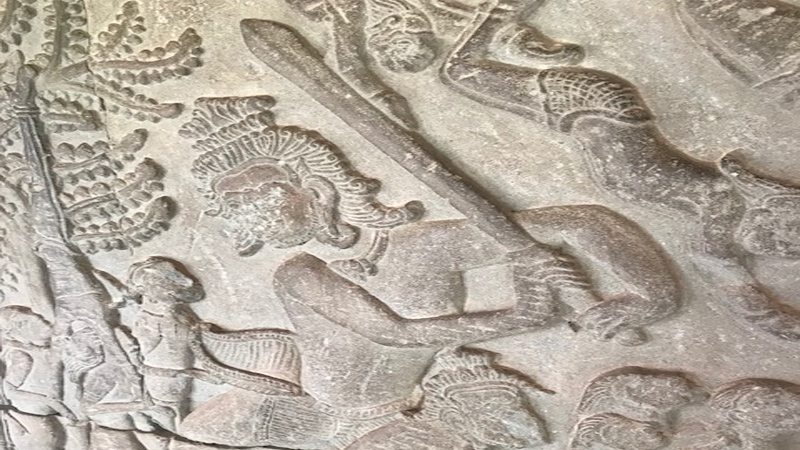
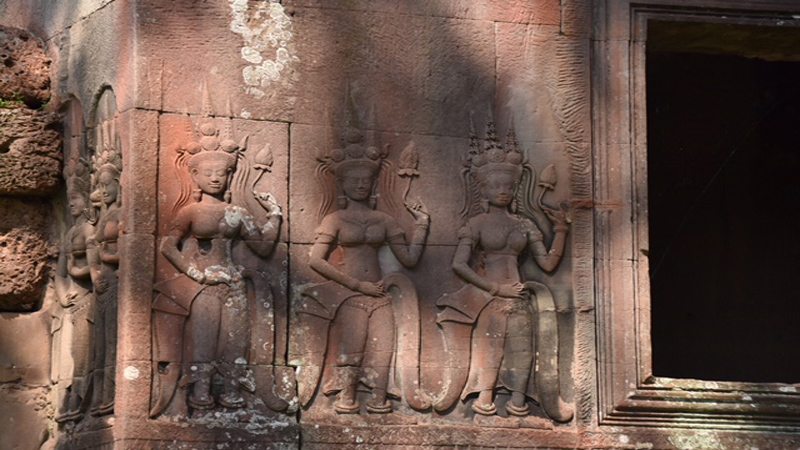
The walls feature extensive bas-relief friezes that run linearly for 600 meters with nearly 2,000 dancers called Apsaras and innumerable devatas narrating episodes from the Hindu epics, Ramayana and Mahabharata.
The highlights include the Battle of Lanka and the Battle of Kurukshetra. There is also a gallery showing King Suryavarman II leading a royal procession, a major battle between the Khmer and enemy forces, and scenes from 32 hells whose ghoulish Dantesque imagery contrasts with blasé scenes from 37 heavens. The Hindu gods live eternally on the temple walls, which are guarded by lions at the gates and protected by giant, often multi-headed nagas (cobras).
 Ancient people from southern India are said to have brought the Hindu religion and the Sanskrit language to Cambodia, belying the myth that there was no India prior to the British Raj. Chinese influences are also visible in the country, which explains why the broader region, which includes Cambodia, Thailand, Laos and Vietnam, is called Indo-China.
Angkor is located near a town called Siem Reap, which means Thailand Defeated, and was the site of a major battle between the two empires.
We also toured two other temples, including one in which large Strangler Fig and Silk-Cotton trees have embedded themselves into the masonry. That one, Ta Prohm, was the site of the film, Tomb Raiders.
At some point, the intense heat and humidity got to me. In the presence of the stone carvings of life and death, I began to feel that I would soon seamlessly pass away into the great beyond. A can of soda water restored my senses.
The Hindu deities were still with me, even after we had exited the sacred grounds. Surprisingly, the temples are not used for worship anymore but I did see a monk in saffron robes praying next to a small fire in one of the open chambers. I asked the guide whether he was real and was told that “we do not have fake monks.” I wondered why Americans were fated to live with a fake monk who was promising greatness in this life.
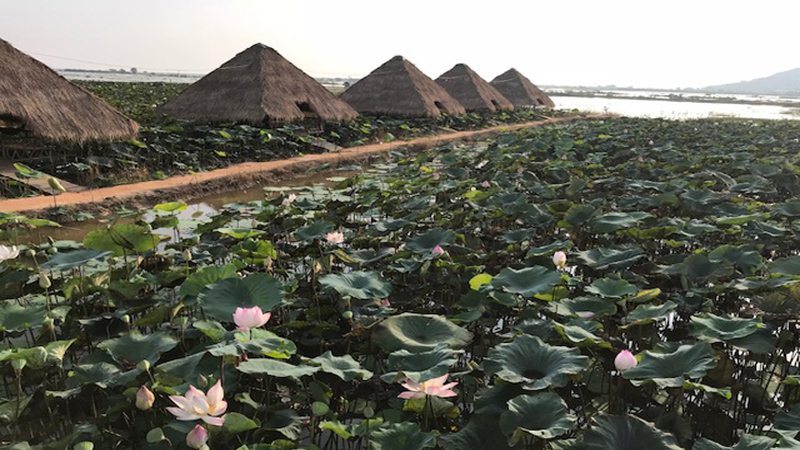
As the afternoon turned into evening, we visited a large Lotus farm which seemed to go on forever. And then we boarded a small boat to see the sunset on Tonle Sap, the largest freshwater lake in Southeast Asia. As the sun descended into the water, it enveloped the entire lake with a surreal glow.
After the sunset, there was a race to get to port. In one of the carvings, warriors who fell off their boat during battle were eaten by the lake’s crocodiles. When we were splashed with the lake’s water by a much bigger boat, crocodiles came to mind.
Along the inlet were small floating houses. In these dwellings, the guide told us that people spent their entire lives, from birth to wedding to death. A small product of one of the weddings was standing in one, waving to us. We waved back and noticed that the child was wearing no clothes.
The floating houses were not connected to the electric grid. They had solar panels on the roof and batteries inside which provided them with power. Mired in poverty, these houses were in some ways further ahead than most houses in America when it comes to green energy.
On the long drive back to the hotel, we talked about the Khmer Rouge, the Vietnam War, Pol Pot, Prince Sihanouk, and Ho Chi Minh’s refusal to give territory back to Cambodia after he had won what in the region is called the American War.
 We also talked how a nation of Buddhists could resort to mass killings of its own people under the Khmer Rouge. I remembered the Dalai Lama saying on TV that Buddhists are not supposed to even kill the insects that land on their arms. I was told, with a wry smile, that Buddhists today just cared about themselves and this life, while still practicing all the rituals of religion, with full knowledge of what that portends for the life in the hereafter. Did this contradiction just haunt the Buddhists, I wondered?
The next day we took atuktuk to tour a silk farm and visited the National Gallery. It is home to a thousand Buddhas, large and small, of stone and of wood. They stood or sat in different ways, and each pose conveyed a different message.
The Sufis tell us that the master appears when the student is ready. As I left the gallery, an inner voice spoke: “If you really want to know how to live a good life, the stones will tell you.”
The author, based in America, has visited 36 countries in 6 continents. [email protected]
Published in Daily Times, November 9th 2017.