 1. Introduction: Strategic Blunder and Scramble for Cover

In the aftermath of Operation Sindoor’s failure, the Modi government finds itself at a political and diplomatic crossroads. What was initially framed by Indian media as a decisive blow to Pakistan has unraveled into a strategic blunder, leaving the BJP-led administration struggling to manage the domestic fallout and international embarrassment.
2. Pahalgam Incident and Political Backlash

The Pahalgam incident, which exposed major security lapses within India’s own borders, became a catalyst for growing public and parliamentary scrutiny. As opposition parties gear up to grill the Modi regime in the upcoming parliamentary session, the government appears cornered. Questions surrounding the efficacy, objectives, and outcomes of Operation Sindoor threaten to pierce the inflated bubble of nationalist triumphalism curated by India’s corporate media, often dubbed as “Godi media.”

3. Operation Mahadev as a Political Diversion
In the midst of this mounting pressure, the Modi government has shifted gears to what appears to be a new diversionary tactic: Operation Mahadev. Billed as a fresh counterterrorism effort, the timing and narrative arc of this operation strongly indicate it may be yet another false flag, designed less for national security and more for public optics. Its real intent seems to be diverting popular attention from the strategic and political failures of the administration

4. The Pattern of Manufactured Spectacles
Conclusion: The Price of Strategic Showmanshi
But how long can a government survive on optics alone? If strategic failures are repeatedly masked by media theatrics, and if real accountability is substituted with manufactured narratives, the consequences could be far graver than electoral losses. They could threaten the very stability of the region.
For India, a mature democracy and aspiring global power, it is time to move beyond performative nationalism and embrace strategic realism. Accepting past miscalculations and reengaging diplomatically with its neighbors may be less glamorous, but it is the only sustainable path forward.

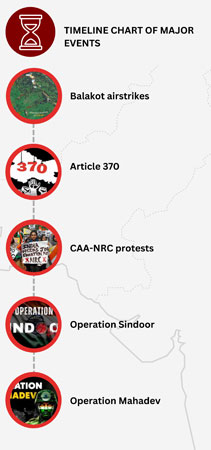
This move, however, is not unprecedented. The current BJP regime has repeatedly turned to national security spectacles to rally domestic support, often ahead of elections or critical political challenges. From Balakot to the revocation of Article 370, high stakes gambits have been deployed to manipulate public sentiment under the guise of patriotism. But this time, the script is fraying.

5. Trump’s Disclosures and Strategic Embarrassment
Adding further complexity is the international dimension. Donald Trump’s repeated claims that he had facilitated behind-the-scenes truces between India and Pakistan have undermined New Delhi’s narrative of strategic strength. If true, these assertions confirm that even as Indian media projected dominance, the reality was one of diplomatic retreat and face saving backchannels

6. Parliament as a Threat to the Myth
More importantly, the parliamentary session ahead could prove decisive in demystifying India’s narrative of victory over Pakistan. It may well reveal that Operation Sindoor, far from being a success, was a calculated gamble that backfired. If the BJP’s political opponents are able to effectively frame this narrative, it would mark a rare instance of accountability in an otherwise tightly controlled information environment.
7. False Flags and Hyper-Nationalism
Operation Mahadev, in this context, is not just a security operation. It is a political maneuver. It signals a government unwilling to admit its errors, choosing instead to inflame regional tensions, distract domestic audiences, and stoke hyper nationalist sentiment to regain lost political capital.