
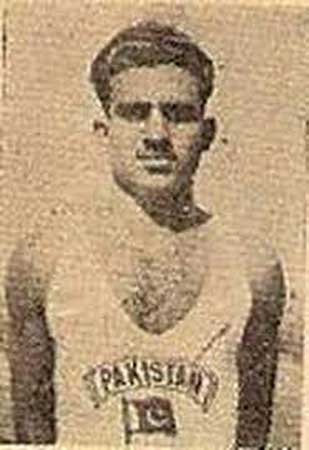
 Pakistan has never won any athletics medal in the Olympics. But Pakistan was a force to be reckoned with at the Asian Games, Commonwealth Games and regional level. Many Pakistan athletes won medals and even held records for many years in these prestigious competitions. No doubt, the 1950s and 1960s were the golden eras of Pakistan athletics. Pakistan produced very good athletes who dominated the Asian athletics scene for a number of years. Abdul Khaliq, also known as ‘The Flying Bird of Asia’, was a Pakistan sprinter who won 100 gold medals in National Games while 26 gold, 23 silver and 15 bronze medals in international events. He competed in 100m, 200m and 4x100m relay races. He participated in the 1956 Melbourne Olympics, 1960 Rome Olympics, 1954 Manila Asian Games and 1958 Tokyo Asian Games. He was among the top seven athletes of the time.
Born in 1933 in Chakwal, a small North Punjab town, Khaliq was fascinated by kabaddi, the traditional sport of rural Punjab. He was a man of medium height but had very strong thighs. His forte was speed and it was extremely difficult to catch him in the kabaddi circle. During those days, Brig CHB Rodham, an Englishman, headed the Pakistan Army Sports Board. Athletics was his first love. Rodham was always on the lookout for talented youngsters. He picked Khaliq from Chakwal’s kabaddi fields and recruited him in the Army. The young soldier immediately showed aptitude for sprints. Progressing through the various tiers of army meets, he was soon the best in the country. In his first appearance in a major international meet, Khaliq astonished everyone –– winning the 100-metre gold at the 1954 Asian Games in a new record time of 10.6 seconds in Manila, Philippines, beating the previous record of 10.8 seconds held by Lavy Pinto of India. This achievement earned him the title of the ‘Fastest Man of Asia’. This performance also forced the chief guest, Indian Prime Minister Jawaharlal Nehru, to declare him ‘The Flying Bird of Asia’.
In the 1958 Asiad in Tokyo, Khaliq retained the 100m crown and thus also the title of the fastest man of the continent. By winning the 100m races at both the 1954 and 1958 Asiads, Khaliq remained the ‘Fastest Man of Asia’ from 1954-1962.
Pakistan’s athletics officials then set their eyes on the 1956 Olympics in Australia. In the intervening years, Khaliq gained much needed experience by participating against the world’s top sprinters. He was at his peak in the Olympics’ year. The first Indo-Pakistan athletics meet was held in New Delhi in March 1956. The highlight of the meet was the ‘Sprint Double’ for Khaliq. In 100 metres, he clocked 10.4 seconds, thus equaling the timings of the gold medallist at the 1952 Olympics. His 21.4 seconds in 200 metres was an Asian record. The Indian media reported: “The country witnessed world class sprinting for the first time.”
The Melbourne Olympics 1956 were Khaliq’s and indeed Pakistan athletics’ finest hour. Athletics have always been the showpiece discipline at the Olympics; and sprints draw special attention. Khaliq got through the first two rounds of the 100m to qualify for the semi-finals where he was narrowly beaten to the 4th place and couldn’t make it to the final. If his show in the shorter sprint got him noticed, Khaliq’s performance in the 200m astounded the world. He made to the semi-finals in a sensational manner, winning both the heats in 21.1 seconds, the best time for 200m at the 1956 Olympics in the first two rounds. The pundits predicted an Olympic medal for the Pakistani dynamo. But luck deserted Khaliq in the semi-final. He couldn’t repeat the form of the previous rounds and finished 4th in a photo finish. Thus he again narrowly missed the qualification for the final. Had he repeated the timings of the first two rounds, he would have won the semi-final because 21.1 seconds was the best time in those Olympics barring the final.
In the 1958 Asiad in Tokyo, Khaliq retained the 100m crown and thus also the title of the fastest man of the continent. By winning the 100m races at both the 1954 and 1958 Asiads, Khaliq remained the ‘Fastest Man of Asia’ from 1954-1962. Khaliq also participated in the World Military Track and Field Championships in 1956 in Berlin, Germany and claimed bronze medals in 100m and 200m events, and in 1957 in the same championships in Athens, Greece, Khaliq lifted silver in 100m. Besides all events mentioned above, Khaliq took part in a number of international athletics meets and won many medals to keep his country’s flag flying high. Khaliq’s peak years were 1954-58. In 1960, he was past his best. Khaliq was among the prisoners of 1971 war and was respected by Indian authorities during his imprisonment. Indian athletics legend Milkha Singh visited Khaliq in the prisoner of war camp. Milkha Singh recalled this meeting with these words: “Tears appeared in the eyes of both.” The then Indian Prime Minister Indira Gandhi even decided to release him but Khaliq refused saying he would like to be released with his countrymen. Khaliq was well-looked after by the Pakistan Army. His achievements on the track earned him out of turn promotions, and he retired in the rank of Honorary Captain ––– the highest a sepoy could get. When the great athlete passed away on 10th March 1988 in Rawalpindi, his family was allotted a house by the Pakistan Army. It is lamentable that our young generation is largely unaware of Pakistan’s sports legends like Khaliq. India has immortalised its legend Milkha Singh by making a movie on his life, but, frankly, we are not such a nation.