• Skip to primary navigation
  • Skip to main content
  • Skip to primary sidebar
  • Skip to footer
Trending:
  • Kashmir
  • Elections
Friday, June 5, 2026

Daily Times

Your right to know

  • HOME
  • Latest
  • Iran-Israel war
  • Gilgit Baltistan Election
  • Pakistan
    • Balochistan
    • Gilgit Baltistan
    • Khyber Pakhtunkhwa
    • Punjab
    • Sindh
  • World
  • Editorials & Opinions
    • Editorials
    • Op-Eds
    • Commentary / Insight
    • Perspectives
    • Cartoons
    • Letters to the Editor
    • Featured
    • Blogs
      • Pakistan
      • World
      • Lifestyle
      • Culture
      • Sports
  • Business
  • Sports
  • E-PAPER
    • Lahore
    • Islamabad
    • Karachi

AFP

China’s rocket segment disintegrates over Indian Ocean

Published on: May 9, 2021 5:31 PM

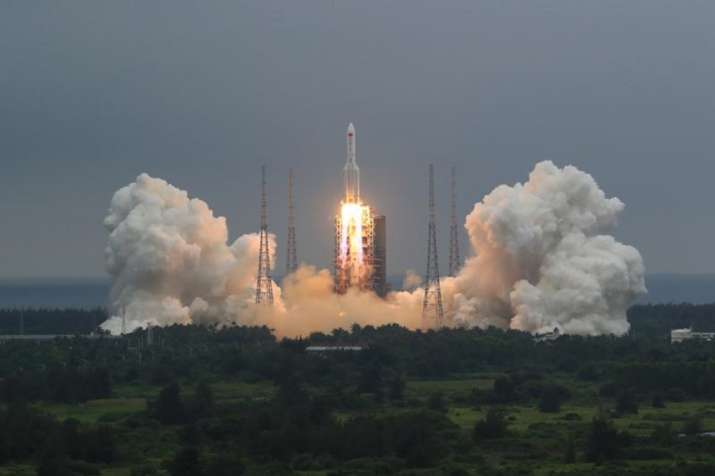
BEIJING: A large segment of a Chinese rocket re-entered the Earth’s atmosphere and disintegrated over the Indian Ocean on Sunday, the Chinese space agency said, following fevered speculation over where the 18-tonne object would come down.

In Beijing, officials had said there was little risk from the freefalling segment of the Long March-5B rocket, which had launched the first module of China’s new space station into Earth orbit on April 29. But the US space agency NASA and some experts said China had behaved irresponsibly, as an uncontrolled re-entry of such a large object risked damage and casualties.

“After monitoring and analysis, at 10:24 (0224 GMT) on May 9, 2021, the last-stage wreckage of the Long March 5B Yao-2 launch vehicle has re-entered the atmosphere,” the China Manned Space Engineering Office said in a statement, providing coordinates for a point in the Indian Ocean near the Maldives.

It said that most of the segment disintegrated and was destroyed during descent. The US military’s Space Command said the rocket re-entered over the Arabian Peninsula at approximately 10:15 pm EDT on May 8 (0215 GMT Sunday). “It is unknown if the debris impacted land or water.”

Monitoring service Space-Track, which uses US military data, said that the location in Saudi Arabia was where American systems last recorded it. “Operators confirm that the rocket actually went into the Indian Ocean north of the Maldives,” it tweeted.

The segment’s descent matched expert predictions that any debris would have splashed down into the ocean, given that 70 percent of the planet is covered by water. Because it was an uncontrolled descent, there was widespread public interest and speculation about where the debris would land.

American and European space authorities were among those tracking the rocket and trying to predict its re-entry. Objects generate immense amounts of heat and friction when they enter the atmosphere, which can cause them to burn up and disintegrate. But larger ones such as the Long March-5B may not be destroyed entirely.

Their wreckage can land on the surface of the planet and may cause damage and casualties, though that risk is low. Last year, debris from another Chinese Long March rocket fell on villages in the Ivory Coast, causing structural damage but no injuries or deaths.

That, and the one that came down Sunday, are tied for the fourth-biggest objects in history to undergo an uncontrolled re-entry, according to data from Harvard-based astronomer Jonathan McDowell. The uncertainty and risks of such a re-entry sparked accusations that Beijing had behaved irresponsibly.

US Defence Secretary Lloyd Austin suggested last week that China had been negligent, and NASA Administrator Bill Nelson echoed that after the re-entry on Sunday. “Spacefaring nations must minimize the risks to people and property on Earth of re-entries of space objects and maximize transparency regarding those operations,” Nelson said in a statement.

“It is clear that China is failing to meet responsible standards regarding their space debris.” To avoid such scenarios, some experts have recommended a redesign of the Long March-5B rocket — which is not equipped for a controlled descent. “An ocean reentry was always statistically the most likely,” McDowell tweeted.

“It appears China won its gamble (unless we get news of debris in the Maldives). But it was still reckless.” Chinese authorities had downplayed the risk, however. “The probability of causing harm to aviation activities or (on people and activities) on the ground is extremely low,” foreign ministry spokesman Wang Wenbin said Friday.

Beijing has poured billions of dollars into space exploration to boost its global stature and technological might. The launch of the first module of its space station – by the Long March rocket that came down Sunday – was a milestone in its ambitious plan to establish a permanent human presence in space.

Filed Under: International, World Tagged With: Beijing, China, china rocket, Indian Ocean, rocket

Submit a Comment


Primary Sidebar


Latest News

Oil falls on hopes of broader peace after Lebanon, Israel halt fighting

Meat exports grow by 4.16%

SBP-held foreign reserves rise by $43m to $17.9bn

Gold prices up by Rs 1,523 per tola

Rupee strengthens against dollar

Pakistan

Bilawal seeks heavy public mandate to protect GB’s rights

PM directs pilot launch of automated tax collection system in Islamabad

Federal budget on June 10

PM hails special ties with Washington at event marking US 250th anniversary

FO rubbishes reports of Dar sharing Iran nuclear information with Rubio

More Posts from this Category

Business

Pakistan’s exports to US up by 1.70% to $5.12bn in 10 months

Pakistan, Tajikistan set $200 million trade target, deepen ties at 8th JCM

Services’ exports up by 17.68% to $8.26bn

OGDCL’s new wells deliver record oil, gas output in FY26

Buying returns as PSX gains nearly 1,000 points

More Posts from this Category

World

No sign of progress in US-Iran talks as Hezbollah rejects truce

Vast accelerates race to replace ISS

Gulf crisis drives India-Venezuela oil partnership

More Posts from this Category


Footer

Home
Lead Stories
Latest News
Editor’s Picks

Culture
Life & Style
Featured
Videos

Editorials
OP-EDS
Commentary
Advertise

Cartoons
Letters
Blogs
Privacy Policy

Contact
Company’s Financials
Investor Information
Terms & Conditions

Facebook
Twitter
Instagram
Youtube

© 2026 Daily Times. All rights reserved.

Manage Consent
To provide the best experiences, we use technologies like cookies to store and/or access device information. Consenting to these technologies will allow us to process data such as browsing behavior or unique IDs on this site. Not consenting or withdrawing consent, may adversely affect certain features and functions.
Functional Always active
The technical storage or access is strictly necessary for the legitimate purpose of enabling the use of a specific service explicitly requested by the subscriber or user, or for the sole purpose of carrying out the transmission of a communication over an electronic communications network.
Preferences
The technical storage or access is necessary for the legitimate purpose of storing preferences that are not requested by the subscriber or user.
Statistics
The technical storage or access that is used exclusively for statistical purposes. The technical storage or access that is used exclusively for anonymous statistical purposes. Without a subpoena, voluntary compliance on the part of your Internet Service Provider, or additional records from a third party, information stored or retrieved for this purpose alone cannot usually be used to identify you.
Marketing
The technical storage or access is required to create user profiles to send advertising, or to track the user on a website or across several websites for similar marketing purposes.
  • Manage options
  • Manage services
  • Manage {vendor_count} vendors
  • Read more about these purposes
View preferences
  • {title}
  • {title}
  • {title}
We use cookies to ensure that we give you the best experience on our website. If you continue to use this site we will assume that you are happy with it.