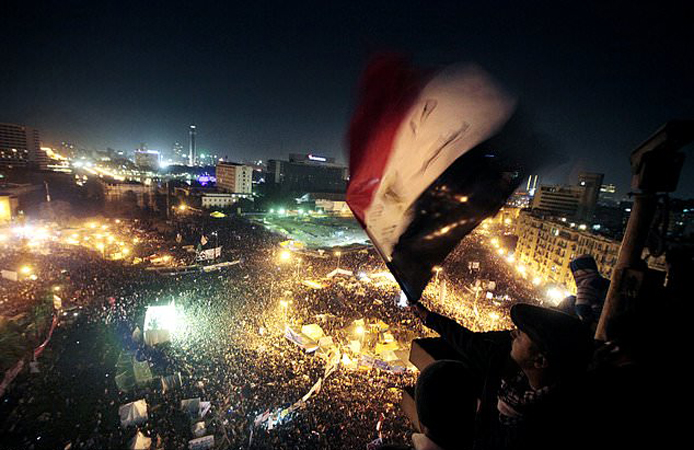
 The Egyptians who took to the streets on Jan. 25, 2011, knew what they were doing. They knew they risked arrest and worse. But as their numbers swelled in Cairo’s central Tahrir Square, they tasted success.
Police forces backed off, and within days, former President Hosni Mubarak agreed to demands to step down.
But events didn’t turn out the way many of the protesters envisioned. A decade later, thousands are estimated to have fled abroad to escape the government of President Abdel Fattah el-Sissi that is considered even more oppressive. The significant loss of academics, artists, journalists and other intellectuals has, along with a climate of fear, hobbled any political opposition.
Dr. Mohamed Aboelgheit was among those jailed in the southern city of Assiut in 2011 after joining calls for revolt against police brutality and Mubarak. He spent part of the uprising in a cramped cell.
Released amid the chaos, he reveled in the atmosphere of political freedom in the Arab world´s most populous country – protesting, working as a journalist and joining a campaign for a moderate presidential candidate. But it did not last.
Interim military rulers followed Mubarak. In 2012, Mohamed Morsi, a member of Egypt´s most powerful Islamist group, the Muslim Brotherhood, was elected as the first civilian president in the country´s history. But his tenure proved divisive. Amid massive protests, the military – led by then-Defense Minister el-Sissi – removed Morsi in 2013, dissolved parliament and eventually banned the Brotherhood as a “terrorist group.” A crackdown on dissent ensued, and el-Sissi won two terms in elections that human rights groups criticized as undemocratic.
“I began to feel, by degree, more fear and threats,” Aboelgheit said. Friends were jailed, his writings critical of the government drew attention, and “I wasn´t going to wait until it happened to me,” he added.
After el-Sissi came to power, Aboelgheit left for London, where he’s published investigative reports on other parts of the Arab world.
At his former home in Egypt, national security agents asked about him. When Aboelgheit´s wife last returned to visit relatives, she was summoned for questioning about his activities. The message was clear.
No one knows exactly how many Egyptians like Aboelgheit have fled political persecution.
Data from the World Bank shows an increase in emigres from Egypt since 2011. A total of 3,444,832 left in 2017 – nearly 60,000 more than in 2013, the years for which figures are available. But it´s impossible to tell economic migrants from political exiles.
They relocated to Berlin, Paris and London. Egyptians also have settled in Turkey, Qatar, Sudan and even Asian countries like Malaysia and South Korea.
Human Rights Watch estimated in 2019 that there were 60,000 political prisoners in Egypt. The Committee to Protect Journalists ranks Egypt third, behind China and Turkey, in detaining journalists.
El-Sissi maintains Egypt has no political prisoners. The arrest of a journalist or a rights worker makes news roughly every month. Many people have been imprisoned on terrorism charges, for breaking a ban on protests or for disseminating false news. Others remain in indefinite pretrial detentions. El-Sissi maintains Egypt is holding back Islamic extremism so it doesn’t descend into chaos like its neighbors. “Sissi wants not only to abrogate the rights of the opposition and to prevent any critical voice from being uttered, Sissi doesn´t actually believe, not only in the opposition, but he doesn´t believe in politics,” said Khaled Fahmy, an Egyptian professor of modern Middle Eastern History at Cambridge University Fahmy believes this is the worst period in Egypt´s modern history for personal rights.
“It´s much more serious, it´s much deeper and much darker, what Sissi has in mind,” he said.
Those abroad who could challenge el-Sissi have chosen to not return. Taqadum al-Khatib, an academic who also worked in the nascent political scene after 2011, was researching Egypt´s former Jewish community in Germany when he learned that returning to his homeland was no longer an option.
The Egyptian cultural attaché in Berlin summoned al-Khatib for a meeting, and an official questioned him about his articles, social media posts and research. He was asked to hand over his passport but refused. Shortly thereafter, he was fired from his job at an Egyptian university. He feels lucky to be able to work toward his doctorate in Germany but misses Cairo´s bustle.
“It´s a very difficult situation. I couldn´t go back to my home,” al-Khatib said.
Fahmy said he´s seen outspoken expatriates have their Egyptian citizenship revoked.
A government press officer did not respond to a request for comment on targeting and intimidating Egyptians – either abroad or at home – based on their work as journalists, activists or academics, or for expressing political opinions. Journalist Asma Khatib, 29, remembers the heady days of 2011, when young people thought they could bring change. A reporter for a pro-Muslim Brotherhood news agency, Khatib covered Morsi´s short presidency amid criticism the group was using violence against opponents and seeking to monopolize power to make Egypt an Islamic state. After Morsi’s ouster, his supporters held sit-ins for his reinstatement at a square in Cairo. A month later, the new military leaders forcibly cleared them out, and more than 600 people were killed.