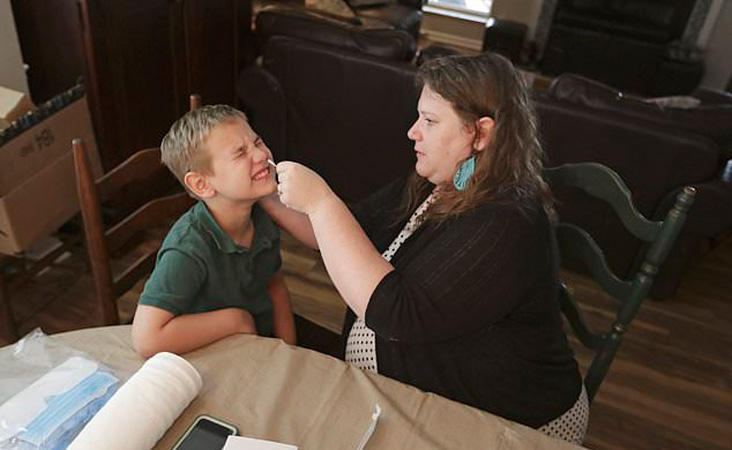
 In a comfy suburb just outside Nashville, a young family swabs their noses twice a month in a DIY study seeking answers to some of the most vexing questions about the coronavirus.
How many U.S. children and teens are infected? How many kids who are infected show no symptoms? How likely are they to spread it to other kids and adults?
“The bottom line is we just don´t know yet the degree to which children can transmit the virus,” said Dr. Tina Hartert of Vanderbilt University, who is leading the government-funded study.
Evidence from the U.S., China and Europe shows children are less likely to become infected with the virus than adults and also less likely to become seriously ill when they do get sick. There is also data suggesting that young children don´t spread the virus very often but that kids aged 10 and up may spread it just as easily as adults. The new study aims to find more solid proof.
“If we don´t see significant transmission within households, that would be very reassuring,” Hartert said.
Some 2,000 families in 11 U.S. cities are enrolled in the DIY experiment, pulled from participants in previous government research. In all, that’s 6,000 people. They have no in-person contact with researchers. Testing supplies are mailed to their homes.
They collect their own nasal swabs for COVID-19 tests, and less often blood and stool samples. The specimens are mailed to the study organizers. Participants get text messages asking about symptoms and reminding them to test and they fill out questionnaires.
The study could help determine the safety of in-class education during the pandemic. But results aren´t expected before year´s end.
For Mendy and Joe McNulty and their two youngest sons in Mt. Juliet, Tennessee, nasal swabbing at home is a family affair. Testing supplies are spread out on a carefully wiped down kitchen counter, where the four gather to perform what has become a ritual. Mendy McNulty helps the boys with their swabbing.
“We were excited to be able to feel like we could contribute somehow,” she said, explaining why the family chose to participate. “This virus is so unknown. Any little bit we can do felt like we were doing something to help.”
It´s hard to pin down the exact number of COVID-19 cases in kids. The Centers for Disease Control and Prevention says at least 175,000 cases have been confirmed in those aged 17 and under, accounting for less than 10% of all confirmed cases. But the true number is likely much higher because many kids have silent infections or only vague symptoms and don´t get tested.
Data on kids and coronavirus spread is also murky. Hundreds of infections have been reported in children and staff members at U.S. day care centers, but whether kids or adults were the main spreaders isn´t known.
The family study is also investigating whether children with asthma or allergies might have some protection against COVID-19. Anecdotal evidence suggests they might but “we don´t know what the mechanism of that might be,” said Dr. Anthony Fauci, director of the National Institute of Allergy and Infectious Diseases. The institute is paying for the research.
As a mom, former school teacher and scientist, Hartert is anxious to help fill in the gaps. She acknowledges it´s possible that none of the families will get infected, but given the number of COVID-19 cases around the country, she says that´s highly unlikely.
Mendy McNulty says so far her family has remained healthy. She and her husband are both 39 and don´t feel overly worried about getting infected.
She’s interested in what happens when her kids return to school in mid-August – two classroom days a week with masks and social distancing, three days online.
“Schools are like little petri dishes anyway,” said McNulty, also a former teacher.
“I am prepared to bring everyone home” if outbreaks occur, she said.
The boys – 7-year-old Andrew and 9-year-old Hudson – were excited to take part in the study, McNulty said. She helps them do the nose swabbing, and they both say it doesn´t really hurt. “Sometimes it tickles,” Andrew said. Other times, “it feels like she´s sticking it up super far.”
Dr. David Kimberlin says he and other infectious disease specialists have been waiting for the kind of data the study will provide.
“Generally speaking, the virus behaves differently in children than adults,” said Kimberlin, a pediatrics professor at the University of Alabama at Birmingham. “Why is that? We just need to know so much more.”