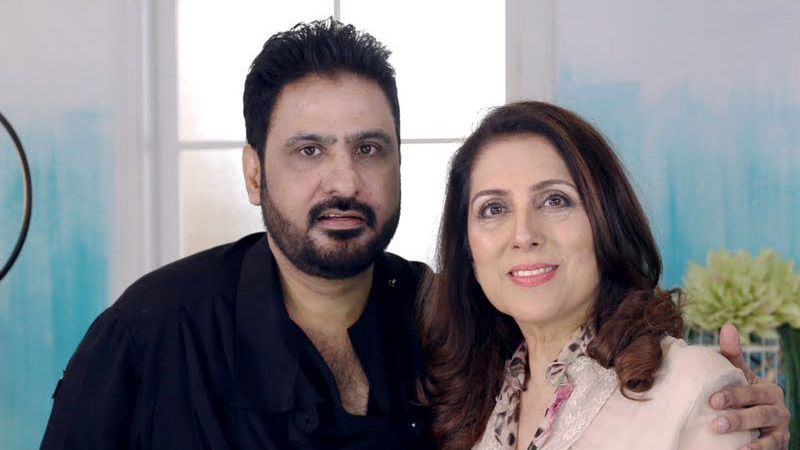
 Faseeh Bari Khan is a Pakistani drama and film writer who might have been criticised for his bold portrayal of social issues, but whose command over a refined usage of Urdu is appreciated by everyone.
Faseeh Bari Khan is known for having worked in a lot of genres, be it telefilms, serials, short films or full-length feature films, directed by various directors but his collaboration with Mazhar Moin has produced the most successful of his works. Lately, the writer has also acted as the content head of Bol Entertainment and has endeavoured to keep the continuation of quality work intact.
How did all of it begin for you?
My mother had a taste for canonical Urdu literature and under her upbringing, I had learnt to appreciate classical writers like Ismat Chughtai, Rajinder Singh Bedi, Manto, Ghulam Abbas and Quratulain Haider. Children stories would never inspire me. Then in 7th grade, I wrote a short story myself titled Kawwe ka Raag based on the unpredictable nature of love, its setting being a quiet, deserted railway station. I grew very excited after having written it but did not know which person to consult. At that point in time, a very senior journalist named Sheen Farrukh would write a column titled Nafsiyaati Uljhanein and people would send her their psychological issues. I sent her my story, also clarifying that it’s not exactly a problem but a story on the basis of which I would like to know if I’m capable of writing or not. A week after that, she responded and asked me to meet her in her office in Karachi. She encouraged me a lot and gave me a few advices as well, asking me to read other writers and observe the people around me.
‘Whatever topic you are tackling or whichever issue you are presenting, you should present all of its details and aspects. I don’t consider myself in a position to say that people can learn something from my dramas. People forcefully try to extract moral lessons from everything, but that does not necessarily have to be done every time’
I also wrote for her magazine Mashriq for quite a few years, reviewing classical films and serials from all over the world. When I was in first year, I was asked by a friend to visit an Iranian hotel where literati would gather and sessions on literary works would take place. I read another story of mine over there and was appreciated a lot. As every youngster does, I then formed a theatre group along with my college fellows and penned a lot of theatrical works before writing for television. Syed Atif Hussain would accompany me in theatre and when he made his first television project named ‘Jab Koi Doosra Nahi Hota’. I wrote the script for it. Yasir Nawaz, who was one of the performers in that play, also asked me to write a script for him, hence his debut dramatic work titled ‘Jaadu’ was written by me. Tazeen Hussain, who acted in the play made me meet her father, Talat Hussain who was also running a production house back then. He also encouraged me a lot and I worked with him. Rubina Ashraf was also one of such supportive people, who performed in my first serial ‘Ab Yeh Mumkin Nahi’. I was lucky enough to come across one encouraging person after another and I kept receiving work. However, my first commercial project which brought me into the limelight was ‘Khala Qulsum Ka Kumba’.
Where does the boldness in your writings come from?
I believe in Mumtaz Mufti’s statement that people write for their own selves. And I feel the same, otherwise I would also have been writing eight to ten serials in a year. At times, I am criticized so much that I feel as if I write porn films, but I do not believe in sugar-coating taboos. Reality should be depicted as it is, without any philosophy. I used to get upset at the negative criticism before but I don’t care about it anymore. I have accepted my works as belonging to my characteristic genre. When a doctor tells you about a disease you are suffering from, he or she would never present it in a subtle manner. Subtlety is of no use if you are not able to convey your message as a writer.
 Do you believe in writers being social workers, who have to create awareness and bring a change in society?
It depends on the topic you are writing. Whatever topic you are tackling or whichever issue you are presenting, you should present all of its details and aspects. I don’t consider myself in a position to say that people can learn something from my dramas. People forcefully try to extract moral lessons from everything, but that does not necessarily have to be done every time.
Have you ever thought of deviating from your characteristic style of presenting stories?
I have written entirely different stuff, such as “Chaal” directed by Mehreen Jabbar, or “Kitna Sataate Ho”, a soft romantic serial. But works in which I have deviated from my signature style have not attained much success. If people have started to recognise your work, it is something commendable. It means that you have established yourself as someone unique and successful in your own area. So, it’s not necessary that you have to move out of your zone, even when it comes to your writing style, only to satisfy people or make them believe that you are versatile.
Faseeh Bari Khan’s latest project has been ‘Mohini Mansion Ki Cinderellayen’, a mega serial shot in the alleys of Lahore and directed by Ali Tahir, casting top-notch actors such as Shabnam, Faryal Gauhar, Naeem Tahir, Yasmin Tahir, Qavi Khan, Nirvan Nadeem, Rabiya Chaudhry and many others.
The writer is a freelance journalist and can be reached at [email protected]