 Solid waste production is one of the biggest challenges not only for a developing country but also for the developed world. In Pakistan, about 48.5 million tons of solid waste is produced annually, and it is increasing more than two percent every year. This is the waste that we are throwing or littering on roads, streets and buildings, and are giving to waste collectors and vendors. Vendors collect and throw it in open dumps. It is recycled, segregated, reused, or reduced.
The government of Pakistan estimates that tons of solid waste is generated per year, mostly in the major metropolitan cities of Pakistan, but rural areas are also not an exception. Karachi is producing 9,900 tons of solid waste, Lahore 7,510 tons, Rawalpindi 4,400 tons, Peshawar 2,000, and Quetta 700 tons per year. If we analyses this issue in developed metropolitan cities of the world, they segregate and recycle waste. Western countries segregate the waste on ground zero. In a house, industry, mall, or markets they segregate the solid waste in four to six categories. Different colour dustbins or drums are placed outside a market, shop or building. People throw glass in one dustbin, vegetable waste in another, metal waste in the third one, and so on. This is the material that can be recycled, reused or disposed off properly. For example, vegetables and other household waste are reused as a fertilizer.
The recycling economy can also be promoted in Pakistan. Two years ago, Department of Sociology, Quaid-e-Azam University, Islamabad, conducted a study on scavengers’ role in nature conservation. In this study, it was found that waste collectors earn a livelihood through recycling business in Islamabad in the absence of a regular employment. According to the study, 55 percent respondents reported that they earn Rs 10,000 to 25,000. It was a kind of self-employment for them. The one who collects all kinds of recycle-able material is called a koray wala. The earning of akabaria (scrap-seller) is in a higher range, from two to three hundred thousand to half a million rupees per month, in rare cases. On an average, they earn one to three hundred thousand rupees per month in Islamabad.
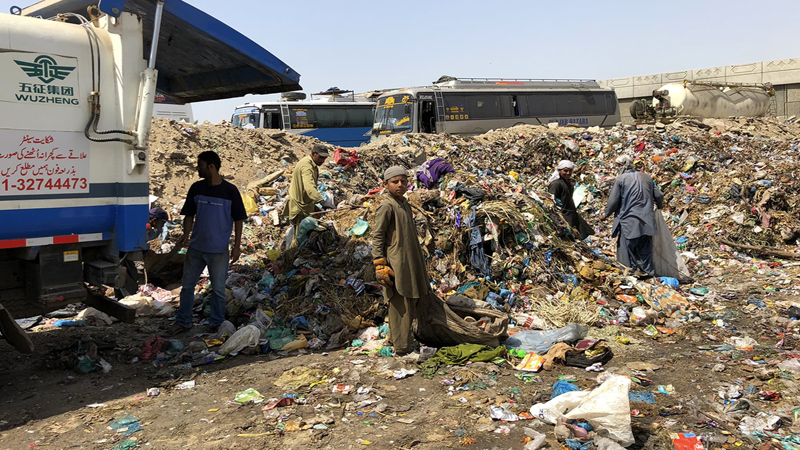
These scavengers contribute in two ways. One, waste collectors earn money for their livelihood. Second, they contribute in conservation of nature. However, scavengers who are in ground zero waste collection in Islamabad are in a bad condition. They have health problems because of exposure to various hazardous things. They face perils that affect their daily life, and they have communicable diseases, poor lifestyle and unhygienic food.
In Pakistan, about 48.5 million tons of solid waste is produced annually, and it is increasing more than two percent every year
If government considers them productive contributors to nature conservation, they should be given some basic aids: gloves, uniforms and masks. The municipal administration should be trained to train them as to how to recycle, reuse, and manage the waste material. They should be trained in order to collect the waste because when they collect the waste, at times, they consume some of the things that are available on a dump site. Some of them eat food that is stale and full of germs.
Disposal of waste is a huge issue. It is the responsibility of the government to first ban plastic production in the country. Islamabad’s ban on plastic bags is an excellent start, but it should be implemented throughout Pakistan. Second, it is also the responsibility of the government to provide dustbins and bags in order to collect the waste on ground zero, and then recycle it.
Government should start a big campaign against solid waste production. This campaign should be focused on promotion of reuse of the waste. Consumption of the waste material or its proper disposal is another step. It is the responsibility of the government, especially the municipality, to formulate a policy about recyclable material.
It is also important to know that all city governments have territories. One is the municipality territory in which the municipal administration collects the waste. For example in Islamabad, urban slums are not under the Capital Development Authority. Resultantly, waste material is thrown in streets and streams. Clean water is polluted with solid waste material in urban slums, one reason being nobody owns it. A lot of plastic stuff, metal and glass are dumped in the Simli and Rawal Dam near Islamabad. These dams are full of plastic material, and plastic material is consumed by marine life.
What goes around comes around. This is true in terms of waste production and consumption. Once we produce waste and throw it away, we think we will never consume it again, and that is untrue. Marine life and animals consume waste. Humans eat fish and meat of a few animals. This is the way we consume waste; the nitrogen cycle cannot be neglected. It is high time that government acted in order to save our environment, and conserve the nature for our future generations.
The writer is associate professor of sociology at Quaid-i-Azam University Islamabad