• Skip to primary navigation
  • Skip to main content
  • Skip to primary sidebar
  • Skip to footer
Trending:
  • Kashmir
  • Elections
Thursday, July 2, 2026

Daily Times

Your right to know

  • HOME
  • Latest
  • Iran-Israel war
  • Gilgit Baltistan Election
  • Pakistan
    • Balochistan
    • Gilgit Baltistan
    • Khyber Pakhtunkhwa
    • Punjab
    • Sindh
  • World
  • Editorials & Opinions
    • Editorials
    • Op-Eds
    • Commentary / Insight
    • Perspectives
    • Cartoons
    • Letters to the Editor
    • Featured
    • Blogs
      • Pakistan
      • World
      • Lifestyle
      • Culture
      • Sports
  • Business
  • Sports
  • E-PAPER
    • Lahore
    • Islamabad
    • Karachi

Agencies

Something fishy: study alleges fraud in US seafood labeling

Published on: March 8, 2019 10:38 PM

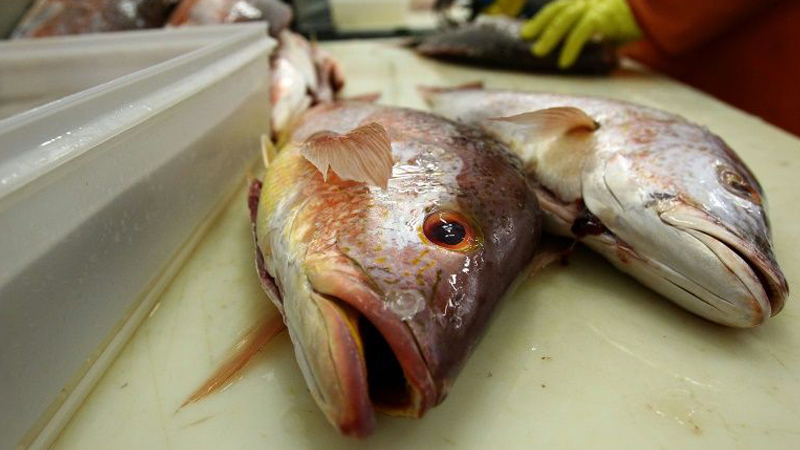
One in five fish sold in America may be mislabeled, according to a report Thursday by an NGO that tested samples from several hundred markets and restaurants and alleged fraud runs through the entire fisheries supply chain.

The NGO Oceana said it analyzed the DNA of 449 fish purchased from March to August 2018 in half of the US states and found that 94 were incorrectly labeled. That comes out to 21 percent.

Oceana said it looked at species which for the past year have not been covered by a limited tracing program implemented by US authorities. The tracing program covers species such as salmon, cod, blue crab and grouper, which a previous Oceana study had shown were also subject to a high level of mislabeling.

The study said that the more expensive the fish, the more often it is labeled incorrectly.

For instance, more than half of fish labeled as sea bass, which is a large category featuring 21 species, were really something else, said Oceana.

Sometimes it was actually palmetto bass or giant perch. Or in the case of one unnamed restaurant in Washington, DC, the fish was really Nile tilapia, which is much cheaper than sea bass.

Snapper was also often misrepresented as Nile tilapia, flounder or rockfish.

Conservationists say this misinformation is important because naming fish properly is key to identifying ones that are in danger of extinction.

Many fish presented as Pacific or Alaskan halibut were actually Atlantic halibut, the stocks of which are endangered. The latter is on the red list of the International Union for the Conservation of Nature.

The same applies to Chilean sea bass, which are often sold simply as sea bass and are actually a large ocean species from cold southern or Antarctic waters and are being overfished, said Oceana.

‘Government needs to do more’

Vendors thus cash in on people’s desire to eat local fish, the study said.

Restaurants and small shops including fishmongers commit more fraud than big supermarkets because the latter are subject to stricter rules on how they market fish imports.

“It’s clear that seafood fraud continues to be a problem in the US, and our government needs to do more to tackle this once and for all,” said Beth Lowell, Oceana’s deputy vice president of US campaigns.

The organization recommends establishing a rule that all fish sold in the US be traceable. Now, only 13 imported species are subject to this requirement.

It also wants to do away with generic categories such as sea bass, which covers widely different species that varying conservation rules.

“Many consumers want to know what species it is, where it was caught and what kind of gear was used to catch it, to make a sustainable choice,” Kimberly Warner, the report’s author and senior scientist at Oceana, told AFP.

Europe requires the area of provenance of any fish to be written on labels, which must indicate the exact species.

“It shows that it is possible,” Daniel Pauly, professor of fisheries at the University of British Columbia, told AFP.

The expert, who is a member of Oceana’s board of directors, also envisions a portable detector to identify fish by DNA.

The samples used in the Oceana study were analyzed by the Canadian Centre for DNA Barcoding at the University of Guelph. “Fish are easy to identify genetically,” said Pauly.

“If legislation required the identification of fish by their scientific name, it would create demand” for developing portable technology, he said.

Filed Under: Infotainment

Submit a Comment


Primary Sidebar


Latest News

Knesset advances bill to ban Muslim call to prayer through loudspeakers at mosques

Diljit Dosanjh recalls performing for Rs5,000

UAE bans social media accounts for children under 15

Pakistan, Saudi Arabia signed an MoU to build cricket stadium

Government raises carbon tax on petrol, diesel

Pakistan

Pakistan, Saudi Arabia signed an MoU to build cricket stadium

Maryam, Punjab speaker meet to ease tensions

US, Iran enter tech talks to secure peace deal, shipping restart

Pakistan gives the lie to India’s remarks on terror strikes along Afghan border

Pakistan urges India to release 97 prisoners during exchange of lists

More Posts from this Category

Business

Pakistan eyes fully Shariah-compliant financial sector from 2028

Pakistan buys spot LNG cargo fearing disruptions over renewed ME tension

Gold prices dip by Rs 5,200 per tola

PSX rises by over 2% on back of bullish momentum

SECP unveils Pakistan’s first ESG mutual funds framework

More Posts from this Category

World

Knesset advances bill to ban Muslim call to prayer through loudspeakers at mosques

UAE bans social media accounts for children under 15

Iran, US talks to resume after Khamenei funeral

More Posts from this Category


Footer

Home
Lead Stories
Latest News
Editor’s Picks

Culture
Life & Style
Featured
Videos

Editorials
OP-EDS
Commentary
Advertise

Cartoons
Letters
Blogs
Privacy Policy

Contact
Company’s Financials
Investor Information
Terms & Conditions

Facebook
Twitter
Instagram
Youtube

© 2026 Daily Times. All rights reserved.

Manage Consent
To provide the best experiences, we use technologies like cookies to store and/or access device information. Consenting to these technologies will allow us to process data such as browsing behavior or unique IDs on this site. Not consenting or withdrawing consent, may adversely affect certain features and functions.
Functional Always active
The technical storage or access is strictly necessary for the legitimate purpose of enabling the use of a specific service explicitly requested by the subscriber or user, or for the sole purpose of carrying out the transmission of a communication over an electronic communications network.
Preferences
The technical storage or access is necessary for the legitimate purpose of storing preferences that are not requested by the subscriber or user.
Statistics
The technical storage or access that is used exclusively for statistical purposes. The technical storage or access that is used exclusively for anonymous statistical purposes. Without a subpoena, voluntary compliance on the part of your Internet Service Provider, or additional records from a third party, information stored or retrieved for this purpose alone cannot usually be used to identify you.
Marketing
The technical storage or access is required to create user profiles to send advertising, or to track the user on a website or across several websites for similar marketing purposes.
  • Manage options
  • Manage services
  • Manage {vendor_count} vendors
  • Read more about these purposes
View preferences
  • {title}
  • {title}
  • {title}