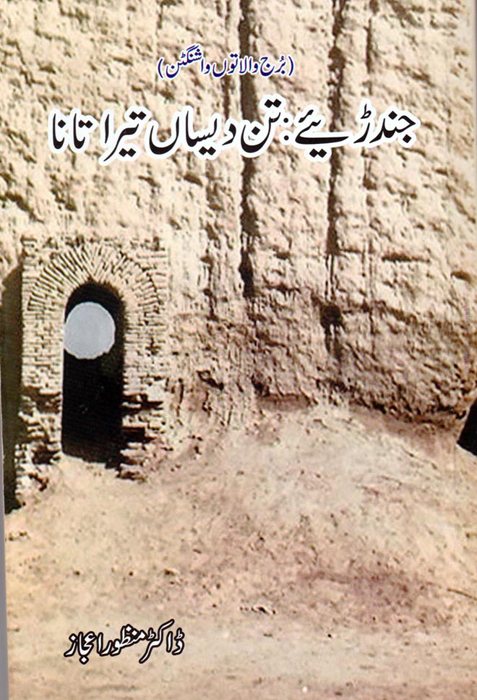
Dr Manzur Ejaz is a poet, writer, columnist, singer and a crusader of Punjabi. He has a number of books to his credit including Waris Nama, Ranjan Yar, Nazamaan, My People My Thoughts and Epistemics of Development Economics. He delivers lectures on YouTube via Wichaar Webcast. He is also an economist. In the 1980s, he settled in the United States and is a member of the Democratic Party. It’s a very difficult and a delicate duty to review the autobiography of a comrade who has also mentioned ones name in some parts of his book but at the same time, it’s easier because one is witness to a number of events and instances, so one has to be doubly cautious, conscious and very objective in his approach. The autobiography of Dr Manzur Ejaz is in fact socio-economic and a political history of Pakistan. The book under review is divided in 16 chapters. It covers creation of Pakistan and author to the present. So it’s a saga of more than 70 years of the struggle of a polio victim. In this book, he has shown that any physical handicap is in no way a hurdle or a handicap in one’s life if one is determined to achieve his goal. He started going on cycle with one leg to school. He has depicted and recounted the village life in minute detail. There are many modern critics of Marx thesis ‘Asiatic mode of production’ but he claims that his village, like other villages of India were self sufficient. The first chapter details his early childhood and schooling and the milieu of his village life that may seem like a dream or a fantasy to a student living today in a city. Village life is presented and portrayed in such an excellent way that it may be called a short story instead of just a chapter. People of all faiths and sects lived peacefully and rituals of birth and marriage were the same. In this autobiography, the author although has given minute details of different aspects of his life but chooses to be silent about his very personal matters. When I first met the author, he was Manzur Yaas. The author has been a good student that is why he won scholarships for studies. He was also the editor of his college magazine. He even got some money from university for appearing in MA Philosophy in Urdu. He has also shared in detail how from a sympathiser of Islami Jamiat-e-Talaba, he became a Marxist. The ’60s inspired youth; allured and pulled them towards revolution and national liberation struggles. US imperialism was facing defeat at the hand of Vietnamese; freedom fighter and former colonies were waging war for liberation. Manzur has rightly pointed out that revolutionary youth of that time sincerely and seriously believed that ‘Revolution was waiting outside River Ravi.’ He has also dealt with evolution and organisation of the left group in university. Dr Azizul Haq and Professor Azizuddin would take study circles. He has also mentioned visit of an American cultural troupe invited by Shahid Mehmud Nadeem where he raised anti American slogans. He was saved with the timely intervention of Palestinian students. He recalled it as his first political activity. The Army chaps are strange fellows particularly when there is martial law or military rule. He along with his comrade Shujahul Haq faced military court twice. Once he was accused of hoisting a red flag on the top of the 100-feet high Faisal Auditorium of Punjab University. He was spared when presiding military officer saw a physically handicapped person who could not even walk without the help of his wooden crutches. After completing his Masters in Philosophy, he got a teaching job in his old department where there were eight boys and 35 girls. He was one of the founders of the Nationalist Students Organisation (NSO). He has rightly eulogised the stand of Dr Aziz against East Pakistan military action which caused a split in NSO. He has also thrown light on the Young People’s Front and what fate it met after the murder of Dr Aziz by Rabia Sumbal’s husband. He once opened a bookshop by the name of Punjabi Adbi Markaz at Mozang, Lahore which not only published some very good progressive literature but was also a hub of progressive workers. He was a culturally conscious bird with left political commitment. He was dedicated to the cause of Punjabi language and did everything possible to promote Punjabi. He once got admission in the Punjabi Department of Oriental College. As a student, he would regularly attend meetings of Halqa Arbab e Zauq and Punjabi Adbi Sangat at Young Men’s Christian Association. He met legendary figure of Najam Hussain Syed in Punjabi Adbi Sangat which turned into a lifelong friendship. He acknowledges help rendered by a couple in rainy days. He has pointed out that former president General Yahya Khan patronised religious extremist forces in Pakistan through General Sher Ali. Professor Eric Cyprian, Professor Manzur and Professor Amin Mughal were dismissed from Islamia College who later on established the Shah Hussain College. On page 60, he alleges that Zulfikar Ali Bhutto never said, “Udhar tum idher hum”. It was a fig of imagination of journalist Abbas Athar. The fact is that apologists of Pakistan People’s Party wrongly blamed the journalist. ZA Bhutto delivered a very lengthy and long speech and supported his claim with history of India and claim of Muslim League’s demand for division of India. It may not be out of context to mention that Maoist Professors’ group distributed a leaflet stating, “Six points for East Pakistan and socialism for West Pakistan.” He established Punjabi Sangat at New Campus but when the university authorities did not allow them to hold meetings at the campus, they shifted to the house of Najam Hussain Syed, on Jail Road. They also started publishing Punjabi magazine Rut Lekha. Folk singer Pathanay Khan would stay with him at a hostel. He revealed on page 176 that six months before the actual coup of former president General Pervez Musharraf took place, Omer Asghar was quietly recruiting talent for him. He did not sit idle in the US. He took many initiatives for the promotion of Punjabi, including APNA, Wichaar Sangat, Democratic and Justice Committee as well as Movement for the Restoration of Democracy. He acknowledges favours done by a number of friends who helped him as a person and the cause of Punjabi. He is well travelled and says the best city in the world is Tokyo. He is a keen observer of the changes brought by the capitalist and technology development in rural Punjab by globalisation. It became difficult for him to recognise his own house in his village. In the last chapter, he has presented a summary of his observations in 15 points. Being a resident of the most powerful city of the world, Washington, he had the opportunity to witness many events and became friends with Pakistani leaders and ambassadors. Ambassador Abida Hussain told him that Chinese think Pakistan as too impatient with the Kashmir issue. He has mentioned many names from school, college to university and practical life but a few helped him on special occasions. According to him, Pakistani radicals became Marxists through literature and reading quotations but he being student of Philosophy and Economics read Marx’s writing in original. Sheikh Ayaz told him that they suggested Bhutto to make Punjabi the official language of Pakistan but when they talked to Meraj Khalid, he disapproved of it. He was surprised when Dr Hamid Kizilbash came with Abida Hussain and asked him to become the office bearer of Wali Khan’s party. It is a thought provoking book and the author has raised many ideological questions.
Every student and political activist must read this book but one does wonder about its limited outreach being written in Punjabi
First, he alleges that Pakistani Marxist leaders did not read Marx’s economics and early writings. They had no analysis of Pakistani society. They were blind followers and were dogmatic.
Two, Soviet, Chinese and Vietnamese revolutions were not socialist revolutions. They could be called attempts made for the welfare of people. Socialism would emerge out of capitalism as Marx predicted.
I think it’s a very good book and every student and political activist must read it but one wonders about its limited outreach being written in Punjabi.
He has quoted poetry of Munir Niazi over and over who ultimately wrote, “Warana Yeh Umer Bhar Kaa Suffar Raigaan Tou Hai.”
The writer can be reached at [email protected]
Published in Daily Times, January 30th 2019.