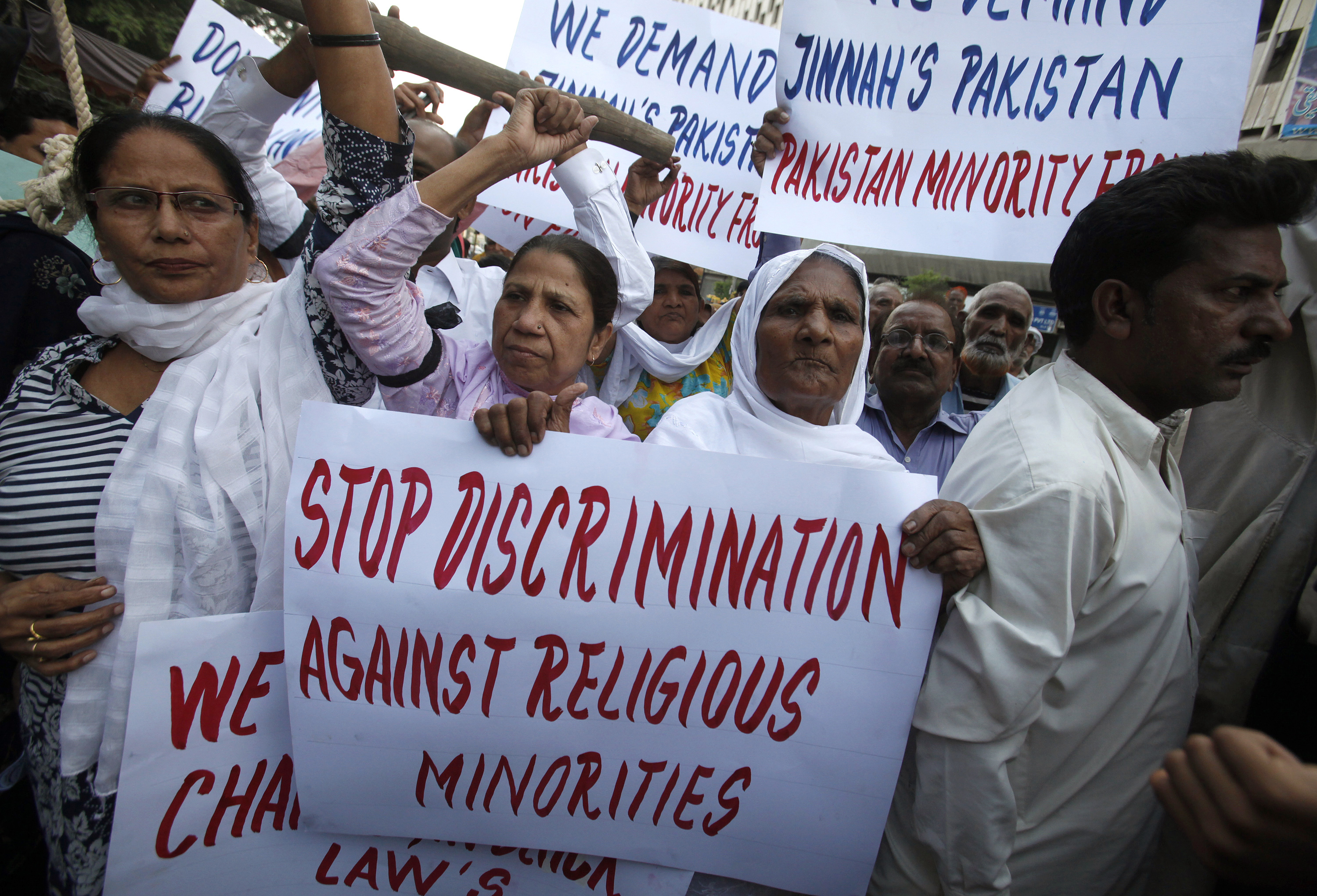
Discrimination is an issue that is largely prevalent in all parts of the world, be it highly developed and modernized societies of the West or the developing and conservative societies of the East. The belief that discrimination would be the thing of the past as the result of modernization and increasing awareness has been proven wrong again and again. Instead of it being put in the past, the boom of internet and social media has given people a new platform for showcasing their condescending and derogatory behavior.
In the international domain, securing rights of religious minorities has gained significant importance over the years, especially rights pertaining to freedom to practice religion, which is considered a non-derogable right; and the Rights of Persons Belonging to National or Ethnic, Religious and Linguistic Minorities. Along with the international community’s recognition of the need to protect minorities from discrimination, came the acceptance of providing ‘special measures’ to protect their rights.
While the international community generally, and the United Nations in particular, were making strategic moves towards ensuring guarantees to minorities, the unrest over the treatment of minorities, particularly religious minorities, seems to have persisted in both Pakistan and India. Both the countries have a history of religious intolerance amongst the masses. This is even more conspicuous as both the countries made several commitments aiming to protect the religious minorities against discrimination in their respective states.
Three weeks prior to the partition the leaders from both Congress and Muslim league gave joint statement which was later re-affirmed by their respective governments; giving assurances of fair and equitable treatment to the minorities and expressing their intention to safeguard the legitimate interests of all citizens irrespective of religion, caste or sex. The statement also specified that: in the exercise of their normal civic rights all citizens will be regarded as equal and able to exercise liberties such as freedom of speech, the right to form associations, the right to worship in their own way and the protection of their language and culture.
As a gesture expressing their compliance to these commitments Pakistan incorporated a white band in the national flag representing the religious minorities of the country along with adopting the Objectives Resolution in 1949 which accounted for providing religious and cultural freedom to religious minorities. However, evidence to the contrary highlights the failure in fulfilling these commitments. The present constitution of Pakistan is more discriminatory in nature as compared to the Indian constitution of 1949, as far as religious minorities are concerned. The Pakistani Constitution contains provisions which discriminate not only against religious minorities in Pakistan in general, but comprises of certain provisions which have led to greater discrimination specifically against Jamat Ahmaddiya in comparison with other religious minorities in Pakistan.
The ‘objective resolution’ incorporated in 1985 via the 8th amendment is mainly known for integration of Islamic principles in the constitution for governing the country, also dealt with the religious minorities and proposed steps to be adopted by the state to enable the religious minorities to ‘freely…profess and practice their religions’. However, at the time of incorporation the word freely was omitted and a provision for safeguarding the ‘legitimate’ interest of minorities was added. Although the term ‘freely’ was later reinstated under the 18th constitutional amendment, passed in 2010. Though, none of the other discriminatory provisions of the Pakistani Constitution were removed, amended or rectified; thus, implying that the pre-amendment jurisprudence, as well as the respective biases and discrimination, still prevails.
The provisions in Pakistan’s constitution are considerably more discriminatory towards Ahmadiyans out of all the religious minorities in Pakistan. For instance, the much debated Zaheeruddin Case – in which five Ahmadi criminal defendants were charged and sentenced for ‘fraudulently’ representing themselves to be Muslims, which the court found ‘offends and outrage’ the feelings of the Muslim majority of Pakistan – openly contradicts the provision; for minorities right to freely profess and practice their religion. However, Ahmadiyans are not the only religious minorities who have suffered under the country’s constitution as proven by events such as the burning down of above 200 Christian houses along with other barbaric actions, over the blasphemy allegation against Sawan Masih in the Badami Bagh incident, or the false blasphemy accusation of a 14-year-old Rimsha Masih shed light on the lack of protection provided to minorities in the country.
The founding father of Pakistan, Quaid-e-Azam Muhammad Ali Jinnah was a staunch supporter of religious equality. He declared non-Muslims to be equal citizens in the new country in multiple of his addresses to the public. Reflecting his secular views, Jinnah tried to establish a multi-confessional state. He nominated a Hindu, several Shias and an Ahmadi to Pakistan’s first cabinet to show his commitment to promoting the equality amongst the people of his country. Today, however, Pakistan’s religious minorities face discrimination and persecution with no end in sight.
Atif Mian, a leading international academic and one of IMF’s top 25 bright, young, economist who was appointed to the economic advisory council by the PM Imran Khan to provide economic advice to the government and the prime minister. His inclusion to the council was protested by various individuals and opposition parties, who objected against his Ahmadi faith. The campaign led the government to request Atif Mian to resign, as it succumbed to pressure of the opposition protesting his appointment.
This fiasco of Atif Mian’s appointment and his alleged resignation over the issue of his religious affiliation is a prompt to the new government of Pakistan to make the necessary amendments to the constitution and repeal discriminatory laws, that still cast a dark shadow over the religious minorities in our country to better protect their interest and avoid further discriminatory incidents.