
 “To travel is to live,” Hans Christian Anderson. If I ever have to make a wish list, travelling and exploring the world will be the first thing I start with. Pakistan is a country that is blessed with some of the world’s most beautiful landscapes —especially the northern areas — stunning Himalayan peaks, the Arabian Sea, deserts, and historical forts. All these make our country one of the world’s greatest tourist destinations. Poets have narrated the beauty of these areas, and many bards have called these places ‘heaven of earth’.
No comparison can be made among these areas since all of them have their own individual characteristics.The Kalash valley, however, has something that makes it different from the others. Among the many other reasons that exist to adore this place, culture is the one that I find most alluring. An urge to explore different cultures, in fact, led me to read more about this fascinating culture.
The origins of the Kalash tribe continue to remain in doubt. Many claim that these people are the issues of the Macedonian conqueror Alexander the Great. Others claim that the Kalash migrated to Afghanistan from a distant place in South Asia called ‘Tsiyam’, a place that also features in their folk songs.
The Kalash are known by some in Pakistan as the ‘black Kafirs’ and their land is called Kafiristan.Razhawai, Cheo, Bala Sing and Nagar Chao, moreover, were some of the famous Kalash rulers who ruled between the 12th and 14th centuries AD. Their fellow tribesmen in Afghanistan were known as ‘red kafirs’.
By 1320 AD, however, Kalash culture had begun to stagnate. The ruler Shah Nadir Raees subjugated the people and forced them to convert to Islam. The Amir of Afghanistan, moreover,also forcefully converted the Red Kafirs to Islam. Moreover, the villages of these converted Red Kafirs in Chitral are known as Sheikhanandeh — the village of the‘converted ones’.
The Kalash are known by some in Pakistan as the ‘black Kafirs’ and their land is called Kafiristan.Razhawai, Cheo, Bala Sing and Nagar Chao, moreover, were some of the famous Kalash rulers who ruled between the 12th and 14th centuries AD. Their fellow tribesmen in Afghanistan were known as ‘red kafirs’
The Kalash countryside in Chitral comprises three unique and stunning valleys: Bumboret, Birir and Rumbur. These places are famous for celebrating the festivalsof Joshi, Uchau and Chawmos.
Joshi, also known as Chilim Jusht,is a four day Kalash spring festival, held on the 13th of Mayin the three Kalash valleys. The Kalash people make unique arrangements for this festival every year. People prepare various milk desserts and also local wine.
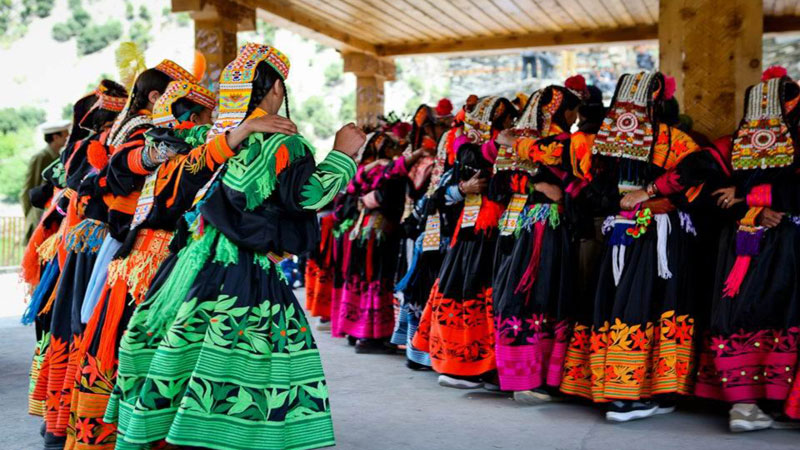
During the festival, Kalash people dance to welcome the spring season. Kalash bachelors also select their life partners in this festival. They do not make special arrangements for marriages, but on the last day of Joshi, young Kalashi couple with their life partners.
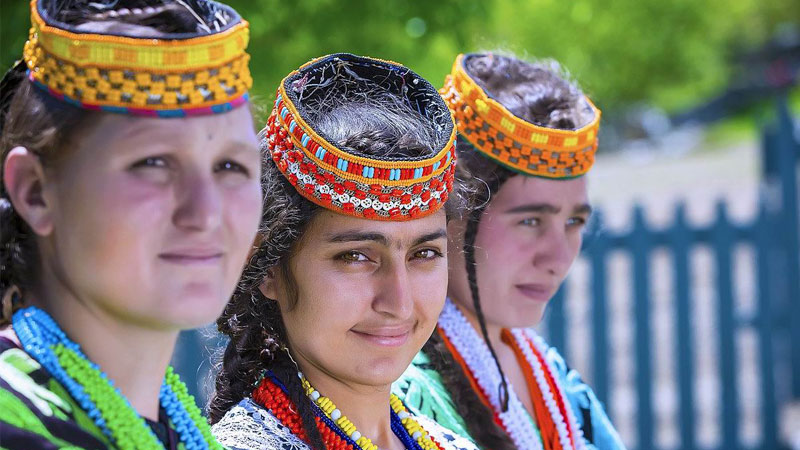
Women usually wear traditional black robes with vivid embroidery and handicraft caps.Their attire also includesneck accessories, which gives the Kalash womentheir unique appearance. Men wear Shalwaar Qameez, while children wear smaller versions of adult clothing after the age of four.These people speak the language called Kalasha which is believed to be a sub-branch of the Indo-Aryan group.
Many tourists visit these valleys to attend the festival but face challenging living conditions because the areas’ roads and hotels were destroyed or damaged due to the floods that struck the area.
When the festival nears, the Chitral Scouts issue security directives to ensure everything happens in a peaceful manner. They instruct locals not to allow tourists to stay at their houses. Journalists, moreover,are required to take permission from the scouts to cover the festival’s events. Tourists are also expected to register their vehicles with the scouts, to hire local guides and to not carry any weapons.
On the first day of the festival, the local peopleadorn their houses with flowers. The festival’s second day is marked by the locals distributing milk among their friends and loved ones and the holding of the ritual of gulparik. This practice involves baptising infants with milk.The Kalash also believe that the God Goshidaiprotects their herds during the summer and spring seasons so they thankGoshidai for his protection during the festival.
The Kalash have kept their ancient traditions alive, including superstitions about menstruation and pregnancy. During these times, women are isolated, and live in a place called Bashali.Although women are allowed to work in the fields, they are not allowed to go home.
 This grand civilization, unfortunately, is now wasting away as many Kalash families have either gone underground or have left the area. This can be a significant potential blow to Chitral which earns millions of rupees from tourism every year.Tourism has also fallen steeply since 9/11. Inthe 1990s for instance, thousands of people visited Chitral annually.That figure now stands at a paltry few hundred tourists every year.
Tourism helps to promote friendly relations between nations and also spurs economic activity, generates income, creates jobs and reduces poverty. Tourism in Pakistan has been racked by bomb attacks, target killings, a weak tourism framework, crime, poor development, a worsening law and order situation, the perennial energy crisis, mismanagement, corruption, ossified means of communication and low standards of cleanliness.
All this presents a highly negative image of our beautiful country which has significantly damaged Pakistan’s tourism sector. Thus, I believe it is high time that our government ensures peace and tranquility in our homeland, and highlights our diversity and soft image at a global stage.
The writer is a recent graduate of Mass Communication from University of the Punjab Lahore and is interested in lifestyle, culture, arts and history. She can be reached at [email protected].Twitter: @Arshiayzahid
Published in Daily Times, May 9th 2018.