
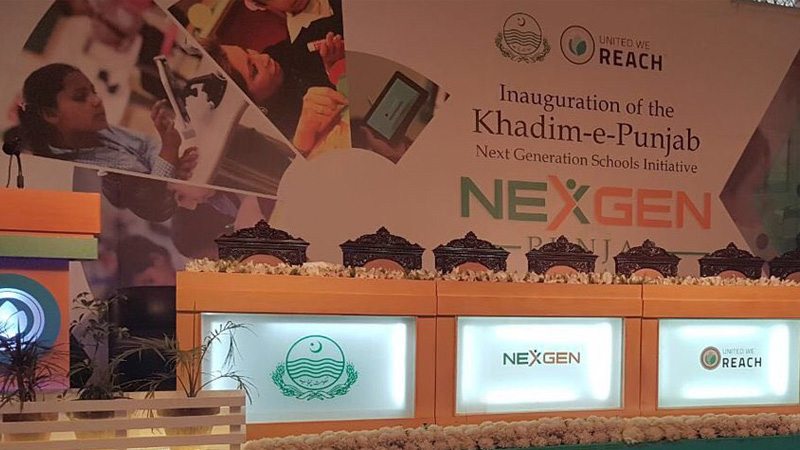
Education reforms in Pakistan enjoy a mixed history. In the early 1970s, the introduction of complete state control over public schools displaced competence. Subsequent denationalisation policies created a new market for private schools, putting the wider rural population at a disadvantage. Since 2000, there have been more than 100 attempts at reforming public education curriculums, learning facilities, and teacher contracts. Even so, the annual drop-out rate among public schools remains one of the highest in South Asia, and less than 50 percent of third-grade students in rural Pakistan can practice basic subtraction. Thus, public education reforms must be met through the latest technological interventions, where global-standard curriculums, dynamic student tablets, and creative lab spaces maximise student learning outcomes. The Khadim-e-Punjab Next Generation Schools Initiative, inaugurated earlier this month, delivers on all of the above.
The initiative is a large-scale collaboration between the Government of Punjab, and UnitedWeREACH, an education-technology NGO. 300 new schools will be set up in its first phase, each equipped with the latest information and communication technologies to foster competitive learning at primary and secondary levels. These technologies include cutting-edge tablets for students and teachers, containing readily scripted lesson plans as well as detailed teaching methodologies, to bring out a baseline performance in even the least qualified of teachers.
The California Education System — widely regarded as 10-15 years ahead of competing systems — will be used to constitute a global-standard curriculum for students. The basis for California’s superiority to other academic systems is the way it defines and approaches “learning”. Students from grade 1-5 treat learning as a process of communication, where reading, writing, speaking and listening collectively compliment student literacy development. Moreover, children demonstrate independence, comprehending complex texts across a range of subjects, and using deductive logic to address real-life problems. Geometric ideas such as shapes, colours and orientations are also used to represent the physical world, and pupils identify key technological tools that can broaden their communication goals, and best expand existing knowledge. As the same technology is used to dispense skill-oriented learning in Pakistan, public school students are set to undergo massive intellectual empowerment.
To facilitate human innovation from a tender age, Next Generation Schools introduce state-of-the-art information technology and science labs, where student learning is measured through tablets and headphones
Interestingly, quality education requires a multi-pronged strategy that extends beyond the physical space of a single classroom. Pioneering social theorist Arjun Appadurai, in his book Modernity at Large, defines learning as “the activation of individual senses and collective imagination in diverse environments.”Thus, students require distinct, creative spaces to experiment with competing for logic. To facilitate human innovation from a tender age, Next Generation Schools introduce state-of-the-art information technology and science labs, where student learning is measured through tablets and headphones. Separate art rooms also surround young minds with dynamic visual representations. The message here is very clear: if kinaesthetic, digital and information-based learnings are combined, Pakistani children would be at par with their global counterparts.
It is important to note that the academic credibility of a nation is represented by the standard of its public education — and not private. Finland uses high-class day-cares to foster responsibility and interaction among young children. In Japan, increased pupil autonomy helps prepare them for a scientific market economy. In Singapore, students’ co-curricular activities are used to inculcate future leadership, enrichment, achievement, participation and service.
Similar innovation techniques, as employed by the Khadim-e-Punjab Next Generation Schools Initiative, could be the key to establishing a superior public education system in Pakistan as well. After all, digital libraries and dynamic lesson applications, make large sums of data available on children’s fingertips. Their ability to construct arguments, deduct logic, and challenge concepts in light of this data far outweighs that of their private school counterparts. Also, these information and communication technologies enable new streams of data to be collected on every student. The strengths, weaknesses and popular preferences of pupils are made available to lesson planners, who can modify the content and learning process in light of individual potential. Such rapid, accurate assessments of individual students are unprecedented across private spheres in Pakistan.
UnitedWeREACH — the technology partner in the Next Generation School Initiative — has successfully implemented tech-based education models in Kenya and Pakistan. By the end of 2016, UnitedWeREACH had distributed scholarship awards in excess of 11,000 across Kenya, and in 2017, its tech-based learning design was functional across the Amal School in Tulspura, Light of Hope School in FC College, and the Creative Learning School at NUST.
For a population of more than 207 million — growing in excess of 2.2 percent annually — tech-based education is the only way to create a scalable impact on a national level. The Khadim-e-Punjab Next Generation Schools Initiative is a welcome sign in the face of low public school enrolment, declining academic standards, and little political support. Its multipronged approach to quality education could leave Pakistan in a better position to meet its academic targets, than ever before.
The writer is a student of Public Policy at NUST, and author of the book on post-modern poetry And the Candles Blew
Published in Daily Times, January 26th 2018.