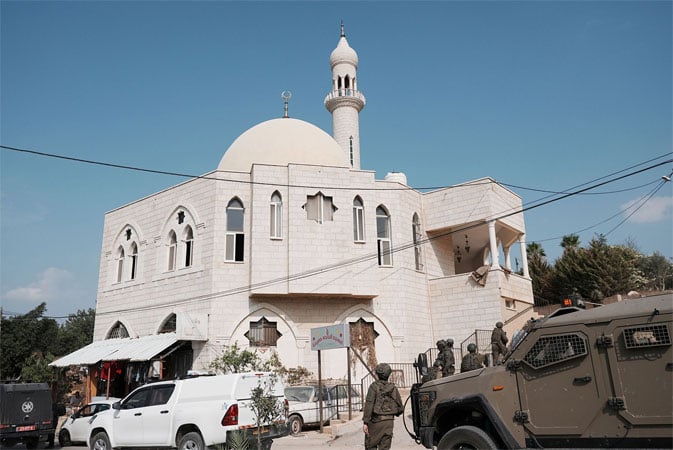
 Israeli settlers set fire overnight to a mosque in a village in the occupied West Bank, a Palestinian official said Sunday, as an AFP journalist saw the structure’s entrance scorched and Hebrew graffiti sprayed on its walls.
The settlers also set fire to two houses and a dairy factory, he said, adding the attackers spray-painted Hebrew graffiti on the walls of the mosque.
The Palestinian religious affairs ministry condemned the attack.
In a statement, the ministry described the arson as “a full-fledged terrorist act”, accusing Israel’s “extremist occupation government” of encouraging settler violence in an effort to displace Palestinians from Masafer Yatta and turn the conflict into “a religious war”.
The Israeli military has declared the region around the Gaza Strip a “closed military area,” in effect from 8am local time on Sunday to 8am on Monday, Al Jazeera reported, citing Israeli media.
The Times of Israel reported that the decision comes ahead of a large march to the area by the right-wing Nahala settler group, which supports the re-establishment of Israeli settlements inside the enclave.
The outlet said the closed area “covers the entire Gaza periphery, from Yad Mordechai in the north of the enclave to Route 232 in the east, all the way to Kerem Shalom at its extreme south”.
It also cited a military source as saying that the closure was ordered due to the settler group’s “intention of entering the Gaza Strip illegally”.
Meanwhile, at least one Palestinian has been killed and 10 wounded by an Israeli air strike that hit tents sheltering displaced people in the al-Mawasi area of Khan Younis in southern Gaza, Wafa news agency reports.
The attack comes despite Israel and Hamas agreeing to a “ceasefire” in October. More than 1,100 Palestinians have been killed in near-daily Israeli attacks since then, while four Israeli soldiers have also been killed.
Separately, Lebanese President Joseph Aoun will make his first trip to the White House this week to present a plan to US President Donald Trump on how to disarm Iran-backed militant group Hezbollah and secure Israel’s withdrawal from Lebanon.
Aoun, who served as the commander of Lebanon’s US-backed army before being elected president last year, is the first Lebanese head of state in nearly 20 years to visit the White House, where he will meet Trump face-to-face for the first time.
Tuesday’s meeting comes at a crucial moment for Lebanon: Israeli troops are occupying a swathe of the country’s south, hundreds of thousands of Lebanese remain displaced following Israeli strikes and Hezbollah has firmly rejected the government’s direct talks with Israel — and efforts by the state to strip it of its arms.