 Finance Minister Muhammad Aurangzeb on Wednesday reiterated the government’s push to review Pakistan’s population-based formula for distributing federal revenues among the provinces, saying the current system was “simply not sustainable” as Islamabad seeks to address rapid population growth.
The debate centers on the National Finance Commission (NFC), the constitutional body that determines how federally collected tax revenues are shared between the federal government and Pakistan’s four provinces. Under the current formula, population accounts for 82 percent of the criteria used to allocate provincial shares, with the remaining weight given to factors including poverty, revenue collection and inverse population density.
Senior government officials, including Planning Minister Ahsan Iqbal and Health Minister Mustafa Kamal, have argued in recent months that the heavy emphasis on population unintentionally discourages provinces from pursuing population stabilization policies because larger populations translate into larger shares of federal transfers. They have proposed revisiting the formula to place greater emphasis on development and other socio-economic indicators.
The proposal has faced resistance from some provinces and political parties, including the Pakistan Peoples Party (PPP), a key coalition partner of Prime Minister Shehbaz Sharif’s government. PPP leaders have argued that altering the population criterion could undermine the spirit of the landmark 18th Constitutional Amendment and reduce provincial autonomy, while maintaining that any changes should be made only through consensus under the constitutional NFC process.
“There are also more structural issues, such as the NFC, where population accounts for 82 percent of the allocation formula. That is simply not sustainable,” Aurangzeb said while addressing a World Population Day seminar in Islamabad.
“So whenever we move this NFC discussion forward in terms of the horizontal allocation criteria, this formula will have to be examined and reviewed.”
The finance minister said international experience suggested three factors were critical to reducing population growth over the long term: educating girls, increasing women’s participation in the workforce and securing the support of religious scholars. He cited Bangladesh, Indonesia and Iran as examples of countries that had significantly reduced population growth rates over the past decade.
Aurangzeb said the government had already taken some immediate steps to control population, including removing the sales tax on contraceptives in the latest federal budget, but described those as “tactical measures,” arguing that broader structural reforms would be needed to slow Pakistan’s population growth.
He also said around $600 million to $700 million annually was available under the World Bank’s Country Partnership Framework to support programs related to population, including reducing learning poverty and child stunting.
Meeting with UK high commissioner
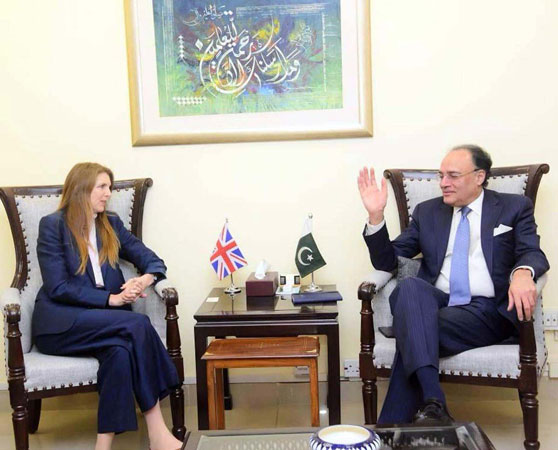
Separately, Aurangzeb held a meeting with the British High Commissioner to Pakistan, Ms Jane Marriott CMG OBE, who called on him at the Finance Division. The meeting focused on Pakistan’s macroeconomic outlook, the Government’s ongoing reform agenda, and avenues for further strengthening Pakistan-United Kingdom economic and development cooperation.
The Finance Minister appreciated the United Kingdom’s continued support for Pakistan’s economic reforms and acknowledged the longstanding partnership between the two countries across a range of sectors, including economic governance, fiscal reforms, climate resilience, public finance, health, and social development.
The meeting reviewed Pakistan’s recent macroeconomic progress, including the successful passage of the Federal Budget 2026-27, ongoing fiscal consolidation efforts, and measures aimed at promoting sustainable economic growth while maintaining macroeconomic stability. Senator Muhammad Aurangzeb highlighted the Government’s commitment to implementing structural reforms, broadening the tax base, improving public financial management, and strengthening investor confidence.