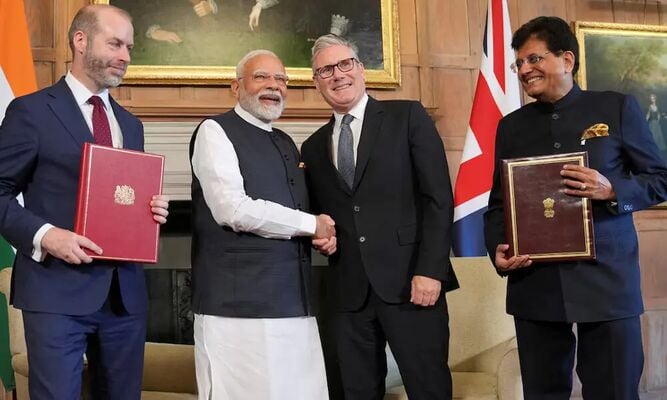
The India-UK Comprehensive Economic and Trade Agreement came into force on Wednesday, reducing tariffs on thousands of products and expanding access for businesses and professionals in both countries. The landmark pact is expected to strengthen bilateral trade, increase investment, and improve market opportunities across manufacturing and services sectors. Officials in both nations described the agreement as a major step toward deeper economic cooperation.
Under the agreement, Indian exporters receive immediate duty-free access to most British tariff lines, benefiting industries including textiles, leather, footwear, marine products, gems and jewellery, and processed foods. Britain, meanwhile, secures wider access to India’s fast-growing market through phased tariff reductions and quotas covering automobiles, alongside expanded opportunities in financial services, education, insurance, procurement, and professional services.
Read more: India’s defeats sparked speculation over changes within team’s
India’s Commerce Minister Piyush Goyal said the agreement would create new opportunities for trade, investment, and innovation while strengthening the competitiveness of Indian businesses. According to India’s trade ministry, the country exported $13.44 billion worth of goods to Britain and imported $11.68 billion during the 2025-26 fiscal year. Bilateral services trade reached $35.44 billion in 2024, with India recording a services surplus of nearly $7.9 billion.
Britain will immediately eliminate tariffs on 96.8% of tariff lines, covering 97.7% of total trade value. India will remove duties on 64.1% of tariff lines immediately and gradually phase out tariffs on another 21%, while protecting sensitive products. The agreement also introduces preferential tariff quotas for 37,000 fully built passenger vehicles annually and broadens market access across 137 services sub-sectors, including information technology, telecommunications, finance, business services, and education.
Read more: Global powers push for peace: Britain offers to mediate Pakistan
The agreement also includes a Double Contribution Convention, allowing eligible Indian professionals and employers to avoid paying into Britain’s National Insurance system for assignments of up to five years. The provision is expected to benefit around 75,000 workers and 900 employers. Additionally, Indian companies gain access to Britain’s government procurement market, valued at approximately £90 billion, while British firms receive reciprocal opportunities in India’s procurement sector worth about $114 billion.