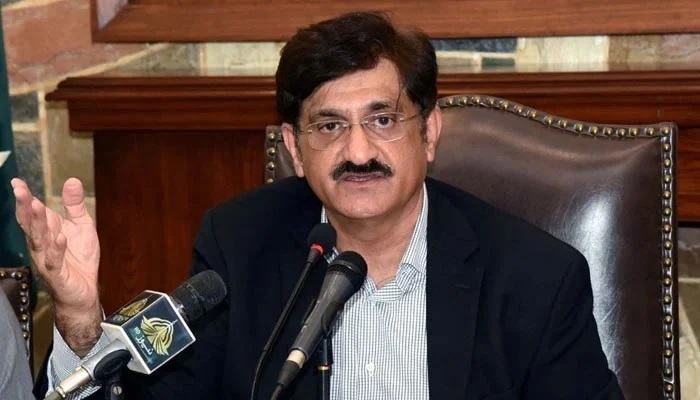
Sindh Chief Minister Murad Ali Shah has said that the Pakistan Peoples Party (PPP) leadership has directed the provincial government to shift its focus from smaller development schemes to large-scale projects aimed at delivering long-term benefits to the public.
Addressing a post-budget press conference in Karachi, the chief minister said the provincial government’s largest expenditures continue to be salaries and pensions. He noted that both have been increased by seven per cent in the new budget, while ad hoc relief allowances granted in 2023 and 2025 have been merged into the basic pay structure of government employees.
Murad Ali Shah said the minimum monthly income under the new budget would be raised to Rs43,000. He also highlighted key allocations, including a grant of Rs26.2 billion for the Sindh Institute of Urology and Transplantation (SIUT) and Rs155 billion for local government institutions.
The chief minister stated that the government plans to complete 2,056 ongoing development schemes during the next fiscal year. He added that no new development schemes have been introduced in the current budget, as the focus remains on completing existing projects.
Referring to the party leadership’s vision, Murad Ali Shah said President Asif Ali Zardari and PPP Chairman Bilawal Bhutto Zardari had instructed the government to think beyond small-scale initiatives and pursue larger projects capable of transforming the province’s economic and social landscape.
He expressed confidence that the party’s planning and development strategy would produce positive results over the next few years and improve overall conditions in the province.
The chief minister also discussed fiscal matters involving the federation and provinces, saying the PPP had opposed proposals to revise the National Finance Commission (NFC) Award formula, arguing that such changes would be inconsistent with constitutional provisions.
He added that all provinces had cooperated with the federal government in matters related to national defence and unity, including providing grants under constitutional provisions despite financial pressures on provincial budgets.