
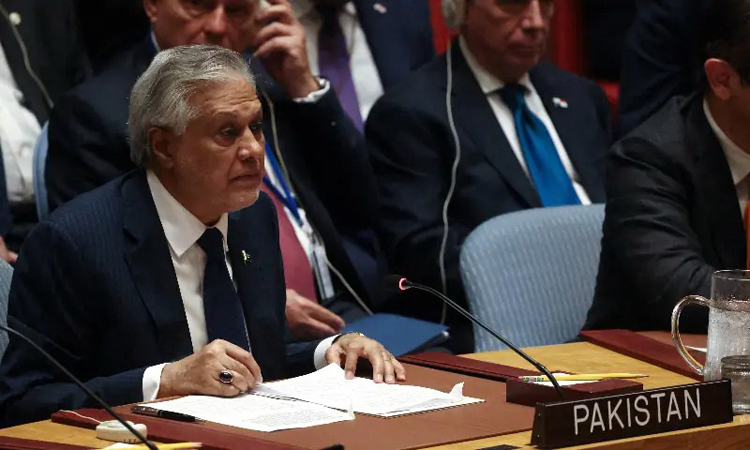
 Pakistan on Tuesday urged the UN Security Council to prevent another prolonged conflict in the Middle East, with Deputy Prime Minister and Foreign Minister Ishaq Dar warning that any confrontation around Iran would endanger regional peace, energy flows and the international order.
Speaking at a debate convened by China on the UN Charter and the UN-centred international system, Dar said Pakistan’s position was shaped by its geography, its relations with Tehran and Gulf capitals, and its “longstanding ties of amity with the United States.”
Pakistan, he asserted, had “consistently stood for restraint, de-escalation and a return to diplomacy.”
“Another prolonged conflict would serve no one,” Dar told the council, continuing that Pakistan had made “sincere efforts” to facilitate “a durable solution,” which could bring lasting peace and keep maritime routes open.
He recalled his March 31 visit to Beijing, where Pakistan and China announced a “Five Point Initiative for Restoring Peace and Stability in the Gulf and Middle East Region.” The effort must succeed “in the interest of regional and global peace and security.”
Dar thanked Chinese Foreign Minister Wang Yi for convening the debate, saying Beijing’s call for a strong UN-centred system was “timely and vital” amid “deepening divisions and growing disregard for international law.”
Iranian Foreign Minister Abbas Araghchi, invited by China, did not travel to New York because of visa issues. Dar said the UN Charter, born from war, remained “the moral foundation of the international order.” For Pakistan, he affirmed, its principles were “sacrosanct”.
Referring to Security Council Resolution 2788, presented by Pakistan and adopted unanimously in July 2025, Dar noted it had strengthened mechanisms for peaceful settlement of disputes.
“Diplomacy is not weakness; dialogue is not concession,” he continued. Peaceful settlement was “not an option of last resort” but “the first duty of states under the Charter.”
The same principle, he emphasised, must apply to Jammu and Kashmir, unresolved for nearly eight decades despite Security Council resolutions promising the Kashmiri people their right to self-determination.
He also warned against attempts to hold the Indus Waters Treaty in abeyance, calling it “a vital framework for water cooperation and regional stability.”
On Palestine, Dar exclaimed, “there can be no durable peace in the Middle East” while occupation, collective punishment, forced displacement and illegal settlement expansion continued. Dar lamented the international system was being weakened by the “selective application” of agreed principles, which “breeds mistrust, fuels grievances, encourages unilateralism and weakens multilateralism.” He also called for Security Council reform, saying it should not create new permanent seats.