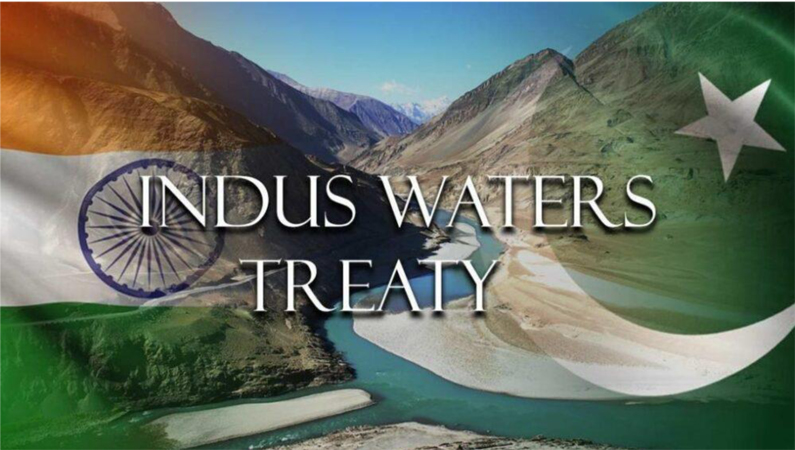
 On April 23, 2025, the South Asian geopolitical landscape was fundamentally altered when India unilaterally announced the abeyance of the Indus Waters Treaty (IWT). This drastic move followed by a false flag operation in Pahalgam which was vehemently designed to provide a pretext for hydraulic aggression.

For over six decades, the treaty brokered by world bank served as a rare beacon of stability, surviving three major wars and numerous border skirmishes. However, by weaponizing water sharing in response to a security event, India has transitioned from a rulesbased engagement to a doctrine of power-based unilateralism.

Diplomatic Rupture & Hydraulic Coercion
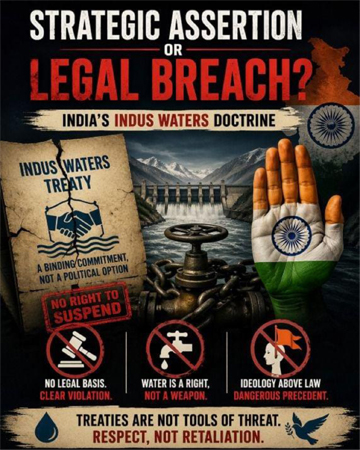
The suspension of the IWT represents the ultimate manifestation of the Blood and Water doctrine. By linking transboundary water flows to domestic security incidents, India has effectively turned a technical resource-sharing agreement into a tool of strategic blackmail.
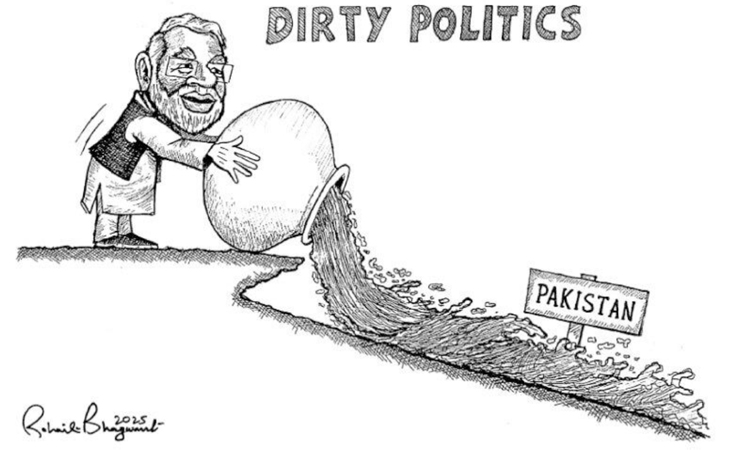
India’s move sends a chilling signal to other lowerriparian neighbors like Bangladesh and Nepal. If a treaty brokered by the World Bank can be suspended at will, no bilateral agreement in South Asia remains sacrosanct.

As a claimant for a permanent seat on the UN Security Council, India’s disregard for a 65-year-old treaty projects an image of “strategic irresponsibility.” It portrays New Delhi as an actor that prioritizes shortterm political leverage over its reputation as a reliable treaty partner.
No Legal Basis for Violation

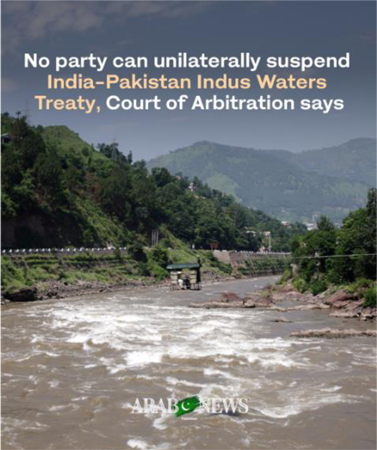
The legality of India’s abeyance is perhaps the most contested aspect of this crisis. Under international law, there is no such concept as “unilateral abeyance” for a treaty that lacks a withdrawal clause.
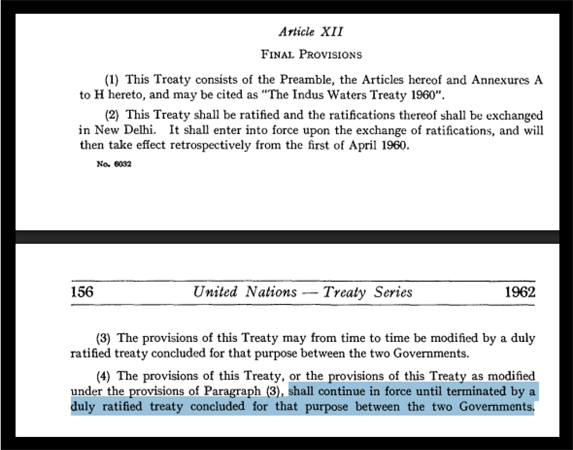
Finality of IWT’s Article XII

As noted in recent legal analyses, Article XII (4) of the IWT states the treaty remains in force until terminated by a duly ratified treaty concluded by both governments. India’s domestic executive order cannot override this international obligation.

VCLT Framework
In the Article 54 of the Vienna Convention on the Law of Treaties (VCLT), the issue of mutual consent in the process of terminating treaties is heavily reinforced. Moreover, unilateral action is drastically limited to the only solid reasons, including a material breach by the other party under Article 60 or a fundamental change of circumstances under Article 62.

Principle of Good Faith

Article 26 of the VCLT mandates that every treaty in force is binding and must be performed in good faith. Suspending the treaty based on a disputed security event—the Pahalgam incident—is a clear violation of this principle.

By rejecting and refusing to participate in the Permanent Court of Arbitration (PCA) proceedings, India further alienates itself from the global legal order.
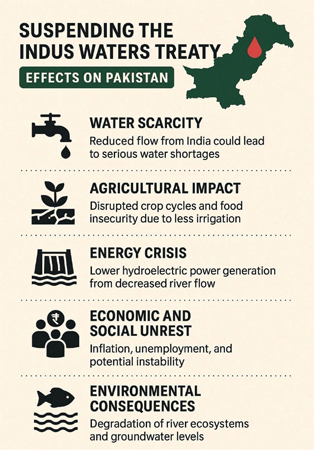
Humanitarian Aspect by weaponizing Scarcity

Beyond the halls of diplomacy and law, the suspension of the IWT has a devastating human face. The weaponization of water is not a victimless strategic move; it is a direct threat to the lives of over 200 million people.

Under Article VI, India is obligated to share daily river flow data. By stopping this exchange, India has created a data blackout.
Without real-time information from the upper riparian, Pakistan’s ability to issue flood warnings is crippled, potentially leading to catastrophic loss of life during monsoon seasons.

Pakistan depends on the Indus, Jhelum, and Chenab for nearly 80% of its irrigated agriculture. Any diversion or storage of these waters under the guise of abeyance threatens the food security of the entire nation.

Violations of UN Sustainable Development Goals (SDGs)
The unilateral suspension of the IWT by India constitutes a direct assault on the United Nations’ 2030 Agenda for Sustainable Development, undermining several interconnected goals. By cutting off critical hydrological data and threatening the flow of the Western Rivers, India is in blatant violation of SDG 6 (Clean Water and Sanitation), specifically Target 6.5, which mandates transboundary cooperation as a prerequisite for integrated water resources management.

Furthermore, the resulting threat to Pakistan’s irrigation network jeopardizes SDG 2 (Zero Hunger) by compromising food security and SDG 1 (No Poverty) by endangering the livelihoods of millions of small-scale farmers. The data blackout also infringes upon SDG 13 (Climate Action), as the absence of early flood warnings increases the vulnerability of downstream populations to climate-induced disasters. Perhaps most critically, India’s retreat from a 65-yearold legal framework is a regression from SDG 16 (Peace, Justice, and Strong Institutions), which promotes the rule of law at the international level, and SDG 17 (Partnerships for the Goals), which emphasizes the necessity of stable, multi-stakeholder agreements for global prosperity. Ultimately, using water as a strategic weapon ensures that “leaving no one behind” remains an impossible ideal in a region where hydraulic unilateralism now dictates the survival of the masses.
Cost of Unilateralism
The Pahalgam incident, whether viewed as a security breach or a false flag, does not grant any state the right to dismantle a foundational international agreement.

India’s attempt to instrumentalize the Indus Waters Treaty for coercive ends is likely to generate enduring reputational damage and provoke broader resistance within the international system.
Ultimately, might-is-right cannot replace rules-based conduct in the management of shared natural resources. The IWT was designed to be conflictresilient; by breaking it, India is not just targeting Pakistan’s water—it is eroding the very foundations of international law and regional stability.