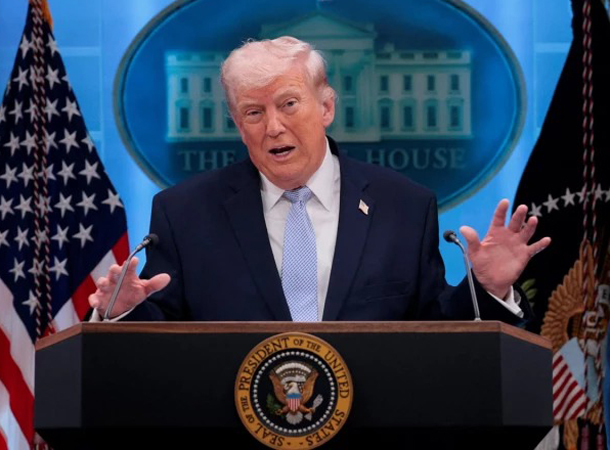
 US President Donald Trump and Iran´s foreign minister said Friday that the Strait of Hormuz is now fully open to commercial vessels, as a 10-day truce in Lebanon appeared to hold.
The truce offered a pause in fighting between Israel and the Hezbollah group and could clear one major obstacle to a deal between Iran and the United States and Israel to end weeks of devastating war. But it remained unclear whether the group would recognize a deal it did not play a role in negotiating and which will leave Israeli troops occupying a stretch of southern Lebanon.
In a social media post, Trump said Iran announced that the strait “is fully open and ready for full passage.”
Minutes earlier, Iranian Foreign Minister Abbas Araghchi posted on X that the passage for all commercial vessels through the strait “is declared completely open” in line with the ceasefire in Lebanon. He said it would stay open for the remaining period of the ceasefire.
It was not immediately clear what that meant for the US blockade of the strait, but Trump said the blockade would “remain in full force” until Iran reaches a deal with the US to end war.
Pakistan President Asif Ali Zardari and Prime Minister Shehbaz Sharif welcomed announcement of a ceasefire in Lebanon.
In a statement, the President termed it an important step towards reducing tensions in the region. He said ceasefire presents an opportunity to move towards lasting peace.
In a post on his X handle, the Prime Minister said that the ceasefire in Lebanon, facilitated through bold and sagacious diplomatic efforts led by President Donald Trump will pave the way for sustainable peace.
The prime minister reaffirmed Pakistan’s unwavering support for the sovereignty and territorial integrity of Lebanon. He said Pakistan will continue to support all efforts aimed at lasting peace in the region
Moreover, Trump signaled Friday that an Iran peace deal was all but done, trumpeting agreements on the Strait of Hormuz and Tehran’s nuclear program.
In a rapid-fire stream of social media posts, Trump hailed a “GREAT AND BRILLIANT DAY FOR THE WORLD!” but without specifically announcing a deal with Iran.
Trump thanked Pakistan and its “Great Prime Minister and Field Marshall, two fantastic people”. Donald trump wrote “Thank you to Pakistan and its Great Prime Minister and Field Marshall, two fantastic people!!!”.
Responding, Prime Minister Shehbaz Sharif, on behalf of the people of Pakistan and Field Marshal Syed Asim Munir, expressed “deep and profound appreciation” for US President Donald Trump’s message praising Pakistan and its leadership.
A Pakistani source involved in mediating between the US and Iran said on Friday there was progress in backdoor diplomacy and that an upcoming meeting between the two sides could result in the signing of a memorandum of understanding, followed by a comprehensive deal within 60 days.
“Both sides are agreeing in principle. And technical bits come later,” the source said on condition of anonymity.
One of the key sticking points has been over Tehran’s nuclear ambitions, with the US proposing at last weekend’s talks a 20-year suspension of all Iranian nuclear activity. Tehran suggested a halt of three to five years, according to people familiar with the proposals.
Iran has demanded international sanctions on it be lifted and Washington has pressed for any highly enriched uranium to be removed from Iran. Two Iranian sources have said there were signs of a compromise on the HEU stockpile, with Tehran considering shipping part of it out of the country.
Trump told reporters outside the White House on Thursday that Iran had agreed to “give us back the nuclear dust”, but Iran’s state media outlet Mizan disputed that claim on Friday, highlighting ongoing differences.
No negotiation regarding the “transfer of Iran’s highly enriched uranium to America had ever taken place, and naturally there is no agreement on this matter either”, it said, citing sources.
Meanwhile in Beirut, barrages of gunshots rang out across the city as residents fired into the air just after midnight to celebrate the beginning of the truce, and displaced families began moving toward southern Lebanon and Beirut´s southern suburbs despite warnings by officials not to attempt to return to their homes until it became clear whether the ceasefire would hold.
A spokesperson for the U.N. peacekeepers in southern Lebanon said Friday that they have not observed any airstrikes since midnight, but accused the Israeli military of violating airspace and artillery shelling in southern Lebanon. The Israeli military did not immediately comment. According to the agreement shared by the State Department, Israel can act in self-defense against imminent attacks but cannot carry out offensive operations against southern Lebanon.
Trump heralded the deal a “historic day for Lebanon,” even as he expressed confidence that the war with Iran would soon end in a Las Vegas speech.
“I will say the war in Iran is going along swimmingly,” Trump said. “It should be ending pretty soon.”
An end to Israel´s war with Hezbollah was a key demand of Iranian negotiators, who previously accused Israel of breaking the current ceasefire deal with strikes on Lebanon. Israel said that deal did not cover Lebanon.
While oil prices fell on hopes of a deal, the head of the International Energy Agency warned that energy shocks could get worse if the Strait of Hormuz did not reopen soon. Iran closed the crucial waterway, through which a fifth of the world´s oil normally passes, shortly after the war began. Europe has “maybe six weeks or so” of jet fuel left and broader economic consequences will grow the longer the strait is closed, IEA Executive Director Fatih Birol told The Associated Press on Thursday.
The fighting has killed at least 3,000 people in Iran, more than 2,100 in Lebanon, 23 in Israel and more than a dozen in Gulf Arab states. Thirteen US service members have also been killed.
Israel´s hard-line Defense Minister Israel Katz warned on Friday that Israel plans to respect the ceasefire even though attempts to completely disarm Hezbollah in southern Lebanon are “not yet complete.” Katz said that Israel would continue to hold all the places it is currently stationed, including a buffer zone extending 10 kilometers (6 miles) from the border with Israel into southern Lebanon. He said that many homes in the area would be destroyed and Lebanese residents will not return to the area.
Earlier, Israeli Prime Minister Benjamin Netanyahu said he agreed to the ceasefire “to advance” peace efforts with Lebanon, but also said Israeli troops would not withdraw.
Israeli forces have engaged in fierce battles with Hezbollah in the border area as they pushed into southern Lebanon to create what officials have called a “security zone.”
“That is where we are, and we are not leaving,” he said.