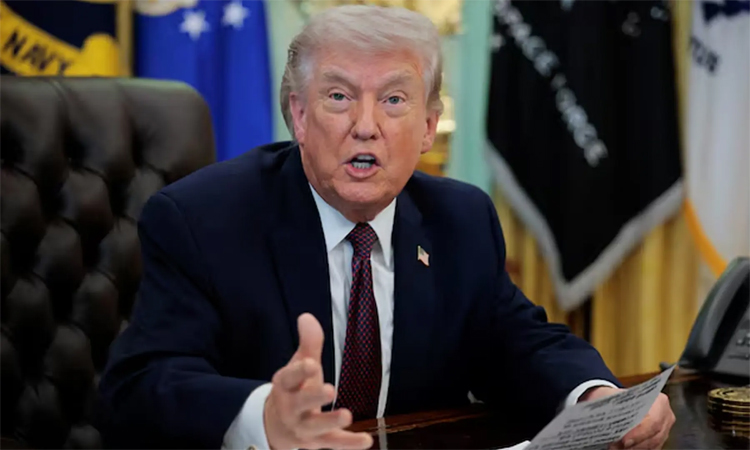
 US President Donald Trump said on Tuesday that Iran talks could resume in Pakistan over the next two days, according to an interview with the New York Post.
“You should stay there, really, because something could be happening over the next two days, and we’re more inclined to go there,” Trump was quoted as saying.
Trump said Pakistan’s Army chief, Field Marshal Asim Munir, was doing a “great job” on the talks.
“He’s fantastic, and therefore it’s more likely that we go back there,” Trump said.
The statement came after the US declared it had blockaded Iran’s ports and Tehran threatened to strike targets across the region following the first round of Islamabad Talks.
Talks were aimed at permanently ending the conflict in Iran – which began Feb 28 with US and Israeli strikes on Iran – failed to produce an agreement last weekend, though Pakistan has proposed hosting a second round in the coming days.
Two Pakistani officials, who spoke on condition of anonymity because they were not authorized to discuss the matter with the media, said the first talks were part of an ongoing diplomatic process rather than a one-off effort.
Two US officials said Monday that discussions were still underway about a new round of talks. A diplomat from one of the mediating countries said that Tehran and Washington had agreed to it.
The talks could happen Thursday, according to the US officials. The location, timing and composition of the delegations had not been decided, although Islamabad and Geneva are being considered as host cities.
The US officials and the diplomat spoke on condition of anonymity to discuss sensitive diplomatic negotiations.
The war, now in its seventh week, has jolted markets and rattled the global economy as shipping has been cut off and airstrikes have torn through military and civilian infrastructure across the region.
The fighting has killed at least 3,000 people in Iran, more than 2,000 in Lebanon, 23 in Israel and more than a dozen in Gulf Arab states. Thirteen US service members have also been killed.
The blockade is intended to pressure Iran, which has exported millions of barrels of oil, mostly to Asia, since the war began. Much of it has likely been carried by so-called dark transits that evade sanctions and oversight, providing cash flow that´s been vital to keeping Iran running.
Both the nature of enforcement and the extent to which ships will comply remained unclear during the first full day of the blockade Tuesday. Tankers approaching the strait Monday turned around shortly after it took effect, though one reversed course again and transited the waterway.
The tanker Rich Starry had been waiting off the coast of the United Arab Emirates, according to shipping data firm Lloyd´s List, which cited data from the energy cargo-tracking firm Vortexa. It was not immediately clear whether the tanker had earlier docked in Iran. Yet it was listed by the US Treasury´s Office of Foreign Assets Control as linked to Iranian shipping.
Lloyd´s List, citing ship registry and tracking data, reported that the vessel is owned by a Chinese shipping company and ultimately bound for China.
US Central Command did not immediately respond to questions about the tanker after it cleared the 21-mile-wide (nearly 34-kilometer) waterway. A day earlier, Central Command said the blockade applied to vessels going to and from Iranian ports.
US Treasury Secretary Scott Bessent said Chinese tankers will not be allowed passage through the strait. “So they’re not going to be able to get their oil,” he told reporters Tuesday on the sidelines of IMF-World Bank meetings.
Since the start of the war, Iran has curtailed maritime traffic, with most commercial vessels avoiding the waterway.
Iran´s effective closure of the strait, through which a fifth of global oil transits in peacetime, has sent oil prices skyrocketing, pushing up the cost of gasoline, food and other basic goods far beyond the Middle East.
US President Donald Trump said Monday that Iran’s control of the strait amounted to blackmail and extortion as the US blockade took effect. He said in a social media post that Iran´s navy had been “completely obliterated,” but it still had “fast attack ships.”
He warned that “if any of these ships come anywhere close to our BLOCKADE, they will be immediately ELIMINATED.”
Iran threatened to retaliate against Persian Gulf ports if attacked.
“If you fight, we will fight,” Iran’s parliamentary speaker, Mohammad Bagher Qalibaf, said in a statement addressed to Trump.
French President Emmanuel Macron and British prime Minister Keir Starmer will co-chair a conference Friday for nations willing to deploy warships to escort oil tankers and container ships through the Strait of Hormuz. The deployment will happen “when security conditions allow,” Macron´s office said Tuesday.
Investors banked on a resolution to the Middle East war even as the US blocked Iran’s ports after the talks collapsed.
ANZ analysts estimate that the supply of about 10 million barrels per day of crude supply has effectively been removed from the market, while a prolonged US blockade could curb an additional 3 million to 4 million bpd of crude shipments.
“The oil market no longer needs a worst-case escalation to justify higher pricing,” ANZ added in a client note. “Tight balances alone are sufficient to sustain the price of Brent near or above recent threshold levels.”
US Energy Secretary Chris Wright suggested oil prices could peak in “the next few weeks” once shipping resumed.
The International Monetary Fund, the World Bank, and the International Energy Agency warned against hoarding energy supplies or adopting export curbs, amid a shock to the global market that they described as the most significant ever.
On Monday, IEA chief Fatih Birol said that while further strategic oil releases might not yet be necessary, the agency remains prepared to act if needed.
The Organisation of the Petroleum Exporting Countries scaled back its second-quarter global demand forecast by 500,000 bpd in its latest monthly report.