 Iran’s Foreign Minister Abbas Araghchi told NBC News that his country will not agree to a ceasefire in the Middle East, saying Tehran must “continue fighting for the sake of our people.”
He accused the US and Israel of targeting civilians, including students and hospitals, and said previous ceasefires, including the one ending last year’s 12-day conflict, had already been violated.
“There needs to be a permanent end to the war,” Araghchi said. “Unless we get to that, I think we need to continue fighting for the sake of our people and our security.”
Araghchi also addressed regional attacks, saying Iran has not intentionally targeted neighbouring Gulf countries but has struck American bases and installations located within their territories. He added that Iranian President Masoud Pezeshkian had apologised to regional populations for “inconveniences” caused by these retaliatory operations.
On leadership changes, Araghchi confirmed that Iran’s Assembly of Experts has chosen a new supreme leader following the death of Ayatollah Ali Khamenei, but he offered no details on the successor. He emphasised that Iran will not allow outside interference in selecting its new leader, affirming that it remains a domestic decision.
Iran’s Revolutionary Guards said Sunday that the country’s forces could fight an intense war for six months against the United States and Israel, which said it struck Tehran’s commanders at a seaside hotel in the heart of Beirut.
Iran’s President Masoud Pezeshkian said his remarks were “misinterpreted by the enemy that seeks to sow division with neighbours”, state TV reported on Sunday, after they were viewed as a decision to suspend attacks on Gulf countries while strikes did not stop.
“It has repeatedly been said we are brothers and must have good relations with neighbours. However, we are forced to retaliate to attacks but this does not mean we have a dispute with a (neighbouring) country or want to upset their people,” Pezeshkian said.
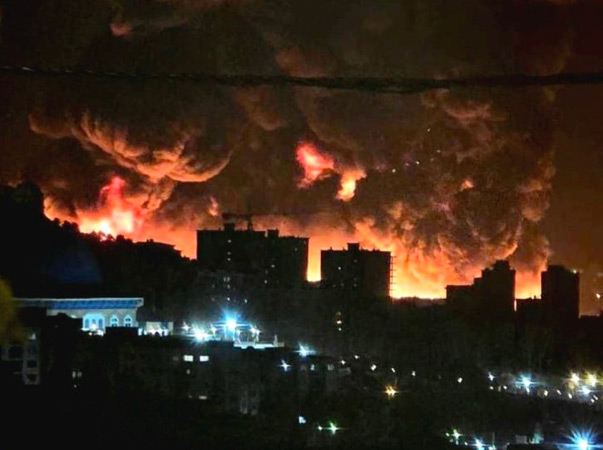
Israel said it had initiated fresh strikes across Iran, and a huge fire engulfed a government office block in Kuwait hit by drones, as a war that has brought chaos to the Middle East and roiled global oil markets entered its second week.
Despite the Iranian president’s apology on Saturday, Iranian attack drones have struck targets in Saudi Arabia and Kuwait, officials in both countries said early Sunday.
In a post on X, the Saudi Defence Ministry said at least 15 drones had been intercepted and destroyed within the kingdom’s airspace. It also said the drones had tried to attack the diplomatic quarter in the capital, Riyadh.
Earlier, it was reported that two people had been killed and 12 wounded in a strike on central Saudi Arabia. Those killed were of Indian and ?Bangladeshi nationalities, the civil defence agency said ?in a post on X.
Iran’s ?Revolutionary Guard said ?earlier that it targeted radar systems in locations that included Saudi’s al-Kharj, where the deaths were reported. The US embassy in Saudi Arabia and US consulate in the United Arab Emirates came under drone attacks on Tuesday.
Meanwhile; President Donald Trump is weighing the option of deploying special forces on the ground to seize Iran’s near-bomb-grade uranium, Bloomberg News reported on Sunday, citing three diplomatic officials briefed on the matter. Reuters could not immediately verify the report.The Iranian army has said that at least 104 people have been killed and 32 injured in a US attack on an Iranian warship last week, Reuters reported, citing Tehran’s Fars news agency. British forces have successfully engaged a one-way drone fired from Iran towards Iraq last night, the UK Ministry of Defence said in an X post.