
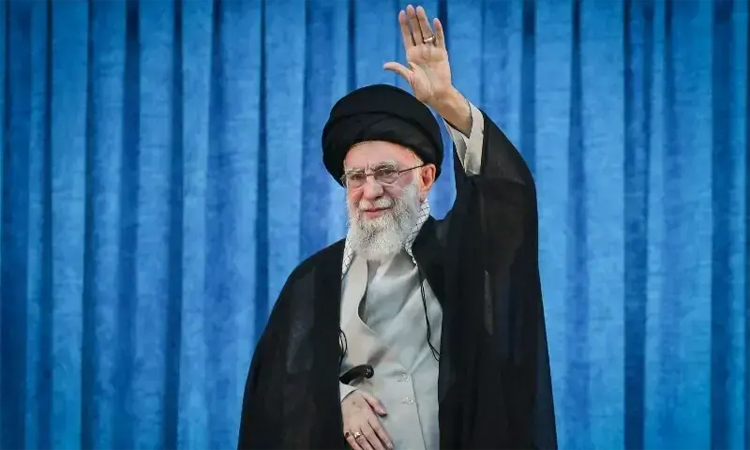
 The killing of Iran’s Supreme Leader Ayatollah Ali Khamenei in a joint US-Israeli strike has marked a historic turning point for the Middle East. What began as a targeted operation against Tehran’s leadership and nuclear sites has spiralled into a multi-front confrontation. Iran has unleashed missile and drone attacks not only on Israel but across the Gulf– from US bases in Iraq to oil facilities in Saudi Arabia and the UAE, raising the spectre of a wider regional war. The supreme leader’s death has left Iran’s leadership in turmoil, even as the country lashes out in what it deems an existential fight.
The shockwaves are already rippling through global markets and city streets alike. Pakistan, given its geography, strategic ties, and economic fragility, cannot afford to remain a bystander to this unfolding crisis.
The loss of the only Supreme Leader Iran has known for three decades has created deep uncertainty over who will claim Khamenei’s mantle. Questions swirl about succession and regime stability in Tehran at the worst possible time, in the middle of a shooting war. There are already reports of factions jockeying for influence in Tehran’s halls of power (with the Revolutionary Guard and Khamenei’s inner circle on edge). However, state media suggests that Iran has named interim leadership, including Iranian President Masoud Pezeshkian, Guardian Council jurist member Ayatollah Alireza Arafi and head of the Iranian judiciary Gholam Hossein Mohseni Eje’i as an 88-member panel known as the Assembly of Experts, which is expected to pick a new supreme leader “as soon as possible.”
An Iran weakened or fractured by internal struggle could become even more unpredictable, potentially unleashing extremist elements or proxy militias that act independently.
The conflict has begun to choke one of the world’s vital oil arteries. Iran’s Revolutionary Guard Corps has effectively closed the Strait of Hormuz, through which a fifth of global oil flows, by warning that no ship may pass. More than a hundred tankers have dropped anchor as insurance rates spike and shipping firms halt voyages. Oil prices are surging. Brent crude jumped roughly 10% to around $80 per barrel in off-hours trading, and analysts warn prices could shoot past $100 if the war intensifies.
Middle Eastern stock markets are reeling, with the Kuwait exchange suspending trading amid “exceptional circumstances.”
A prolonged Hormuz closure or regional conflict would deal a severe economic shock worldwide, pushing up inflation and rattling investors in all parts of the world.
The strikes have ignited fury far beyond Iran’s borders. In Baghdad, crowds of pro-Iran demonstrators surged towards the U.S. embassy, clashing with Iraqi security forces. In Pakistan–home to one of the world’s largest Shia populations–grief and anger have boiled over. Mobs in Karachi tried to storm the US consulate, protesting strikes on Iran as they smashed security barriers. By the day’s end, at least 19 protesters lay dead. “At least 30 were injured, while firing at protesters originated from inside the U.S. Consulate,” noted Faisal Edhi, chairman of the Edhi Foundation, adding most had bullet wounds.
In the normally tranquil Gilgit-Baltistan region, enraged crowds set fire to a United Nations office in Skardu in protest. Thousands of people were also taking to the streets in the eastern city of Lahore, with Khamenei’s portrait in hand, venting their outrage at the US and Israel.
Elsewhere in Islamabad, at least two protesters died, and over 30 were injured during clashes with law enforcement personnel near the Diplomatic Enclave, after the district administration had banned all kinds of gatherings under Section 144 of the Code of Criminal Procedure (CrPC). Police resorted to heavy shelling in an effort to stop the protesters and eventually succeeded, with the help of Rangers.
Calls of restraint by the interior minister, who noted that peaceful protest was everyone’s right, have as of now done little to cool down the temperatures.
The ongoing violence is a grim reminder of Pakistan’s own history with sectarian bloodshed. Shia Muslims comprise roughly 20% of Pakistan’s population and have often been the focus of militant attacks. Perhaps, this is why religious leaders like Allama Sajid Naqvi are asking followers to “remain peaceful and do not become part of any conspiracy being prepared against Pakistan. Register your protest, but strictly avoid violence, vandalism and arson.”
What’s brewing in Iran cannot be dismissed as a distant conflict for Pakistan. A collapse of authority in Tehran or a full-blown Iran-US war could unleash chaos along Pakistan’s western frontier. Officials fear a spillover of militancy and weapons if Iran fragments or hardline factions break loose. The 900-km Pakistan-Iran border, sparsely patrolled and already a corridor for smugglers and insurgents, may see infiltrations by extremists or floods of refugees.
Moreover, a multi-front war raises the unthinkable: uncontrolled escalation between nuclear-armed states. Israel’s undeclared nuclear arsenal shadows this conflict, and any miscalculation could have radiation fallout or worse. Pakistan’s own nuclear posture is shaped by notions of deterrence and last-resort defence; a precedent where a nuclear power (Israel) directly targets a major regional rival with impunity will not be lost on strategists in Islamabad.
Pakistan’s fragile economy is perilously exposed to the turmoil triggered by this war. The country relies on imported oil for the bulk of its energy needs, and a sustained price spike could be devastating. Analysts note that every $10 increase in oil prices bludgeons Pakistan’s trade balance and fuels domestic inflation. Already, global crude prices are climbing fast.
Beyond oil, the shutdown of Hormuz threatens Pakistan’s maritime trade routes. Much of Pakistan’s commerce – from petrochemicals to consumer goods – comes via Gulf shipping lanes now in jeopardy. Mueez Dewan, president of a local chamber of commerce and industry, lamented, “Any disruption could worsen shortages and drive up prices of essentials at home.”
Perhaps the most immediate economic risk is to remittances. Millions of Pakistanis work in the Middle East, especially in Saudi Arabia and the UAE, sending home a lifeline of roughly $40 billion last year. A regional war could lead to job losses or the evacuation of expats, slashing these inflows when Pakistan can least afford it. Memories of the 1990 Gulf War still haunt policymakers, when tens of thousands of Pakistani workers had to flee Kuwait and Iraq almost overnight. With foreign exchange reserves already wafer-thin, Pakistan cannot weather a remittance shock easily.
Navigating the geopolitics of this crisis is an exceptionally delicate task for Islamabad. Pakistan sits at the nexus of clashing alliances: it has a long, porous border with Iran and a history of neighborly (if occasionally tense) relations; it counts Saudi Arabia and the Gulf monarchies as economic benefactors and hosts to its diaspora; it considers China a close strategic ally deeply invested in regional stability; and it cannot ignore the United States, which still holds influence over financial lifelines like the IMF. All these relationships are now being tested. Pakistan’s government has so far tried to perform a careful balancing act– expressing grief and solidarity with Iran over Khamenei’s martyrdom, while simultaneously condemning Tehran’s missile strikes on Gulf Arab states. Prime Minister Shehbaz Sharif publicly termed the assassination of Khamenei a violation of international law and a dangerous escalation, reflecting Pakistan’s official discomfort with the precedent of targeting a foreign leader. At the same time, he reaffirmed support for Saudi Arabia’s security after Iranian missiles struck Riyadh. This balancing act is growing more precarious by the hour. Riyadh has invoked its new Strategic Mutual Defence Agreement with Islamabad–a pact that states an attack on Saudi Arabia is an attack on Pakistan. That puts Pakistan in a tight spot as pressure mounts to join a potential coalition retaliating against Iran.
Diplomatic channels are humming. Pakistani envoys are in touch with Tehran, Washington, Riyadh and Beijing, aiming to defuse tensions. There is even talk of Pakistan offering to mediate, leveraging its unique position of trust with multiple sides.
Western pundits may frame the US-Israel vs Iran showdown in terms of regime change or military victory, but from Islamabad’s vantage point, the more pertinent narrative is one of regional fragmentation and peril. A power vacuum in Iran or a conflagration engulfing the Gulf would leave Pakistan contending with chaos rather than any tidy outcome, according to a security source, something it is in no position to stomach, especially as it grapples with trouble on both eastern and western borders.