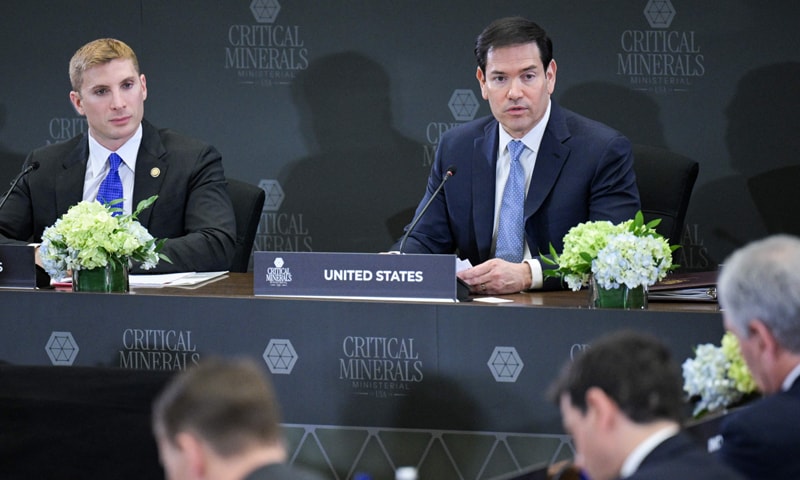
The United States (US) has unveiled a proposal to establish price floors for critical minerals and create a preferential trading arrangement among participating countries, an initiative that Pakistan is approaching cautiously as it seeks to balance relations with both Washington and Beijing.
Read More: Pakistan, US kick off 13th counter-terror drill
US Vice President J.D. Vance outlined the plan during a two-day meeting in Washington attended by representatives from more than 50 countries. He said the proposal aims to stabilise prices of critical minerals essential for clean energy, advanced technology and defence industries, arguing that sharp market fluctuations have discouraged long-term investment.
Diplomatic sources in Washington said Pakistan has been briefed on the initiative but has not yet committed to it. Islamabad was represented at the meeting by Federal Minister for Energy Ali Pervaiz Malik rather than a senior political delegation, reflecting what officials described as a calibrated approach to a proposal widely viewed as targeting China’s dominance in the global critical minerals supply chain.
Speaking at the gathering, Mr Vance said volatile pricing had made sustained investment in the sector “nearly impossible,” particularly when foreign supplies flood markets before new projects become commercially viable. He proposed setting reference prices at each stage of production, which would function as price floors for members of a preferential trading zone, maintained through adjustable tariffs.
The initiative is part of a broader US strategy to reduce reliance on China, which accounts for around 60 per cent of global critical mineral production and nearly 90 per cent of processing and refining capacity. US officials have repeatedly described this concentration as a strategic vulnerability.
US Secretary of State Marco Rubio, who hosted the inaugural Critical Minerals Ministerial, said the effort was aimed at strengthening economic security through diversified and resilient supply chains. India’s External Affairs Minister S. Jaishankar also highlighted the risks of excessive concentration and called for structured international cooperation to de-risk supply chains.
Read More: Pak-US relations enter new era in 2025, reports Washington Times
Pakistan, believed to hold significant but underdeveloped reserves of copper, gold and rare earth elements, used the meeting to showcase its mineral potential while avoiding any overt alignment against China. Islamabad is set to host the Pakistan Minerals Investment Forum in April, with both the US and China invited, as it seeks to attract foreign investment and unlock an estimated $6–8 billion in annual mineral export potential.