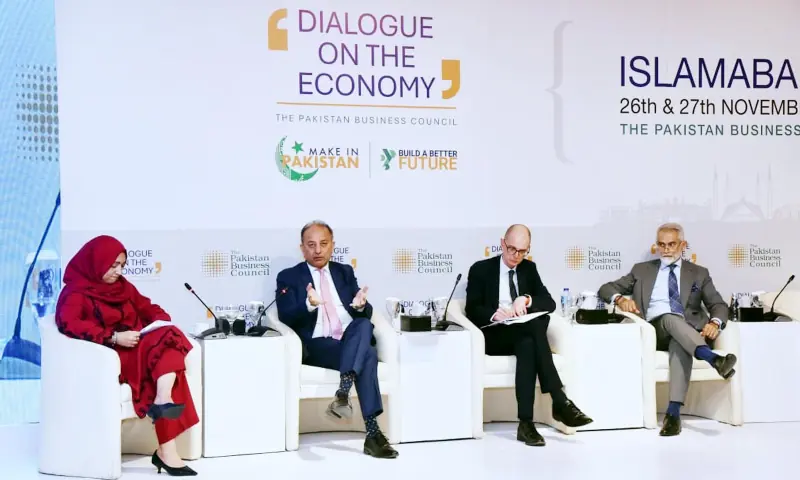
ISLAMABAD: Federal Minister for Climate Change Senator Musadik Malik on Wednesday issued a stern warning about the scale of climate-driven devastation facing Pakistan. Speaking at the 4th edition of the Pakistan Business Council (PBC) Dialogue on the Economy 2025, he urged policymakers, businesses, and international partners to address the country’s climate vulnerabilities with urgency.
Read More: Earth heats faster as climate crisis deepens globally
The event, which also marked PBC’s 20th anniversary, brought together senior ministers, economists, corporate leaders, and global partners to discuss Pakistan’s economic direction. Organisers highlighted that clarity, predictable reforms, and stronger institutional collaboration were essential for sustainable growth and business resilience.
Musadik Malik noted the staggering human impact of Pakistan’s recent floods. Between 4,600 and 4,800 people lost their lives, 18,000 were injured or permanently disabled, and nearly 40 million were displaced. In the most recent flood, around three million people were uprooted, including over 1.5 million school-going children, resulting in nearly 120 million lost school days in a single event.
Pakistan has called for urgent and equitable climate finance, enhanced technology transfer and stronger global cooperation to support climate-vulnerable countries@ClimateChangePK @Team_Musadik @DrMusadikMalik @ForeignOfficePk #RadioPakistan #ClimateChange… pic.twitter.com/TRBw8YmSWd
— Radio Pakistan (@RadioPakistan) November 22, 2025
The minister also outlined the economic toll of recurring climate disasters. The 2022 floods alone caused losses equivalent to 9.8 percent of GDP, while the last four major floods led to damages ranging from 1.5 to 9 percent of GDP. He warned that Pakistan’s location below Himalayan glaciers places it on the frontline of climate risk, despite contributing less than 1 percent of global emissions.
Other threats highlighted included worsening smog, crop-cycle disruptions, looming food insecurity, and glacial melt affecting irrigation systems. Sam Waldock from the British High Commission emphasised that climate inaction now directly affects business operations, with displacement, agricultural, and asset losses estimated in the hundreds of billions of dollars.
Read More: Climate change: causes, outcomes in Pakistan and a way forward
The PBC announced a Climate Risk Awareness Toolkit to help smaller firms assess vulnerabilities. Both speakers stressed that integrating climate risk into business planning, adopting resilience strategies, and accessing climate-finance tools are essential steps to mitigate the growing crisis.