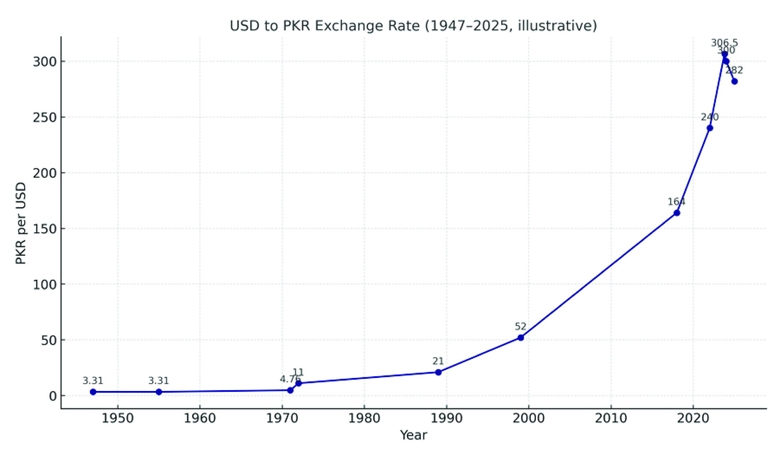
 When Pakistan gained its independence in 1947, the exchange rate in 1 United States Dollar (USD) to Pakistan rupee (PKR) was ~ Rs 3. Today, as of 17th September 2025, the rate of USD to PKR is Rs.282 per dollar. Couple of Rupees during the first decade of independence had the purchasing power of hundreds of Rupees today; for example, petrol prices were PKR 2 per liter in 1950s and are now nearly PKR 300 per liter in 2025, the change attributed to a decline of PKR against USD in the forex market, as oil is priced in USD globally.
Although, part of price increases can be due to global inflation in recent years, the depreciation of PKR against USD in the international currency market has also played a crucial role in raising prices of imported products over the years.
Historically, PKR was strong in its introductory years; 1 USD = 3.31 PKR from 1947-1955, while 1 USD = 4.76 PKR from 1956-1971. A devaluation- that is the government deliberately changing the price of the currency under a fixed exchange rate system- caused PKR to skyrocket to 11 per USD in 1972, but this was to boost economy through exports.
However, fixing the rate led to eroding foreign exchange reserves, which ultimately lead to change to managed float exchange rate system (allowing the rate to be influenced by market forces of demand and supply of currency within a given range) in 1982. Pakistan also had to face significant trade deficits (import expense exceeding export revenue) during the 1980s, eventually forcing the government to rely on foreign borrowing to finance the deficits. All these pushed the rate to PKR ~21 per USD in 1989.
In 1990s, there was a change to a free-floating exchange rate system; market forces were able to influence the rate without no restrictions, exposing PKR to market volatility.
There were other challenges:
political instability and frequent government changes undermined investor confidence and reduced foreign investment; poor economic policies led to balance of payments instabilities, causing International Monetary Fund (IMF) to intervene and change nations’ policies; nuclear tests were followed by international sanctions, causing huge blows to the economy. All these hurdles pushed the rate to PKR 52 per USD in 1999.
The depreciation did not stop there. In 2000s and 2010s, current account, trade and fiscal deficits were still persistent, leading to debt- fueled operation of the economy. This in turn, coupled with 2008 global financial crisis and high interest rates in United States, discouraged foreign investment in Pakistan. Also, in 2008, peaked oil prices increased demand for USD. All these factors led to a sharp fall in PKR.
“According to a World Bank-cited report in Business Recorder (2011), Pakistan’s real effective exchange rate had already depreciated by 34% since 2007, reflecting ‘large and persistent structural macroeconomic imbalances”.
In 2020, Covid-19 further disrupted transport of supplies across countries, causing more extreme negative trade balances. By mid-2022, the rupee crossed the 240 marks, marking its weakest at Additionally, 2022 floods resulted in $40 billion dollars’ worth of economic losses, further degrading PKR.
All the political and economic difficulties have been piling up for many years and almost all of them are still impacting the PKR price negatively to this day.
Impact on the locals has been severe. Rising import prices have meant that people cannot afford basic commodities, leading to more people entering poverty. Rising oil prices has had drastic consequences as well: petrol prices have risen; electricity breakdowns; transport costs have skyrocketed; trade deficit worsens further; and inflation has risen, increasing cost of living and reducing living standards.
Other currencies such as The Great British Pound, have also seen a decline against the USD but at a low steady rate, instead of a steep one.
In conclusion, PKR is in desperate need of remedial policies. Solutions, to stabilize PKR rate against USD, can be highly subjective, as it depends upon several factors including political will and pace of economic reforms. Dr Ishrat Husain, former Governor of the State Bank of Pakistan, once noted: “Pakistan needs to strengthen its institutions and adopt consistent policies to attract investment and promote sustainable growth. Without these structural reforms, currency pressures will persist regardless of short-term measures.” Following from this, long term measures such as to use renewable energy sources to reduce dependence on oil, export diversification, and lowering import expenditure on non-essential items could contribute to the desired revival of PKR.