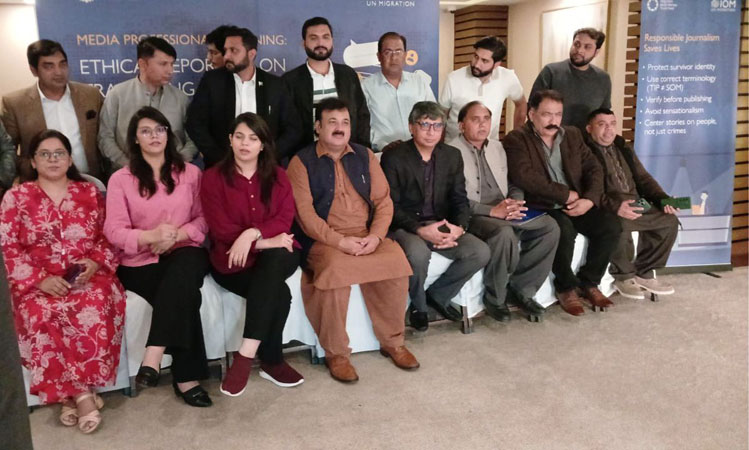
 A three-day workshop was organized in Murree by the International Organization for Migration (IOM) in collaboration with the United Nations (UN) to help journalists understand the key differences between Human Trafficking and Migrant Smuggling.
Trainer and senior journalist Aoun Sahi explained that Migrant Smuggling refers to the act of illegally transporting a person from one country to another for the purpose of unlawful entry, while Human Trafficking involves the buying, selling, coercion, or deceitful recruitment of people for forced labor, sexual exploitation, or other inhumane purposes.
He emphasized that both are separate crimes with distinct legal definitions and punishments.
According to Aoun Sahi, Migrant Smuggling is a $200 billion global business, controlled by large international mafias.
Participants noted that in Pakistan, FIA and other relevant authorities are not effectively performing their roles.
The workshop clarified that according to international law, Human Trafficking falls under the jurisdiction of the police, not the FIA. However, in Pakistan, there is confusion and overlap among investigative bodies.
Journalists cited the existence of a Human Trafficking Cell within the FIA as an example of this institutional misunderstanding.
The workshop, supported by UN and IOM, also highlighted the urgent need for the state to take stronger actions to stop illegal migration (known as “Dunki”).
Senior journalist Aoun Sahi revealed that educated youth are now being trapped by agents offering fake IT jobs in countries like Thailand and Cambodia, where victims are later exploited for illegal activities.
Participants pointed out that a well-organized network of human smugglers is still operating across Pakistan, especially in Punjab.
They added that even after tragic boat incidents in Libya and Greece, the illegal business continues – with agents now charging higher rates.
The workshop concluded with a collective call for state institutions, law enforcement, and media to work together to end this dangerous trend.