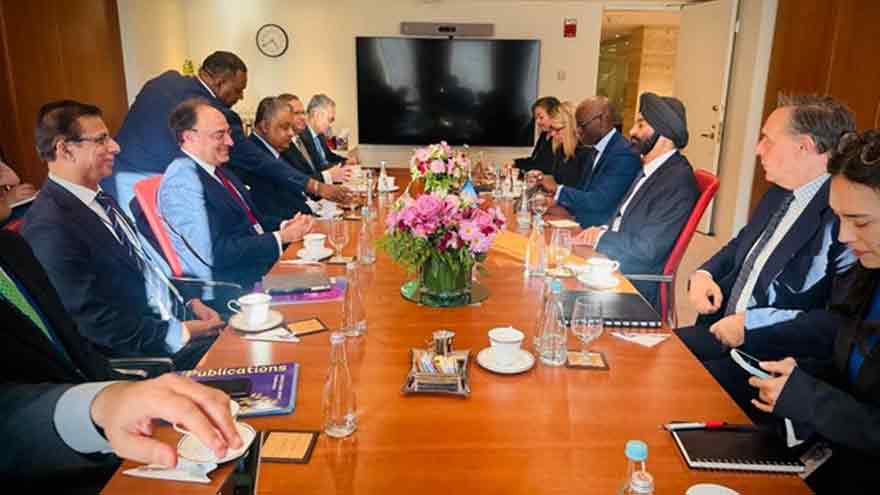
ISLAMABAD – Federal Minister for Finance and Revenue Senator Muhammad Aurangzeb continued his fifth day of engagements in Washington, D.C., where he is attending the Annual Meetings of the International Monetary Fund (IMF) and the World Bank Group.
During his meeting with World Bank President Ajay Banga, Aurangzeb discussed Pakistan’s flood recovery efforts and appreciated the Bank’s continued support in post-disaster rehabilitation. He endorsed using technology and cooperatives to reach small farmers and thanked the Bank for its assistance in shaping Pakistan’s new Tariff Policy.
Read More: Salesforce Sued by Authors Over Artificial Intelligence Software
He also informed the World Bank chief about the signing of MoUs with provinces for implementing the Country Partnership Framework (CPF) and requested additional support under the IDA window, given Pakistan’s reduced allocations. Both sides agreed on adopting a comprehensive approach to reforms in the gas and power sectors.
In a separate meeting with UK Minister for International Development and Africa, Baroness Jenny Chapman, Aurangzeb lauded the UK’s development partnership and acknowledged its contribution to the Digital Dashboard initiative.
Read More: Trump Issues Fresh Warning to Hamas Over Gaza Violence
Later, addressing a high-level event titled “Financing in a Fragmented World”, the minister outlined global growth challenges for 2025–26, including rising trade barriers and declining energy prices. He noted that despite global headwinds, Pakistan’s economic outlook was improving due to its IMF Staff Level Agreement (SLA), ratings upgrade, and key geopolitical partnerships with China, the U.S., and Saudi Arabia, as well as the launch of CPEC 2.0.
Aurangzeb emphasized that global trade fragmentation was driving countries to strengthen regional corridors and diversify partnerships, while climate change remained an existential threat for Pakistan following devastating floods.
Read More: Australia Eyes Rare-Earth Deal with US Amid China’s Export Ban
During his meeting with TCX leadership, he welcomed collaboration to develop hedging mechanisms for local currency loans and shared Pakistan’s plan to extend debt maturities to mitigate refinancing risks. He also revealed that Pakistan intends to re-enter international capital markets through Panda Bonds, Eurobonds, and Sukuk issuances.
In talks with Dr. Adnan Chilwan, Group CEO of Dubai Islamic Bank, Aurangzeb commended DIB’s role in arranging Pakistan’s sovereign Sukuk and discussed upcoming privatization initiatives, including the First Women Bank. He reaffirmed Pakistan’s intent to diversify funding across USD, Panda, and Sukuk markets. Meetings were also held with Sharjah Islamic Bank and Ajman Bank to encourage greater participation in Pakistan’s upcoming financial instruments.
Read More: Orbán Celebrates Hungary as the Only Place for Trump-Putin Talks
In his meeting with Dr. Hajar El Haddaoui of the Digital Cooperation Organization (DCO), Aurangzeb reaffirmed Pakistan’s commitment to digital transformation in key areas such as IT, payments infrastructure, and e-governance, and welcomed the DCO’s plan to expand its footprint in Pakistan.
He also met officials from Fitch Ratings, thanking them for upgrading Pakistan’s credit rating to B- (stable). Aurangzeb expressed optimism for further improvement as Pakistan sustains reform momentum in taxation, energy, SOEs, and privatization.
Read More: US Shutdown Could Force Mass Layoffs of Nuclear Staff
Concluding the day, the finance minister joined a Roundtable on Pakistan’s economic future hosted by the Peterson Institute for International Economics (PIIE), where he detailed fiscal reforms, the IMF program, and progress at the Federal Board of Revenue (FBR) focused on people, processes, and technology.
Earlier, he attended a World Bank reception hosted by Axel van Trotsenburg in honor of Singaporean President Tharman Shanmugaratnam, and gave an interview to China Global Television Network (CGTN) highlighting Pakistan’s reform agenda and international engagement priorities.