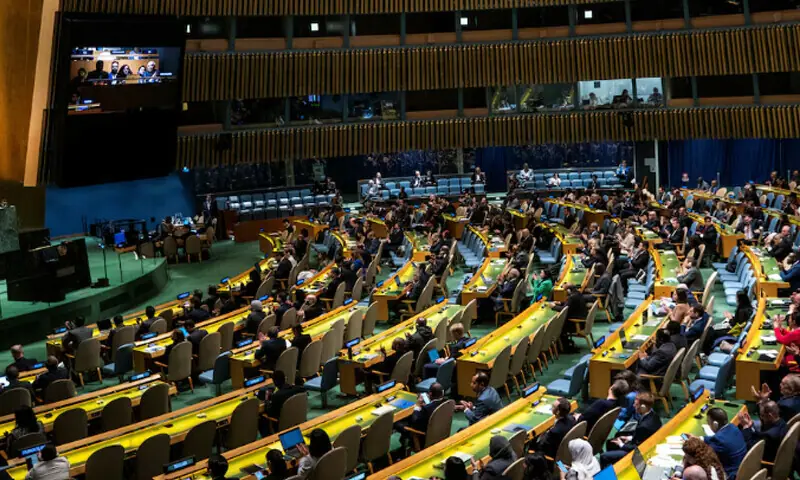
The United Nations General Assembly once again became a stage for fiery exchanges between Pakistan and India, as both countries traded accusations despite Indian Prime Minister Narendra Modi’s absence from the 80th session. Although there was no direct confrontation between the two premiers this year, the “Right of Reply” segment witnessed sharp remarks, reviving decades-old rivalry that frequently dominates such gatherings whenever both nations present their cases.
Prime Minister Shehbaz Sharif recalled the May 2025 conflict, asserting that Pakistan’s armed forces had downed seven Indian fighter jets during clashes. He praised former U.S. President Donald Trump for brokering a ceasefire and lauded him as a “champion of peace.” Sharif further revealed that Pakistan had even nominated Trump for the Nobel Peace Prize, stressing that the request for ceasefire had, in fact, been initiated by New Delhi, indirectly challenging India’s narrative.
Read more : Pakistan blames India for sponsoring terrorism at UN
However, India swiftly rejected these claims through its UN representative, First Secretary Petal Gehlot. She argued that Indian forces had inflicted heavy damage on Pakistani airbases and insisted that Pakistan itself had sought ceasefire following the failure of “Operation Sandur.” By presenting this account, New Delhi attempted to project strength while dismissing Islamabad’s version of events as fabricated and misleading.
Pakistan’s diplomat Saima Saleem strongly countered India’s remarks, calling them a “false narrative” aimed at hiding battlefield failures. She accused India of operating as both a “democracy in disguise” and “the world’s biggest factory of fake news.” Saleem further alleged that India sponsors terrorism at home and abroad, using it as a state policy to spread fear and destabilize the region. She stressed that Pakistan had defended its sovereignty during the May conflict and emerged stronger despite Indian aggression.
Meanwhile, Indian Foreign Minister Subrahmanyam Jaishankar, addressing the Assembly, warned the international community against “turning a blind eye” to nations supporting terrorism. Without naming Pakistan directly, he claimed that a single neighboring country served as a hub of global terrorism and had links to many major international terror incidents. He reiterated that India would always exercise its right to defend its people against such threats.
In a dramatic turn, a senior Indian diplomat walked out of the session following Pakistan’s scathing response. Pakistani diplomat Muhammad Rashid accused India of running covert networks to sponsor cross-border terrorism, undermining its credibility on the world stage. He added that numerous reports confirmed India’s destabilizing activities in neighboring states, calling them a routine violation of international law. Rashid emphasized that such behavior not only exposed India’s double standards but also raised serious doubts about its anti-terrorism claims.