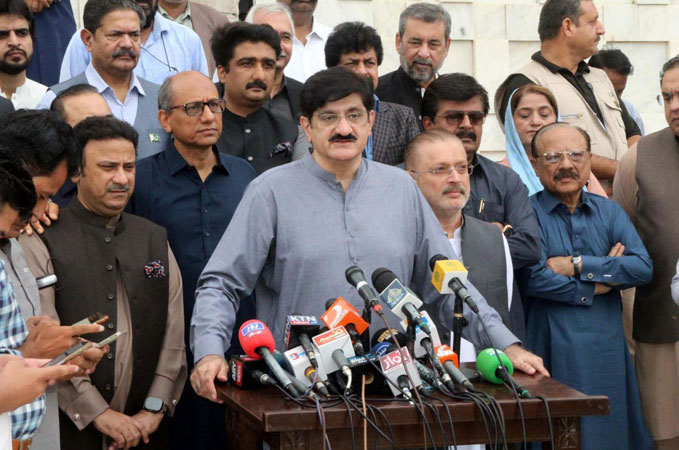
 Sindh Chief Minister Syed Murad Ali Shah has said that unplanned expansion in the city has created serious issues, but his government, with support from the World Bank, is implementing a comprehensive Master Plan covering transport, water supply, drainage, waste management, and more.
He said this while speaking to the media shortly after paying his respects to the father of the nation, Quaid-e-Azam Muhammad Ali Jinnah, on the 77th death anniversary of Pakistan’s Founder. The CM paid respects at Mazar-e-Quaid on Thursday, accompanied by cabinet members. The Chief Minister laid a floral wreath, offered prayers, and paid tribute to Quaid-e-Azam’s sacrifices.
Addressing Karachi’s unplanned urban growth, the Chief Minister stressed the importance of human-centric solutions. “During a recent visit to the Lyari River, numerous informal settlements were identified. Protecting residents from displacement without sufficient resources remains a priority,” he said.
The Sindh government has completed World Bank-supported studies for the Karachi Master Plan, covering transport, electricity, water supply, drainage, waste management, and general development. Infrastructure upgrades include construction on Bhutto Road, a 39 km highway linking Qayyumabad to the M9 motorway, the CM said. He added that 37 kilometres of new road and a two-km link road are under construction, with 15 km currently in safe, active use.
Mr Shah said that water pressure issues have been addressed by erecting retaining walls, with ongoing monitoring overseen by him. “The Shahrah-e-Bhutto project is valued at Rs 52 billion under a public-private partnership, managed by developers, engineers, financial institutions, and project managers,” he said. He expressed gratitude to Allah for the project’s success and public approval.
Syed Murad Ali Shah emphasised that Pakistan can progress towards development and stability by adhering to Quaid-e-Azam’s principles. He highlighted the importance of hard work and commitment, especially among the youth, to realise the vision of the nation’s founder. “Pakistan is a result of the efforts and sacrifices of Quaid-e-Azam. We must remain committed to his values of unity, faith, and discipline,” he stated.
The CM further expressed hope for a brighter future, praying for prosperity for upcoming generations. He also recalled the significant contributions of Shaheed Zulfikar Ali Bhutto, who led Pakistan to become a nuclear power, and Shaheed Benazir Bhutto, for advancing the country’s defence.
Mr Shah mentioned that the nation recently stood united to counter Indian aggression, referencing the events in May. He strongly condemned ongoing Indian atrocities in Kashmir as well as Israeli aggression in Palestine and Qatar, calling for unity within the Muslim Ummah to respond collectively to such actions. He asserted that just as Pakistan challenged Modi’s actions, similar unity is needed to end Israeli hostilities.
Addressing the current flood situation, the Chief Minister stated that while Punjab, Khyber Pakhtunkhwa, and Gilgit-Baltistan have suffered flood damage, the Sindh government is taking all possible steps to minimize losses under the leadership of the Pakistan Peoples Party. The safety of lives and the protection of barrages and embankments remain top priorities, he reiterated, noting that federal agencies and NDMA are also supporting efforts under the Prime Minister’s directives.
Chief Minister Shah gave a call for unity and constructive discourse, stating, “Developed countries too face natural disasters. Only collective effort and public cooperation will help us overcome these tests. May Allah have mercy on all of us.”
The Chief Minister of Sindh provided a detailed briefing to the media regarding recent flood management efforts, infrastructure development, and water projects across the province.
The Chief Minister recalled the severe flood of 2010 that broke the Todhi bund and posed a serious threat to the Sukkur Barrage. Since then, smaller and medium floods have occurred, but protective measures, supported by the grace of Allah, have helped manage the situation.
Sukkur Barrage, an engineering masterpiece built in 1932 by expert engineers, faced an unprecedented situation where 10 gates had to be closed after three years. Instead of simply closing the gates, concrete was used to seal them, showcasing engineering innovation. Originally designed to pass 1.5 million cusecs of water, after closing these gates, the capacity decreased to 960,000 cusecs. To date, 1.1 million cusecs of water have flowed through the barrage.
Mr Shah said that maintenance efforts focus on gate replacement, which is critical for the barrage’s longevity and capacity. For the first time since its construction, the barrage floor was opened and repaired to extend its durability. Studies are also underway to enhance the barrage’s capacity in response to changing climate conditions.
To a question, Murad Shah said that flood control efforts include ongoing work on Ulra Jageer bund in Khairpur and addressing 45 high-risk locations. Work is also progressing on several bunds in Matiari, Thatta, Sujawal, and on the right side in Larkano, reflecting comprehensive provincial flood prevention measures.
The Chief Minister expressed gratitude for the protection provided by Allah and highlighted the dedication of the entire administration in facing recent challenges. He noted past instances of heavy rainfall in Karachi during 2006 and 2007, which caused significant casualties and widespread urban flooding.
Murad Shah said that in 2020, the city experienced record rainfall, resulting in substantial water accumulation in low-lying areas. He said he personally monitored the situation and witnessed rapid drainage the following day.
Talking about August 19 in the city, the CM said that heavy rainfall exceeded predictions, but the water drained efficiently by 9 pm. He added that during the ongoing rainfall, the administration, including Rescue 1122, PDMA, district officials, police, and elected representatives, remained fully mobilised.
Mr Shah, discussing the flood in different areas of Karachi, said that flood warnings in the border areas between Sindh and Balochistan were not forecasted. Water flowed through feed channels onto the Motorway/Super Highway and Saadi Town. He added that Infrastructure challenges at the M9 motorway are being addressed through ongoing interventions, with water crossing permissions pending.
Following floods in 2011, 2012, and 2022, interventions include clearing blockages and enhancing infrastructure on the left and right banks of major water bodies, including Manchar Lake. The Chief Minister acknowledged the global difficulty of flood management, stressing the need for unity, positivity, and continued political will. Water projects require both technical expertise and sustainable political commitment.
To a question regarding delays in the new Gaj Dam project (District Dadu), Mr Shah said that he won’t give a negative statement at this stage, but he urged the federal government to accelerate construction.