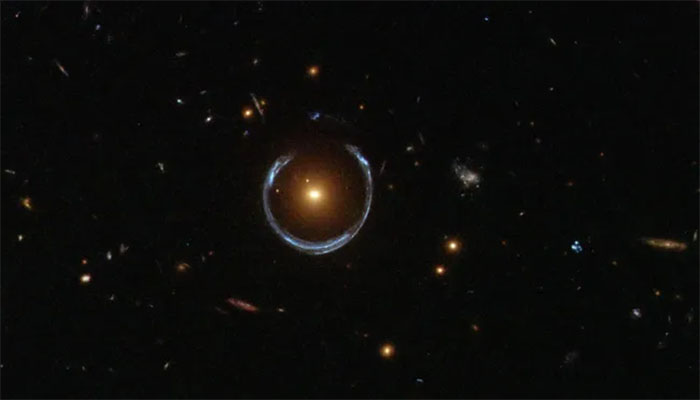
Scientists have announced the discovery of the largest black hole ever detected in the universe. This supermassive black hole is located about 5 billion light-years from Earth. It weighs an astonishing 36 billion times more than our Sun, making it one of the heaviest objects ever observed.
The black hole is also 10,000 times more massive than the one at the center of our own Milky Way galaxy. The findings were published in the Monthly Notices of the Royal Astronomical Society. This black hole resides in a distant galaxy called the “Cosmic Horseshoe,” named after its unique shape caused by gravitational effects.
Its enormous gravity is so strong that it bends the fabric of space and time around it, affecting the paths of particles and even light traveling nearby. Scientists used a powerful technique known as gravitational lensing to spot this black hole. This method treats a closer galaxy as a giant natural lens, magnifying and distorting the light from faraway objects behind it.
By carefully analyzing this distorted light, researchers were able to detect the hidden presence of the black hole billions of light-years away. Scientists at the University of Portsmouth in the UK led the research and say this black hole ranks among the ten biggest ever discovered, and may be the largest known to date.
What makes this discovery even more remarkable is that the black hole is “dormant” or inactive, meaning it is not currently pulling in gas or matter. Typically, dormant black holes are very difficult to observe because they do not emit much light or energy. However, gravitational lensing enabled scientists to detect this quiet giant.
Interestingly, the black hole was discovered accidentally while the researchers were studying the distribution of dark matter in the “Cosmic Horseshoe” galaxy. This unexpected find offers a new way to study dormant black holes and the role they play in galaxy formation and evolution.