
The war in Vietnam continues to haunt the American psyche. A new TV series on PBS documents in 18 painful hours what happened and why. The first episode was watched by 13 million people, the biggest audience for a PBS programme since the finale of ‘Downton Abbey.’
As expected, the production has stirred a hornets’ nest. Some claim it overlooks the role of the anti-war movement for ending the war. Others say that it does not condemn the US for attacking Vietnam without any provocation. The latter argue that the Vietnamese under Ho Chi Minh were fighting a war for national liberation against the French. After eight years, the French were vanquished in a final battle in 1954.
Concerned that Vietnam would fall to communism, the CIA launched what was then a covert war through a puppet regime in Saigon. That theme was highlighted in Graham Greene’s book, The Quiet American, which was released as a film in 2001.
In 1964, President Johnson alleged that North Vietnam had attacked American naval vessels. A panicked Congress passed the Gulf of Tonkin resolution and Johnson authorized the bombing of North Vietnam.
A few months later, the first American troops landed in Vietnam. In his typical Texan drawl Johnson thundered, “No one should think for a moment that we will be worn down, nor will be driven out.”
On the other side of the PBS documentary are those who claim it does not give enough credit to the US for fighting a necessary war to prevent South Asia from falling into the Communist camp during the Cold War, per the Domino Theory, and for the bravery and heroism shown by American troops who were fighting an invisible enemy.

At one point, the US had more than half a million troops in Vietnam. Some 58,000 American died in the war, a number which pales in comparison to over 3 million people from Vietnam, Cambodia and Laos who died, most of them civilians.
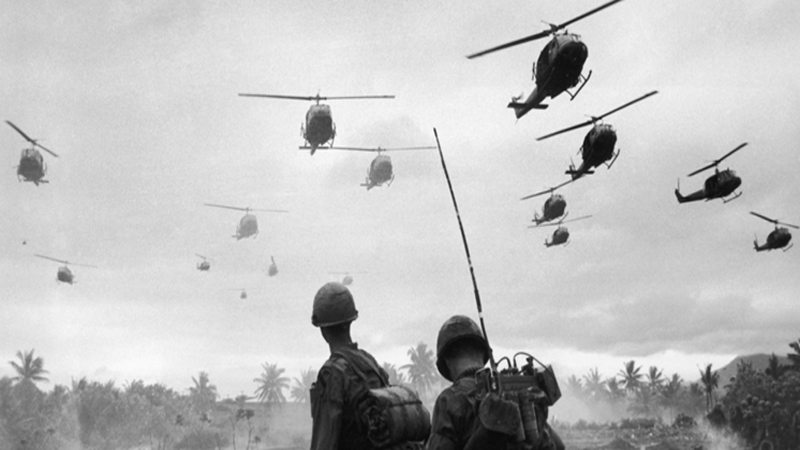
The images of the war are seared in memory.
In his 1997 book, Dereliction of Duty, General McMaster, the current US National Security Advisor, published a terrible indictment of US foreign policy and defense policy during the war.
Robert McNamara’s1995 book, “In Retrospect”, was equally damning of the war, of which ironically he was the main architect and strategist. A Harvard MBA, he was the president of Ford Motor Company when President Kennedy asked him to become the Secretary of Defense. He went on to become the longest serving secretary of defense. He later admitted, “We were wrong, terribly wrong. We owe it to future generations to explain why.” He went on to become president of the World Bank, which some saw as a chance for him to expiate for his sins.
But General Westmoreland, the US commander in Vietnam, was unrepentant. He felt the US had won the war militarily and lost it politically. He continued to think that in 1968 the US had defeated the North Vietnamese during their Tet offensive.
In fact, the massive US response to the North Vietnamese backfired. It shocked the American public. They were outraged by the escalation of hostilities. Protest rallies were held around the country, armed with the battle cry: Hey! Hey! LBJ! How many kids did you kill today? The national outcry convinced President Johnson not to seek re-election.
National security advisor to presidents Kennedy and Johnson McGeorge Bundy did not want to negotiate peace with the North Vietnamese. As brought out in the 2008 book, Lessons in Disaster, Bundy thought they could be hammered into submission by American firepower.
In 1982, Colonel Harry Summers wrote ‘On Strategy. He showed how the US had violated Clausewitz’s tenets of warfare in the Vietnam War. He narrates a conversation between himself and a Vietnamese colonel in Hanoi soon after the war ended. Summers tells his counterpart that the US never lost a battle to them. The Vietnamese retorts, “That is totally irrelevant since you lost the war.” Summers also reports a startling statistic; at the height of the conflict, 70 percent of American generals did not know why the war was being fought.
In my view, the US largely lost the war entirely due to it’s hubris. General Curtis Le May, a former air chief, felt that if the North Vietnamese did not fall in line, he would simply bomb them back to the “Stone Ages.” He was even prepared to use nuclear weapons to end the war. Prior to starting his infamous massive bombing campaign in 1972, President Nixon told his aides “The bastards have never been bombed like they’re going to be bombed this time.”
His national security advisor, Henry Kissinger, thought the North Vietnamese were a fourth-rate power that would be compelled into surrender by military force. Somebody forgot to share the joke with him which gained currency on MacNamara’s appointment to the defense department. He had brought his systems analysis skills to the post and fed all the data into a computer to find out how long it would take to win the war. The computer, focusing only on the enormous military superiority of the US, told them, “You won the war in 1962.”
After the war ended in abject humiliation for the US, wrong lessons were drawn. President Nixon believed that he had won the war but it was Congress that lost the peace. General Westmoreland, who commanded US troops in Vietnam until 1968 and later was promoted to army chief said he could won have the war with a million troops.
As MacNamara noted in his memoirs, America never learned the three key lessons of the war. These were to understand the mindset of the adversary, never unilaterally apply military power, and accept the fact that some problems have no military solution.

Last year, I visited the War Remnants Museum in Saigon. It is filled with pictures upon pictures of bombing victims, and displays after displays of captured US hardware. Not too far away from Saigon you can walk through the tunnels from where the Viet Cong pestered US forces. The Vietnamese have preserved for posterity the tragic and awful memories of what they rightfully call The American War.
History tells us that it is not easy for the US to fight a short war. The wars in Afghanistan and Iraq, one dating back to 2001 and the other dating back to 2003, are still ongoing. Deposing Mullah Omar and Saddam Hussain was the easy part. Maintaining law and order has been difficult. Even Kissinger thinks the US lost both wars.
These days North Korea is in the cross-hairs of the American establishment. A recent poll has disturbingly found that 50 percent of Republican voters are in favor of going to war with North Korea, a country armed with nuclear weapons and long-range missiles. The US has never attacked a nuclear power. Let’s hope that fact alone will lead to restraint.
The world does not need another General LeMay at the helm of the world’s most powerful air force. The US should not embark on another march of folly. Three is enough.
The writer is a defence analyst and economist. He writes on military history, can be reached at [email protected]
Published in Daily Times, October 22nd 2017.