
Sindh harbours enormous monumental, classical and historical buildings, tombs of Sufi saints, forts, mosques and imperial palaces that have splendid and impressive architectural exquisiteness and attractiveness. Most of these beautiful architectural structures were constructed during the period of the Mughal Empire in India. During the Mughal Empire, Sindh had been ruled by the Kalhora and Talpur dynasty respectively. Not unlike some of the rulers of the Mughal Empire, a few of the rulers of the Talpur family were keenly interested in the erection of unique, monumental and outstanding structures.
Khairpur, one of the districts in interior Sindh was a separate state ruled by the Talpur Dynasty from 1783 to 1955. The state of Khairpur, as claimed by one of the descendants of the Talpur rulers, was the only state in pre-partition India that had established air-conditioned textile mills and had imported air-conditioned buses from the United Kingdom for its people. At the time of Partition, the then Talpur ruler had agreed to make Khairpur state a part of Pakistan. In 1955, the government of Pakistan announced the abolition of all the princely states and thus Khairpur was annexed into the new province of West Pakistan. Khairpur houses the tomb of the better known Sufi saint Sachal Sarmast and it is famous all over Pakistan for its date’s production, which plays a overarching role in Pakistan’s economy. Talpur rulers generally called Mirs were the rich and wealthy rulers, who loved constructing monumental buildings with royal grace, some of which have attracted the interests of national and international tourists.
The Royal Classical Architecture of Faiz Mahal
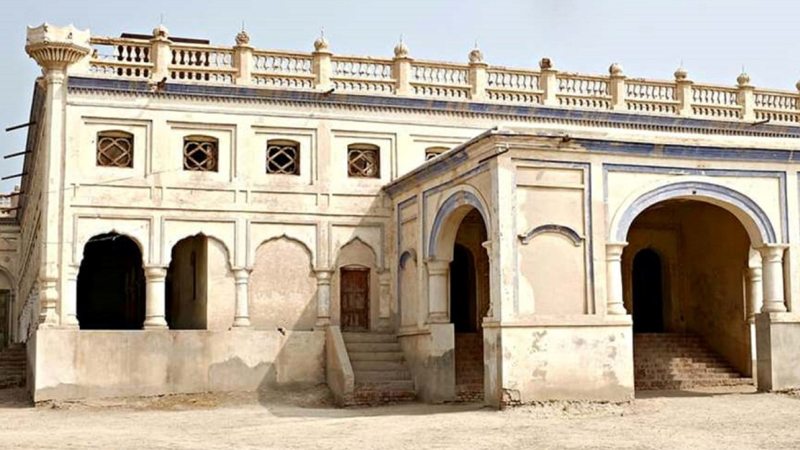
Erected two hundred and nineteen years back in 1798 by Mir Suhrab Khan, one of the rulers of Talpur dynasty, Faiz Mahal, the royal palace with classical and unique architectural design was the residence of Talpur rulers of Khairpur state, which is now known as the “Talpuro ki aram garr”, or the “Talpurs’ resting place”.
The historical building of Faiz Mahal was the Talpur rulers’ court. It consisted of a ruler’s chamber along with 16 waiting rooms for courtiers and guest rooms for royal guests alongside the darbar and a dining hall. In the middle of the Mahal’s building there is a big central hall walled with portraits of Maharajas and princes of the Talpur family. The tremendous architecture of this palatial building is constructed on the patterns of the beautiful buildings of the Mughal Empire’s period. The palace’s stunning exterior view and its interior beautiful, cool and airy look decorated with unique calligraphy work, designs and handycraft reminds me of the old Mughal era buildings. Sindhi TV channels shoot dramas, songs, and different programmes related to Mughal, Talpur and Kalhora dynasties here in this building.
Mir Ali Murad Khan II, one of the descendants of the Talpur family, by profession an environmentalist had established an extraordinary flora and fauna safe haven called Mehrano reserve nearby Faiz Mahal that furthers its beauty, it is famous for its black buck and hog deer, which are rare in Sindh at the moment.
Under the Sindh Cultural Heritage (Preservation) Act, 1994, it is the legal obligation of Sindh government’s culture and tourism department to promote, protect and preserve ancient sites and objects of historical, archaeological, architectural, anthropological, ethnological, artistic, and national value
To maintain originality and attractiveness of an ancient and classical structure is an arduous and backbreaking task. , Credit goes to the present descendants of the Talpur family and the Sindh government for their untiring efforts at keeping this stupendous palatial architecture intact in its original form. As a result, even today its pulchritude and impressiveness attracts large crowds of the local, national and international tourists.
Sheesh Mahal
Built by Mir Faiz Muhammad, one of the rulers of Talpur family, the spectacular building of Sheesh Mahal is one of the many splendid edifices scattered throughout Khairpur district. From inside the building, there are hand-painted tiles on the ceilings, wooden carved doors and tinted windows. The interior of the corridor is adorned with profound colourful patterns. The main hall of the edifice has exquisite craft work on the walls and roof. The distinctive feature of the mahal, which distinguishes it from other buildings, is the glass and tiny pieces of mirrors which have been used immensely and expertly with the hand-crafted patterns. This is why the building is called Sheesh Mahal. The magnificent architecture shows that the rulers of Talpur dynasty were patrons of arts, crafts and classical structures. But unfortunately, unlike Faiz Mahal, the Sheesh Mahal is deteriorating. The edifice has lost its beauty. Its red brick boundary walls have eroded over time and have lost height due to the repeated road constructions beside them. The main gate of the building has been damaged to a great extend.
Kot Diji Fort
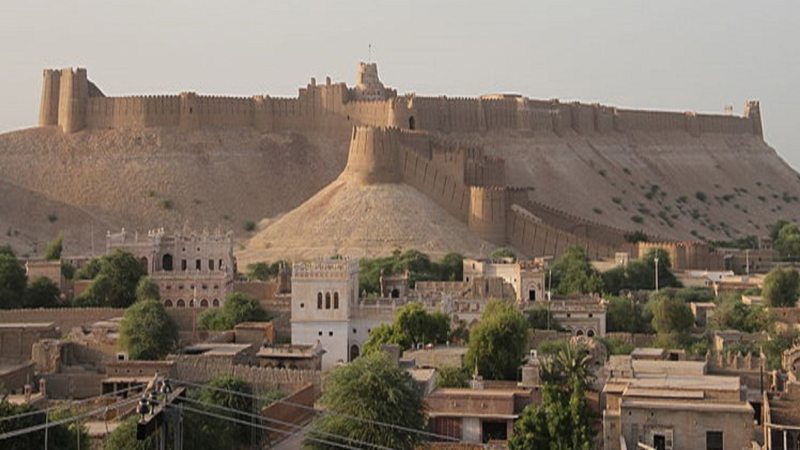
Built between 1785 and 1795 on the ridge of a steep narrow hill by Mir Suhrab Khan Talpur, one of the Talpur dynasty rulers, who reigned from 1783 to 1830, the Kot Diji Fort, formally known as Fort Ahmedabad is situated around 25 miles east of the Indus River at the edge of the Nara-Rajistan desert at the town of Kot Diji in Khairpur district.
After the Pakistan Department of Archaeology excavated this ancient site in 1955 and 1957, it was found that the hill site, where the pompous Kot Diji Fort was erected, and its lower habitation area belonged to the pre-historic early Harappan civilization, which dates back to about 3500 BCE. Pottery designed with horizontal and wavy lines or loops and simple triangular patterns has been found from this site. Furthermore, other unique objects found are pots, pans, storage jars, toy carts, balls, bangles, beads, terracotta figurines of mother goddess and animals. Though after the excavation of this pre-Harappan archaeological site in 1955-57 the signs of massive burning over the whole site including the lower habitation area and fortified town were found, but the main cause of the disruption and damage of the site is still mysterious.
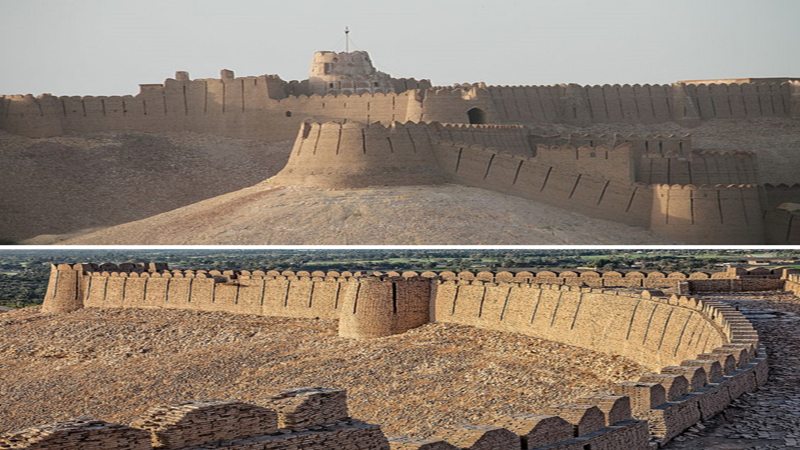
The structure of this emblematic fort is constructed on 110 feet high hill that rises above the Kot Diji town. The sumptuous fort with three strategically placed towers each measuring about 50 feet high and 30 feet tall walls that encircle its uppermost portion has narrow-wide boundary of around 1.8 kilometers. The fort is constructed with kiln-baked bricks and limestone. The fort has a water reservoir, which had been used for storing sweet potable water. There are some roofless rooms, which were used as ammunition storage, are locally called Barood Khano. Moreover, there are remains of prison, courtroom, numerous cells for troops and a small regal residence. It has only one main gate called Shahi Darwaza or the royal gate, which is the work of genius engineering. The fort is further guarded expertly by two heavy bastions. The access through the bastions is from the east, while the wooden gate with heavy iron spikes stands towards the western corner of the northern wall. The spikes ensured that no a huge contingent, or elephants could break open the wooden gate. This is why the fort was never attacked and considering it invincible Mir Talpurs had made it their royal residence. Unfortunately, because of the lack of repairing and maintenance work of its damaged parts, the archaeological treasure has been losing its originality and has been transforming into ruins.
Under the Sindh Cultural Heritage (Preservation) Act, 1994, it is legal obligation of the Sindh government’s culture and tourism department to promote the culture through protection and preservation of the ancient places and objects of historical, archaeological, architectural, anthropological, ethnological, artistic and national values but the department has not been taking concrete and constructive measures to preserve our centuries old civilization. However, not only these but hundreds of such other sites are at risk of obliteration in the province.
The writer is an academic, and can be reached on Twitter @ARShykh
Published in Daily Times, October 21st 2017.