

When journalists, activists, researchers or anyone who writes for a living are targeted for their work, they are posthumously recognised far and wide. But when they are alive, those echelons of fame are hard to come by. In aspiring to do so, some pay for it with their lives.
Pakistanis have often headlined on notable publications, but often as ones who have been killed for transgressing the inviolable boundaries that exist in severely violent societies.
Journalists, in their endeavours to investigate the truth and break the latest news, often become the most vulnerable targets. Responsibility for their deaths is often heaved onto the profession they follow, instead of state apparatuses which fail to punish violent groups and individuals. Always aiming to be ahead of the news or at its forefront has its price, and usually a very high one depending on the nature of the story.
A few weeks ago we heard of the assassination of award-winning Indian journalist Gauri Lankesh in the Indian state of Bengalaru. Gauri was a strong independent journalist who was known for her opposition to the ruling BJP and Prime Minister Modi’s alleged support to Hindutva extremists. She was brutally murdered outside her home on September 5 and her killers remain at large.
Gauri’s murder is another reminder of the vastly hostile world we live in. Pluralistic views are shunned and opposition to authority violently silenced. In India, female journalists are often the victims of cyberbullying and harassment.
With harassment comes violence or at least a desire to be violent. There’s hatred involved which, if unexamined, can go out of hand. Gauri was a victim of this because she stood up for the increasingly curtailed rights of minorities in India. She was known to call Dalit victims her ‘sons’, and wrote extensively against the BJP which rules in the centre. Although she was living in a majority Congress state, India’s current ruling elite was irked by her influence and her murder is a testimony to the threats dissidents of the state are vulnerable to.
India’s minority communities today are vulnerable to threats of the harshest kind. Gauri stood up for the Muslims and others castigated by a state rife with caste differences and upholding of the status quo.
A day before her murder, a ‘caravan of love’, (Karawan-e-Mohabbat) began in the state of Assam. Following Gauri’s death, it has picked up pace as it aims to atone for the violence against minorities and plead love and humanity in its place. It aims to travel across India to meet the families of people who have been victims of violence.
As the caravan edges towards the various areas of India, particularly to areas which have witnessed violence, it is likely to face opposition to its message. Bigotry and hatred are entrenched in the history and worldview we study and those are currently entrenched in the class and ruling system of the country.
A day before her murder, a ‘caravan of love’ began in the state of Assam. Following Gauri’s death, it has picked up pace as it aims to atone for the violence against minorities and plead love and humanity in its place
Like most minority groups, the vast mix of India’s minority citizens are likely to become submissive to the authoritarian rigour of their government and threatened by an aggressive majority. The few who don’t, are increasingly targeted, like Gauri.
Gauri’s death is a reminder of the impunity given to the murderers of journalists around the world.
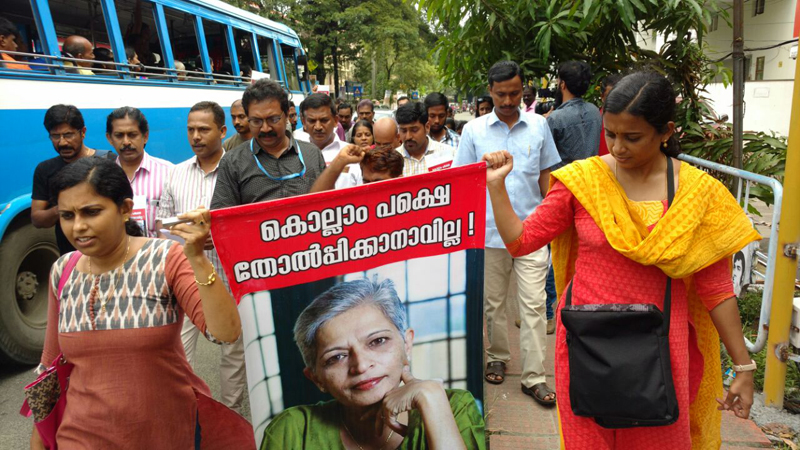
A week after her murder, residents, writers and social activists in Bengaluru took to streets, while her murderers still loom at large. Thousands of people gathered in a protest rally in Lankesh’s name, while also rallying for the cause and ideals she stood for.
Violent attacks on minorities including mob lynchings have risen exponentially since Prime Minister Modi’s government came to power in India. And the space for dissension is rapidly shrinking. Protesters wore headbands saying, ‘I am Gauri’ in a show of strength against those trying to silence dissent.
However, the extent to which these protests may just be a pithy tribute to victims of violence is yet to be seen. Lankesh’s case is quickly becoming an eerie reminder of the murder of MM Kalburgi, a rationalist and scholar who was murdered outside his house in North Karnataka two years ago.
Current reports suggest that Kalburgi and Lankesh may have been shot by the same 7.65-mm country-made pistol, which indicates that both their unidentified assailants may belong to the same outfit. That they still loom at large, especially two years following the murders, raises suspicions about the protection given to these groups. Journalists and lecturers are being targeted who have the largest potential to shape opinions and raise voices against unjust practices.
However, the more these attacks happen the more Indian support against them grows. Movements like KeM are evidence of this, which urges Indians to fight for the values in the Indian Constitution of liberty, justice and fraternity. But is a reminder of constitutional values of good citizenship likely to restore harmony amongst groups that have begun perpetuating violence? Or is a more effective show of support by the government required for catching the culprits and masterminds that dictate their actions.
Recently, the KeM has also been subjected to violence as it reached the city of Behror in Rajasthan where a dairy farmer was lynched by a mob of cow vigilantes.
The recent spats of violence are broadening the divide in a country which was once proud of its diversity. Now citizens of India repeatedly have to defend this. If the impunity granted to these perpetrators does not halt, the mobs and murderers are likely to be emboldened.
The writer is an Assistant Editor at Daily Times. She tweets @HumairaSaeed10
Published in Daily Times, September 19th 2017.