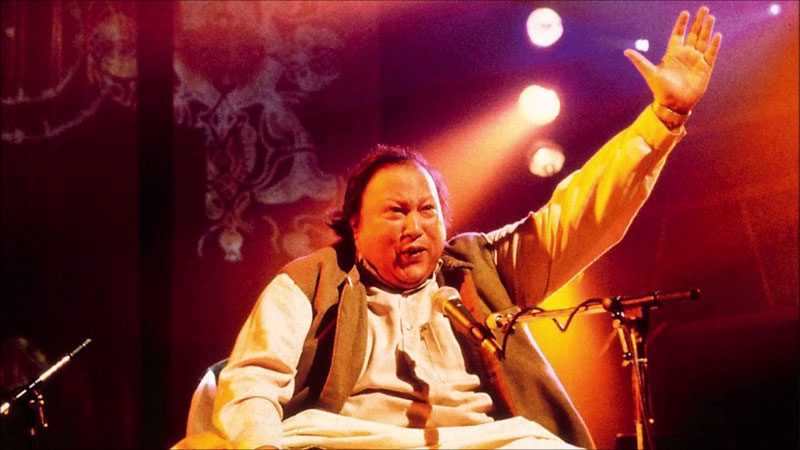
 So what if cross-border social-media musical collaborations are ruffling up some feathers. Last heard, paying homage to legends on the other side was still allowed.
It gets even better when progressive rock band Indian Ocean doff their hats to Ustad Nusrat Fateh Ali Khan’s immensely popular qawwali – Akhiyan Udeek Diyan. Yes, you read that right. Indian Ocean and qawwali, with a sprinkling of psy-trance riffs. “Qawwali, I feel, is the earliest forms of trance music,” says percussionist-vocalist Amit Kilam.
The song is like a walk in a pitch-dark forest, you walk, cautious of what you might step into, but you walk, in a trance, pulled by splashes of diverse sounds, familiar and unexplored. Therapeutic, in this lockdown. The melodic ad lib prelude starts slow with Kilam’s clarinet and Nikhil Rao’s layering of four guitar tracks and elongated notes as the beats pick up tabla player Tuheen Chakravorty’s khanjira. It was an experiment and added later, says Kilam, 46, as an evolving mood piece rather than start straight with rock. Rao’s otherworldly riffs take the listener to places where early Pink Floyd would have. “I was looking at the collaborations of Canadian guitarist Michael Brook and Nusrat Fateh Ali Khan, how Nusrat Saab produced his qawwalis in the Western fusion context,” says Rao, 35. The qawwali icon, too, dappled with rock in his collaboration with Eddie Vedder for the soundtrack for Dead Man Walking. To recreate the feel of clapping common in qawwali, Chakravorty, 33, fashions beats on the wooden tabla cover with a bowl of water – just enough so that it doesn’t spill – placed on it. While Kilam, who had vocally arrived with Mann kasturi re, had it in mind to somehow bring in the element of that one voice in the background in qawwalis that takes the high notes, and so he hits the ooncha sur. In one melody, it even seems, he might just break into an SD Burman folk number.
The wait has been long. Six years since their seventh album Tandanu. With this studio single, which has garnered 14,000 and counting YouTube views since its release on Friday, the band is treading unchartered territories. Indian Ocean 2.0 has a new sound while holding on to the classic essence. And, in these times of short attention spans, shorter music pieces, ear-bleeding remixes and poor copies, the band brings out an 11-minute song. It takes the Saraiki ang refrain/chorus from the original written by Khwaja Pervez, and coalesces it with Khwaja Ghulam Farid’s poetry – explored by not too many.
“Qawwali, in which a khayal runs through, allows you the liberty to add to it. Both Nusrat Saab’s song and Ghulam Farid’s lines have the same thought and desire, only the ‘yaar’ in the qawwali is the beloved while in Farid’s poetry, it’s God. The metaphor of crow cawing as a signal of a visitor has been used by many, like Shiv Kumar Batalvi, in their poetry,” says vocalist Himanshu Joshi, 57. The Kumaoni folk singer-filmmaker had to learn Punjabi for this song, which was recorded two-three years ago at YRF Studios. At the time, Times Music had approached them, besides other musicians like Karsh Kale, Midival Punditz, to do a song each for a tribute album to Nusrat Fateh Ali Khan, which didn’t see the light of day. The song – which they have been performing live – “wouldn’t have been possible,” says bassist-vocalist Rahul Ram, 57, “without Himanshu, who has literally grown in Jamia Millia Islamia. He brought a lot of that knowledge into the song. Qawwali is not what we do or know. We knew we won’t be able to do it in the old Indian Ocean way.” The basic “dhara is Nusrat Saab’s”, but the song’s structure has been reinvented, his tune only comes towards the end. “The entire thing is ours,” says Joshi.
Rolling Stone magazine wasn’t entirely wrong when it said Tandanu was their best album till date in 2014, because with the band, the best is always in the making. Akhiyan Udeek Diyan is the first track of their eighth album to be released online, rest will follow one by one, of which two are collaborations – with Grammy Award-winning ghatam doyen Vikku Vinayakram and California-based saxophonist George Brooks, who brings Hindustani and Carnatic elements to jazz and has played with tabla maestro Zakir Hussain.
“After Tandanu, we thought this is it, no more. It was exhausting to be surrounded by such musical genius. A lot of these guys are far superior to us, they had to bring themselves down to our level. For instance, Vishwa Mohan Bhatt knew that we could only play up to a certain speed, jhaala would be unattainable for us.” And yet, every time the band comes out with a new song, a critical mass pops its head to say, “woh mazza nahin aa raha, pehle jaisi baat nahin rahi”.
It has been routine for a decade now. “When people say they miss the classic line-up, they have all the right to. Even if we try, we won’t succeed, because the people were different,” says Chakravorty. “On Facebook, people say, nothing can replace that Indian Ocean,” says Ram, “that they miss Asheem-da and Sushmit-da. Yes, you do. Even I do. But what can I do about it? We decided to carry on and we are carrying on.”
“For a whole generation, their introduction to us have been through Tandanu or Masaan first, and then they went back to hear our older stuff. For them, this is Indian Ocean,” says Ram, asserting that he is “mighty pleased” with the outcome and happy if “modern songs” work. The band, in its 30th year, is excited about new material. “It is quite unusual when so many bands, existing for more than 30 years, are just doing legacy acts, like Deep Purple, Rolling Stones, and even in India,” says Rao, the half of the one-and-a-half PhD-ians in the band. Ram, the other full, says, “Every band’s sound evolves over time. In the beginning, Indian Ocean was a guitar-based band. Vocals entered later when I pushed Asheem. Then, the rhythm section became tighter.” It’s not that they are doing something totally out of the blue. Bandeh had electric guitar, played by Paresh Kamath.
“It made a big difference,” says Ram, chuckling, while adding, “somewhere along the way, I learnt to play the saxophone, though very badly.” Even in After the War, Sushmit played the electric guitar, “but he took a long time to do it, weirdly I had to play the first part,” says Ram. The band started tinkering with the online space back in 2010, by giving out 16/330 Khajoor Road album for free. What’s new now, Ram says, is their desire to monetise live shows on the digital space, say, paying Rs 5-10 for a show.