
Islam, the religion of peace, moderation and tolerance has, unfortunately, been virtually hijacked by some people with a narrow understanding of its true spirit. They believe that those who differ with them deserve to be obliterated. Consequently, we see a surge in intolerance and extremism that manifests itself sometimes in a Hazara genocide, sometimes in the for of issuing of blasphemy edicts against those who don’t sign up to a particular view, and sometimes in the killing of a teacher by his student. Intolerance and extremism have enveloped our society.
 Islam, on the contrary, is the embodiment of tolerance and patience, and rejects extremism and intolerance. The Quranic injunction in this regard is quite clear. It says: “For you is your religion, and for me is my religion.” (109: 6). We can’t force others to accept our point of view and religion or faith. In Holy Quran, Allah says: There is no compulsion in religion… (2:256).
Muslims may tolerate anything but Islam teaches zero tolerance for injustice, oppression and violation of human rights. Allah says in Holy Quran: And why should you not fight in the cause of Allah and of those who being weak are ill-treated? Men, women and children whose cry is: ‘Our Lord! Rescue us from this town whose people are oppressors, and raise for us from your side one who will protect, and raise for us from your side one who will help’.
Once the holy prophet was asked:”What is iman (belief/faith)?” He replied: “Iman is patience and tolerance.”
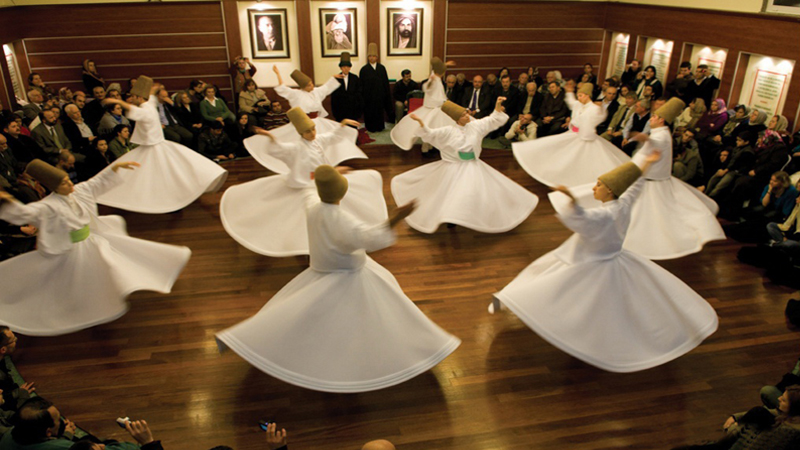
Sufism promotes a dispensation premised on brotherhood, equality and peaceful co-existence. We, therefore, can counter extremist ideologies by propagating sufi teachings. Given the unabated extremism and intolerance in our society, the need of the hour is to disseminate the teachings of sufis.
Sufi practices are based on the concepts of non-interference and acceptance of differences and plurality. The Arabic word tasamuh roughly means forbearance and indulgence; it corresponds to the Turkish word musamaha, for which the Sufi poet Yunus Emre also used the expression hos goermek (accept everything). In religious context, in the Su? tradition of South Asia and Afghanistan, scholars favour the North Indian term rawadari (derived from the Persian rawa meaning permitted/tolerated) for ‘letting things happen’. In this sense Pakistani and Indian Sufis often use the expression: ‘Keep your faith and do not interfere with those of others.’ This wise saying is based on the Quranic verse: “To you your religion and to me mine.”
Sufis preaching rawadari have always propagated the old folk wisdom mohabbat sab ke liye, nafrat kisi se nahin (love for all, hate for no one). It re?ects the Sufi understanding of the basic equality of all aulad-i-Aadam (descendants of Adam).
Sufis believe in love for humanity, and stress haqooq-ul-ibaad (rights of people) rather than haqooq-Allah (rights of Allah), for they contend that if one wishes to please Allah, the Sublime, he must please His creatures. This is vividly reflected in their literature.
Let me quote here a few renowned Sufis who played an instrumental role in presenting the true image of Islam through their work as well as their courteous code of conduct. They attracted many non-Muslims to embrace the true faith, not through coercion but through a course of love and affection.
One of the noted Sufis, Ibn-i-Arbi writes in his book The Interpreter of Desires (Tarjuman al-Ashwaq), Poem 11:
My heart has become capable of every form:
It is a pasture for gazelles and a convent for Christian monks,
And a temple for idols and the pilgrims of Kaa’ba,
And the tablets of the Torah and the book of the Quran.
I follow the religion of Love: whatever way love’s camels take,
That is my religion and my faith
He also warned against religious exclusiveness. In this vein, he writes: “Do not attach yourself to any particular creed so exclusively that you disbelieve all the rest; otherwise, you will lose much good, nay, you will fail to recognise the real truth of the matter. God, the Omnipresent and Omnipotent, is not limited by any one creed, for He says, ‘Wheresoever you turn, there is the face of Allah’.”
Muslims might tolerate anything but Islam teaches zero tolerance for injustice, oppression and violation of people’s rights
Another celebrated Sufi, BabaFarid, a contemporary of Ibn-i-Arbi, once addressed a visitor with the remarkable lines:
Don’t give me scissors! Give me a needle!
I sew together! I don’t cut apart!
(Nizami I976, page 89)
Baba Farid’s abode in Pakpattan was a place where Muslims and Hindus met and exchanged views peacefully, where sufis even discussed questions of spirituality with Hindu yogis. Conversion of Hindus was never Baba Farid’s immediate purpose.
Jalaluddin Rumi, arguably the greatest and best-known Sufi poets who came from Persia but lived most of his life in Anatolia, gave the following message of love for humanity through his quatrain:
Come! Come! It doesn’t matter what you are,
A kafir, an idol or a ?re-worshipper.
Come! Our caravan is not a place of despair!
Come! Even if you have broken your vows a hundred times, come yet again!
Other verses by Rumi show clearly that for him as for other Su?s who, to remain in their imagery, have ‘drunk from the wine cup of ma’rifat (gnosticism) and haqiqat (mystic truth)’; religious differences among seekers of God are not relevant and are transcended. This means that in the pure experience of divine unity there is no room for religious distinctions.
“For those who love, there are no Muslims, Christians or Jews.” (Rumi, 2005, p 75)
Sultan Bahu, the ?rst important Sufi poet of rural Punjab, like many mystics disappointed by the formalistic religiosity of normative faith promoting sectarianism, clearly expressed his dislike of institutionalised scriptural religion in the ?rst two lines of one of his poems:
Neither am I Sunni nor am I Shi’a
My heart is bitter with both of them
Last but not the least, the great Sufi poet Bulleh Shah, also known as the ‘Rumi of Punjab’ versified on the love of humanity and equality in the following gravitating lines:
We are neither Hindus nor Muslims
We just sit and turn the spinning wheel
We have nothing to do with pride in the religious creed
We are neither Sunni nor Shi’a
We are non-violent toward everyone
Su?s oppose the language of the antagonism of ‘closed’ theocratic world views as well as the discourse of religious hardliners that generates intolerance. Their tolerance of religious differences and their ‘live-and-let-live’ cultural diversity that comes from the philosophical concept of tawhid (oneness of the Divine) bear testimony to an ‘open’, holistic worldview. This view is entirely oriented towards God, refrains from interfering in religious views and concerns of those of other faiths and welcomes the togetherness of all in sacred places.
Thus, realising the gravity of situation that our country is undergoing today in terms of extremism, intolerance and sectarianism, we should highlight the importance of Sufism and spread its teachings. Media, academia, rightly guided religious luminaries and enlightened civil society should come forward and defeat the extremist narrative by presenting Sufism as a counter narrative.
The writer is a Quetta-based lawyer