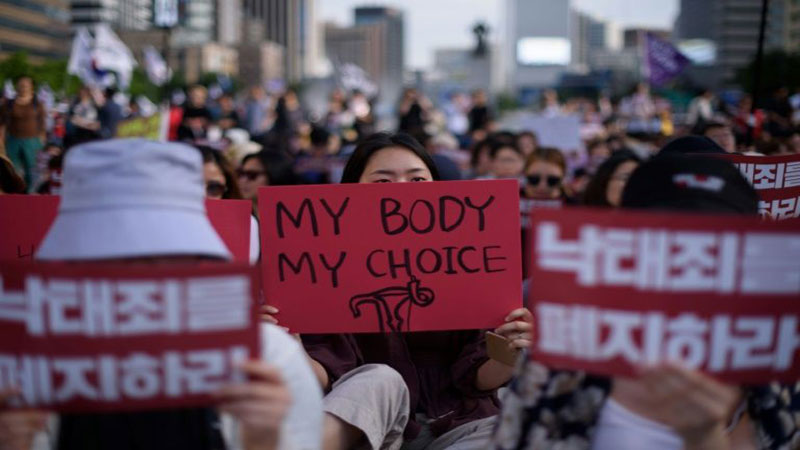
 More than a quarter of a century after the first of her three abortions — illegal in South Korea — Lim is still haunted by her sense of shame.
She was 24 and had a boyfriend, but neither was ready to wed. And it was 1993, when sex before marriage was still very much a taboo in the conservative country.
Keeping the baby would have meant living with stigma, even if the couple married after the birth, so she chose an illegal abortion — also a taboo.
The country’s constitutional court is due to rule Thursday on the legality of the ban, which campaigners say is unfairly applied and targets mostly young, unwed women.
“I still remember the disgusted look on the doctor’s face -– he kept on clicking his tongue and shook his head,” Lim told AFP.
“When I told him it hurt when he inserted a medication, he said it shouldn’t hurt me because I was a woman who had already ‘done everything’. It was humiliating.”
Fast forward 26 years, and South Korea remains one of the few developed economies that still bans abortions except in cases of rape, incest or when the mother’s health is in danger.
Women who undergo the procedure can be jailed for a year and fined, while doctors who carry out terminations can be given two years in prison.
The law is widely flouted and rarely results in prosecutions, but campaigners say it leaves young women facing being unable to pay for terminations, unsafe procedures, and social isolation.
When Lim had her second and third abortions — as a married woman with two children — she says her experience was dramatically different, with pleasant medical staff and her mother even accompanying her to the clinic.
“All I had to say was that my husband and I already had two kids,” she said. “The doctor was suddenly very caring –- he said to me: ‘Of course, we totally understand’.”
Statistics show that as recently as 2011, most South Korean women who had abortions were married, but rights groups say the majority of those charged for undergoing the procedure have been unmarried, including teenagers.
They also say many women whose relationships are breaking up fear their husbands or partners could report their past terminations to authorities.
In 2017, a high school student told a rally in Seoul she had been forced to end her education after having an abortion.
“My teacher told me if I don’t leave school, he’d report me to the legal authorities,” she said. “He said I’d committed a sin because I fell pregnant as a student.”
South Korea comes near the bottom of many OECD gender equality tables and Ryu Min-hee, the lead counsel on the constitutional court case, said that as long as women cannot make their own choices about pregnancy and parenthood, the country “won’t be able to establish an equal society in its true sense”.
Secrets and stigma
The day she had her abortion in 1993, Lim — who asked for her forename not to be used to protect her anonymity — stayed in a cheap motel room by herself.
She rested there as long as she could and then headed home to her parents, acting as if nothing had ever happened.
To this day, aside from her husband, no-one in Lim’s life knows about it.
“I didn’t dare to share it with anyone,” she said. “My parents would have been very ashamed of me.
“This was an era where people would count the (pregnancy) months when a baby was born to figure out whether the baby was conceived before or after the wedding –- and call the mother promiscuous if the child was born too fast.”
Religious belief is widespread in South Korea, and some of its evangelical mega-churches are among those leading the charge against overturning the ban.
“There is nothing in the world that comes before the life of a human being,” a group of mostly Catholic professors said in a statement last year.
But Lim says her own experience demonstrates how South Korea’s pro-lifers have been selective about which lives matter.
“If the goal of this abortion law is really to protect all lives, then I should have been shamed for undergoing my second and third abortions, as well as my first,” she said.
“I just hope no one has to go through what I had to go through in that motel room.”